NSW is trying to make the selective school application process fairer – but is it doing enough?
- Written by: Christina Ho, Associate professor, University of Technology Sydney
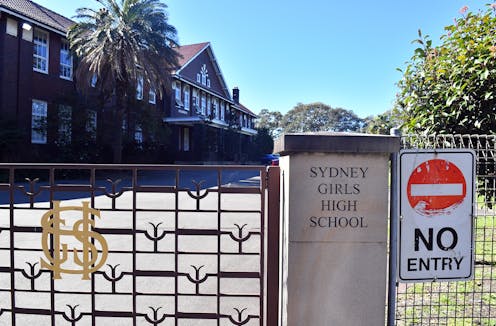
The NSW state government has just announced a major overhaul[1] of its selective school program. From the 2023 intake, up to 20% of the places on offer will be set aside for students from a disadvantaged background.
This is in response to long-held concerns[2] these highly sought-after public schools were dominated by students from advantaged backgrounds.
But does this change do enough? How else can we ensure all students get a fair shot at a coveted selective school place?
What are selective schools?
Selective schools are public high schools where students sit a test in year six to be accepted in year seven. In NSW, the exam tests English, maths and “thinking skills” (largely based on logical reasoning).
It is very competitive to get a place. Selective schools are among the very top performers[3] in the state in year 12 exams and many parents view them as as pathway to success.
The number of applicants for selective high schools increased from 14,961 in 2019 to 15,660 applications for 2023 for 4,248 places[4].
The first selective high school opened in 1849 and they include some of NSW’s oldest schools. Having increased in number since the 1980s, there are now 51 fully or partially selective schools[5] around the state (this is compared to just four in Victoria).
Read more: New South Wales has 48 selective schools, while Victoria has 4. There's an interesting history behind this[6]
Their aim is to provide an environment for gifted students who may not have the same stimulation in a mainstream setting, and to give them a cohort of like minds.
But while the curriculum may be more accelerated, the rest of the set up is just like any other public school. The teachers are public school teachers and the facilities are public school facilities.
Selective schools only favour some gifted students
A 2018 NSW Department of Education review[7] found the selection system for selective schools needed serious updating.
It found “unintended barriers” in the application process may be deterring some students from disadvantaged backgrounds, Indigenous students, students with disability and students in rural and remote areas from putting their hands up.
Researchers, including myself, have also pointed out[8] how selective high schools are among the most “socio-educationally” advantaged in the state, surpassing even prestigious private schools. Socio-educational advantage is based on parents’ education and occupation, the school’s geographic location and proportion of Indigenous students.
A significant announcement … but
Overall, this announcement is a very significant and positive step. This is the first time since the release of the 2018 review that the state government has tried to address these equity issues in a meaningful way.
But it is not the complete answer and the details matter.
Read more: Selective schools mainly 'select' advantage, so another one won't ease Sydney's growing pains[9]
A key concern is getting disadvantaged students to apply for selective places, through new targeted campaigns. For example, in April the Sydney Morning Herald reported[10] the number of Indigenous students applying, being offered and accepting places was at its lowest level in four years, with just 29 students accepting a spot last year compared with 48 in 2018.
This entire program relies on the students applying for these schools in the first place. If they don’t apply, then these places will revert back to regular applicants.
A spokesperson for the NSW education department says it has a “program of work in place to increase awareness […] in under-represented groups”. However, given this change has only just been announced and begins immediately (for next year’s intake) there has not been a chance to promote the new rules to disadvantaged students and their families.
What about other ways to apply?
If there is a broader mix of ways to identify students (beyond the application process), this would maximise the chances of students from a diverse range of backgrounds going to selective schools.
One way would be to allow primary schools to nominate gifted or high potential students who wouldn’t otherwise apply. After all, there will always be a cohort of disadvantaged families who just won’t have the application, or test preparation, on their radar.
Then there’s the test
We also need to think beyond the test itself.
The test has been adjusted[11] to make it less “coachable”, with less emphasis on maths and more on English. But I know from my research that the coaching industry has adapted, for example, by providing students with hundreds of sample “thinking skills” questions.
The admissions criteria are always going to favour kids who are good at tests and who have been trained to do this particular test. This in and of itself favours families who have the time and money to train their kids up for the test.
The test only measures a narrow range of abilities, when the NSW government’s high potential and gifted education policy[12] defines “potential” as not just intellectual, but also creative, social-emotional and physical. The selective schools test does not identify students with these abilities.
Don’t forget the mainstream system
Lastly, we can’t forget the mainstream comprehensive public school sector.
Inevitably, this is where the vast bulk of gifted students are taught. Providing opportunities for all gifted students requires that all public schools are able to offer acceleration and enrichment programs to those who need them.
The door to the selective system may have opened slightly wider, but these schools are not the only solution when it comes to educational opportunity.
References
- ^ just announced a major overhaul (www.smh.com.au)
- ^ long-held concerns (theconversation.com)
- ^ very top performers (www.smh.com.au)
- ^ 4,248 places (education.nsw.gov.au)
- ^ 51 fully or partially selective schools (www.smh.com.au)
- ^ New South Wales has 48 selective schools, while Victoria has 4. There's an interesting history behind this (theconversation.com)
- ^ review (education.nsw.gov.au)
- ^ pointed out (theconversation.com)
- ^ Selective schools mainly 'select' advantage, so another one won't ease Sydney's growing pains (theconversation.com)
- ^ reported (www.smh.com.au)
- ^ adjusted (www.smh.com.au)
- ^ policy (education.nsw.gov.au)