


From ‘pretty communist’ to ‘Jabcinda’ – what’s behind the vitriol directed at Jacinda Ardern?
- Written by: Suze Wilson, Senior Lecturer, Executive Development/School of Management, Massey University
With recent polling[1] showing National edging ahead of Labour for the first time in two years, Jacinda Ardern’s previously strong support has eroded rapidly[2] since winning a remarkable outright majority at the 2020 general election.
But the dip in electoral fortunes is only part of the story. It’s probably not an overstatement to say Ardern is presently one of the most reviled people in Aotearoa New Zealand, attracting vitriol that violates the bounds of normal, reasoned political debate.
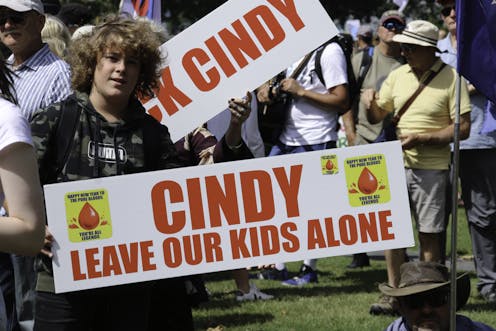
During the recent illegal occupation of parliament grounds, the apparent hatred was fully evident[3]. There were ludicrous claims the prime minister is a mass murderer, and demands she be removed from office[4] and executed for “crimes against humanity”.
Even on the supposedly professional social networking site LinkedIn, false claims that Ardern is a “tyrant” or “dictator” have been increasingly commonplace. For those making such claims, factual, constitutional, electoral and legal realities seemingly hold no weight.
So, what fuels these levels of antagonism? I suggest three factors are at play.
Context matters
How a leader is judged and what they can achieve is never simply a reflection of their individual characteristics and abilities.
Rather, as leadership scholars have long emphasised[5], the expectations of followers and the wider political, economic, social and historical context influence both how they are judged and their ability to achieve desired results.
Read more: The reward for good pandemic leadership: Lessons from Jacinda Ardern's New Zealand reelection[6]
In Ardern’s case, the public’s main concerns right now – food and fuel prices, rental and home ownership costs, and the effects of the Omicron outbreak – are beyond the direct control of any political leader. Some will require years of transformative effort before significant improvements are seen.
A paradox of leadership is that while followers will often hold unrealistic expectations that leaders can solve complex problems quickly, they are also quick to blame[7] leaders when they fail to meet those unrealistic expectations.
Ardern is caught in the maw of these dynamics, and that’s one of the factors fuelling the attacks on her.
COVID controversies
The second obvious reason lies in the COVID-related policies – including vaccine mandates, crowd limits and border controls – that have disrupted people’s lives and been heavily criticised by vested interests such as expat New Zealanders[8] and various business sectors[9].
Anti-mandate protests, in particular, have become a front for wider anti-vaccine movements[10] and extreme right-wing conspiracists[11]. While the prime minister must balance restrictive policies with the greater public good, detractors are not bound by such considerations.
Read more: The extremism visible at the parliament protest has been growing in NZ for years – is enough being done?[12]
Ironically, by demonstrating a firmness of resolve to act in the nation’s best interest – something leaders might normally expect praise for, and for which Ardern has won international admiration – leaders become open to accusations of being inflexible and unresponsive.
Echoed by opposition politicians and some media commentary, these elements combine to feed a sense of growing frustration.
Old-fashioned sexism and misogyny
But these first two factors alone, while significant, don’t explain the full extent of the violent and hateful rhetoric directed at Ardern, albeit by a minority. Rather, it’s clear this is rooted in sexist and misogynistic attitudes and beliefs, further amplified by conspiratorial mindsets.
Research shows[13] both men and women with more traditional views desire “tough”, “bold” and “authoritative” leadership. A man displaying traditionally masculine behaviours, who is an assertive risk-taker, dominating and commanding others, is their ideal leader. This aligns with an assumption[14] that women should follow, not lead.
Read more: Misogyny in the Capitol: Among the insurrectionists, a lot of angry men who don't like women[15]
Ardern’s emphasis on traditionally feminine ideals, such as caring for vulnerable others, and her strongly precautionary COVID response run counter to what traditionalists respect and admire in leaders.
What’s known as “role incongruity theory[16]” further suggests that Ardern jars with what traditionalists expect of “good women”. Overall, the sexism and misogyny inherent in these traditionalist beliefs mean Ardern is treated more harshly than a male prime minister pursuing the same policies would be.
Worryingly, the 2021 Gender Attitudes Survey[17] (carried out by the New Zealand National Council of Women) showed such traditional views about leadership and gender are on the rise.
Traditionalist myths
Insults and abuse commonly directed at Ardern on social media reflect the generally gendered nature of cyberviolence[18], which disproportionately targets women. These insults translate traditionalist beliefs into sexist and misogynistic acts.
Referring to Ardern as “Cindy”, for example, infantilises her. Calling her a “pretty communist[19]” not only reflects the sexist and misogynist view that a woman’s worth is measured by her appearance, but also suggests her looks disguise her real aims.
Read more: Analysis shows horrifying extent of abuse sent to women MPs via Twitter[20]
This plays on the traditional trope of woman as evil seductress. From there it’s a short leap to the conspiracy theories that depict Ardern as part of an evil international cabal.
Unfortunately, for traditionalists and extremists alike, the evidence shows[21] that effective leaders do not conform to their ideal or play by their rule book. Instead, they tend to be collaborative, humble, team-oriented and able to inspire others to work for the common good – qualities women often exhibit.
Of course, Ardern’s performance is not beyond criticism. But a fair-minded analysis, free from sexist and misogynist bias, would suggest the hatred directed toward her says more about the haters than Ardern.
References
- ^ recent polling (www.1news.co.nz)
- ^ eroded rapidly (www.theguardian.com)
- ^ fully evident (www.stuff.co.nz)
- ^ removed from office (www.1news.co.nz)
- ^ long emphasised (www.e-elgar.com)
- ^ The reward for good pandemic leadership: Lessons from Jacinda Ardern's New Zealand reelection (theconversation.com)
- ^ quick to blame (www.researchgate.net)
- ^ expat New Zealanders (www.groundedkiwis.com)
- ^ various business sectors (www.stuff.co.nz)
- ^ anti-vaccine movements (thespinoff.co.nz)
- ^ right-wing conspiracists (www.newsroom.co.nz)
- ^ The extremism visible at the parliament protest has been growing in NZ for years – is enough being done? (theconversation.com)
- ^ Research shows (www.sciencedirect.com)
- ^ assumption (onlinelibrary.wiley.com)
- ^ Misogyny in the Capitol: Among the insurrectionists, a lot of angry men who don't like women (theconversation.com)
- ^ role incongruity theory (psycnet.apa.org)
- ^ Gender Attitudes Survey (genderequal.nz)
- ^ gendered nature of cyberviolence (www.liebertpub.com)
- ^ pretty communist (www.newshub.co.nz)
- ^ Analysis shows horrifying extent of abuse sent to women MPs via Twitter (theconversation.com)
- ^ evidence shows (hbr.org)










