In 2021 #MeToo finally made it to #Auspol – what happens next?
- Written by: Blair Williams, Research Fellow, Global Institute for Women's Leadership (GIWL), Australian National University
It has been a momentous year in Australia as the #MeToo movement made its way across the globe and into Australian federal politics.
After years of silence and rumours, federal parliament was forced to grapple with its “man problem”.
It feels like we have seen history being made, but will 2021 result in permanent change?
2021: a momentous year
Grace Tame, a survivor of child sexual assault, set the tone for 2021 when she was named Australian of the Year in January for her role in raising public awareness about the impacts of sexual violence. A few weeks later, inspired by Tame, former Liberal staffer Brittany Higgins said she was raped by a colleague in a ministerial office in March 2019 (the man accused denies[1] any sexual activity took place).
Higgins’ bravery was followed by other accusations. Within the the space of a month, former Attorney-General Christian Porter was accused[2] of raping a 16-year-old girl in 1988 (a claim he strenuously denies) and Liberal MP Andrew Laming of harassing women (a claim he also denies[3]). Video also surfaced of staffers[4] masturbating on the desks of women MPs.
The government’s initial response was not encouraging. In fact, Higgins said she was distressed[5] by Morrison’s “continued victim-blaming rhetoric”.
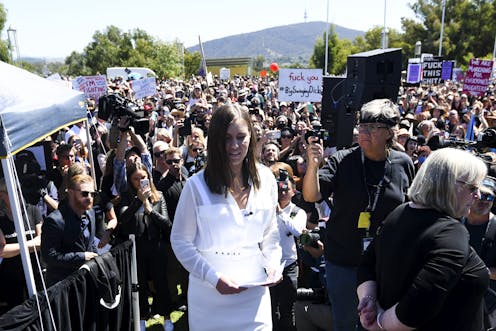
On March 15, more than 100,000 Australians participated in the March4Justice rallies to protest sexual assault and harassment in politics, while calling for an end to gendered violence. As an organiser of the Canberra contingent, I witnessed palpable anger but saw hope in the overwhelming desire for change.
But the public anger and ensuring debate had its faults. As Indigenous Studies Professor Bronwyn Carlson[6] has rightly observed, “there is a noticeable silence in Australia when victims of violence are Indigenous”.
Not just parliament
Elite private schools also came under fire for what is known as the “misogyny pipeline[7]” – whereby privileged boys follow a trajectory from expensive single-sex private schools to elite universities and then powerful professions, where they circulate with each other and reinforce their values.
Read more: Could the Morrison government's response to sexual assault claims cost it the next election?[8]
In February, former private school student Chanel Contos spearheaded a petition[9] demanding sexual consent education in Australian schools, inspiring over 5,000 victim-survivors to anonymously share stories of teenage sexual assault.
A common thread in these events is the abuse of power and entitlement in the hands of elite white men.
A fundamental shift?
Given all these shocking revelations and sustained public attention and debate, has there been a fundamental shift in the way we talk about gender, inequality, and sexual violence?
Parliament – especially under the Coalition – has certainly faced a reckoning this year, but it is very hard to argue there has been concrete change as a result (yet).
Prime Minister Scott Morrison claims to take these issues seriously, yet he has made some serious blunders, from begrudgingly empathising[10] with Higgins only after his wife convinced him to “think about [it] as a father first”, to responding to the March4Justice protests by stating[11] protesters should be grateful they weren’t “met with bullets”.
Even during his address at the Women’s Safety Summit, he came under fire[12] for retelling survivors’ private disclosures of sexual assault. This was criticised[13] as looking like an attempt to seem genuine, by using other people’s trauma.
Parliament’s big opportunity
Morrison has created new ministerial positions, such as Women’s Safety Minister and Women’s Economic Security Minister. He has also launched multiple inquiries into parliamentary work culture, including the recently released review by Sex Discrimination Commissioner, Kate Jenkins.
The Set the Standard report[14] was handed down at the end of November. It revealed that one in two of those currently working in parliament have experienced bullying, sexual harassment, or sexual assault.
The report contains 28 independent, expert recommendations to improve the culture at parliament and make it safe and healthy for those who work there. This includes targets to increase gender balance among parliamentarians, a new office of parliament staffing and culture and a code of conduct for parliamentarians and their staff.
Read more: The Jenkins review has 28 recommendations to fix parliament's toxic culture – will our leaders listen?[15]
But it remains to be seen if they will be implemented. Jenkins’ previous report on sexual harassment, Respect@Work, was ignored for more than a year after its release, before the Morrison government announced it would only agree to half the recommendations.
What’s in store for 2022?
The fundamental shift has occurred outside parliament. People in power are not controlling the agenda or the public attitude when it comes to gender equality and violence against women. Higgins and Tame, along with many women journalists, activists, and advocates[16], are now shaping public conversation and have inspired people across Australia to push for change.
As in our efforts to combat climate change, we are moving on, whether the government is with us or not.
So, what’s in store for 2022? The organisers of the March4Justice protests have announced first anniversary marches on February 27 to put further pressure on this government in the lead-up to the federal election. If the government fails to implement recommendations from Set the Standard, expect this to be an election flashpoint.
However, identifying and acknowledging the problem is just the first step, and one that is still currently very much in progress as more allegations[17] come to light.
The next stage is to create a more inclusive, diverse, and respectful workplace for everyone at parliament house – this will flow on to the laws that are made and the policy responses provided.
Making this happen is not easy, but it’s not a mystery either. Implementing every single recommendation from the Set the Standards report is the obvious place to start.
If you or someone you know is impacted by sexual assault, family or domestic violence, call 1800RESPECT on 1800 737 732 or visit www.1800RESPECT.org.au. In an emergency, call 000. International helplines can be found via www.befrienders.org.
References
- ^ denies (www.theguardian.com)
- ^ accused (theconversation.com)
- ^ also denies (www.theguardian.com)
- ^ staffers (www.abc.net.au)
- ^ distressed (www.sbs.com.au)
- ^ Bronwyn Carlson (theconversation.com)
- ^ misogyny pipeline (www.canberratimes.com.au)
- ^ Could the Morrison government's response to sexual assault claims cost it the next election? (theconversation.com)
- ^ petition (www.theguardian.com)
- ^ empathising (www.themonthly.com.au)
- ^ stating (www.abc.net.au)
- ^ came under fire (www.abc.net.au)
- ^ criticised (twitter.com)
- ^ report (humanrights.gov.au)
- ^ The Jenkins review has 28 recommendations to fix parliament's toxic culture – will our leaders listen? (theconversation.com)
- ^ activists, and advocates (theconversation.com)
- ^ more allegations (www.abc.net.au)
Read more https://theconversation.com/in-2021-metoo-finally-made-it-to-auspol-what-happens-next-173153