The first Thanksgiving is a key chapter in America's origin story – but what happened in Virginia four months later mattered much more
- Written by: Peter C. Mancall, Andrew W. Mellon Professor of the Humanities, USC Dornsife College of Letters, Arts and Sciences
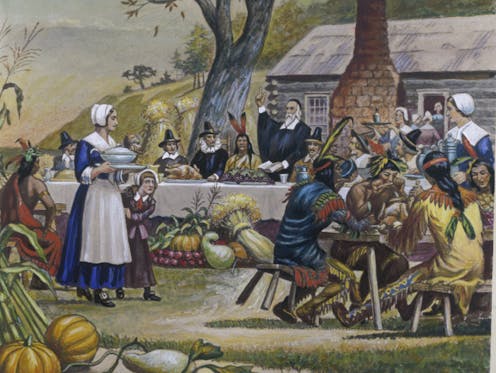
This year marks the 400th anniversary of the first Thanksgiving in New England. Remembered and retold as an allegory for perseverance and cooperation, the story of that first Thanksgiving has become an important part of how Americans think about the founding of their country.
But what happened four months later, starting in March 1622 about 600 miles south of Plymouth, is, I believe, far more reflective of the country’s origins – a story not of peaceful coexistence but of distrust, displacement and repression.
As a scholar of colonial New England[1] and Virginia[2], I have often wondered why Americans tend to pay so much less attention to other English migrants of the same era.
The conquest and colonization of New England mattered, of course. But the Pilgrims’ experience in the early 1620s tells us less about the colonial era than events along Chesapeake Bay, where the English had established Jamestown in 1607.
A compelling origin story
The Pilgrims etched their place in the nation’s history long ago as plucky survivors who persevered despite difficult conditions. Ill-prepared for the New England winter of 1620 to 1621, they benefited when[3] a terrible epidemic raged among the Indigenous peoples of the region from 1616 to 1619, which reduced competition for resources.
Having endured a winter in which perhaps one-half of the migrants succumbed, the survivors welcomed the fall harvest of 1621. They survived because local Wampanoags had taught them how to grow corn, the most important crop in much of eastern North America[4]. That November, the Pilgrims and Wampanoags shared a three-day feast.
This was the event that now marks the first American day of Thanksgiving, even though many Indigenous peoples had long had rituals that included giving thanks[5] and other European settlers had previously declared similar days of thanks – including one in Florida in 1565[6] and another along the Maine coast in 1607[7].
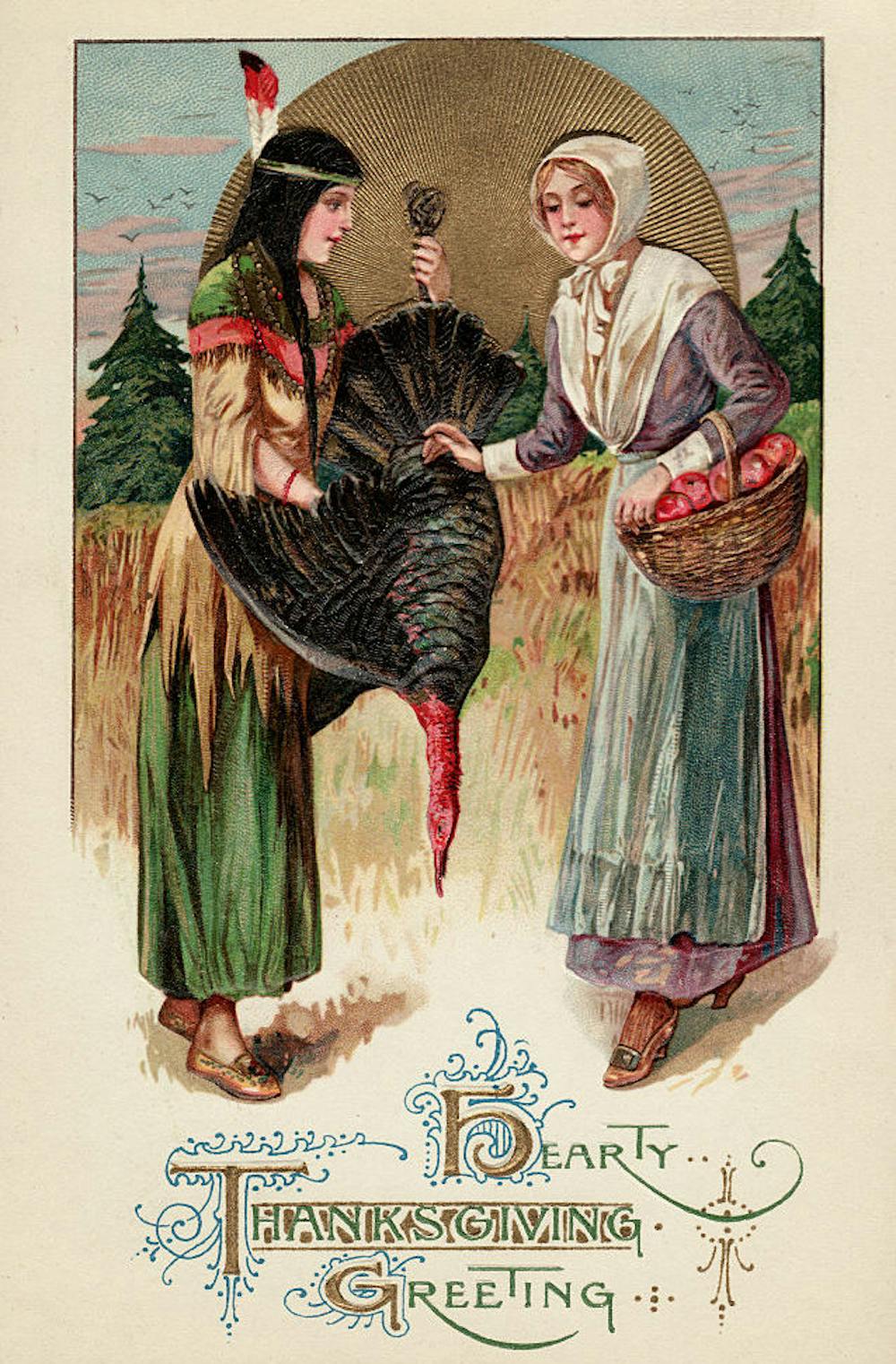
In 1623, Pilgrims in Plymouth declared a day to thank their God for bringing rain when it looked like their corn crop might wither in a brutal drought. They likely celebrated it in late July. In 1777, in the midst of the Revolutionary War, the members of the Continental Congress declared a day of Thanksgiving for Dec. 18[9]. The Pilgrims didn’t even get a mention.
In the 19th century, however, annual Thanksgiving holidays became linked to New England, largely as a result of campaigns to make the Plymouth experience one of the nation’s origin stories[10]. Promoters of this narrative identified the Mayflower Compact as the starting point for representative government and praised the religious freedom they saw in New England – at least for Americans of European ancestry.
For most of the last century, U.S. Presidents have mentioned the Pilgrims in their annual proclamation, helping to solidify the link between the holiday and those immigrants[11].
In Virginia, a tenuous peace shatters
But the events in Plymouth in 1621 that came to be enshrined in the national narrative were not typical.
A more revealing incident took place in Virginia in 1622.
Since 1607, English migrants had maintained a small community in Jamestown, where colonists struggled mightily to survive. Unable to figure out how to find fresh water, they drank from the James River, even during the summer months when the water level dropped and turned the river into a swamp. The bacteria they consumed from doing so caused typhoid fever and dysentery[12].
Despite a death rate that reached 50% in some years, the English decided to stay. Their investment paid off in the mid-1610s when an enterprising colonist named John Rolfe planted West Indian tobacco seeds in the region’s fertile soil. The industry soon boomed[13].
But economic success did not mean the colony would thrive. Initial English survival in Virginia depended on the good graces of the local Indigenous population. By 1607, Wahunsonacock[14], the leader of an alliance of Natives called Tsenacomoco[15], had spent a generation forming a confederation of roughly 30 distinct communities along tributaries of Chesapeake Bay. The English called him Powhatan and labeled his followers the Powhatans.
Wahunsonacock could have likely prevented the English from establishing their community at Jamestown; after all, the Powhatans controlled most of the resources in the region. In 1608, when the newcomers were near starvation, the Powhatans provided them with food. Wahunsonacock also spared Captain John Smith’s life[16] after his people captured the Englishman.
Wahunsonacock’s actions revealed his strategic thinking. Rather than see the newcomers as all-powerful, he likely believed the English would become a subordinate community under his control[17]. After a war from 1609 to 1614 between English and Powhatans, Wahunsonacock and his allies agreed to peace and coexistence.
Wahunsonacock died in 1618. Soon after his passing, Opechancanough, likely one of Wahunsonacock’s brothers, emerged as a leader of the Powhatans. Unlike his predecessor, Opechancanough viewed the English with suspicion, especially when they pushed on to Powhatan lands to expand their tobacco fields[18].
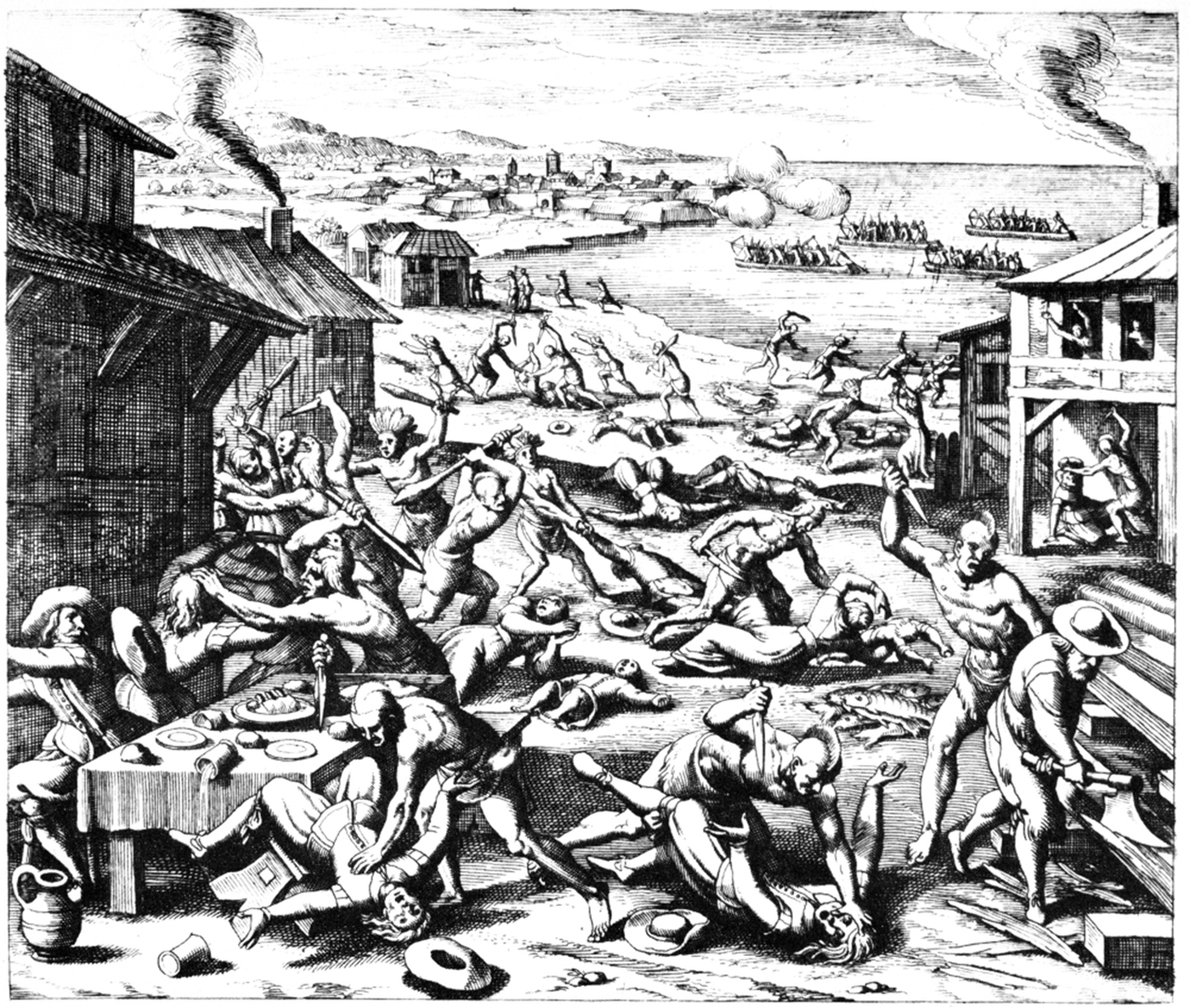
By spring 1622, Opechancanough had had enough. On March 22, he and his allies launched a surprise attack. By day’s end, they had killed 347 of the English. They might have killed more except that one Powhatan who had converted to Christianity had warned some of the English, which gave them the time to escape[19].
Within months, news of the violence spread in England. Edward Waterhouse, the colony’s secretary, detailed the “barbarous Massacre” in a short pamphlet[20]. A few years later, an engraver in Frankfurt captured Europeans’ fears of Native Americans in a haunting illustration[21] for a translation of Waterhouse’s book.
Waterhouse wrote of those who died “under the bloudy and barbarous hands of that perfidious and inhumane people.” He reported that the victors had desecrated English corpses. He called them “savages” and resorted to common European descriptions of “wyld Naked Natives.” He vowed revenge.
Over the next decade, English soldiers launched a brutal war against the Powhatans, repeatedly burning the Powhatans’ fields at harvest time[23] in an effort to starve them and drive them away.
Conflict over cooperation
The Powhatans’ orchestrated attack anticipated other Indigenous rebellions against aggressive European colonizers in 17th-century North America.
The English response, too, fit a pattern: Any sign of resistance by “pagans,” as Waterhouse labeled the Powhatans, needed to be suppressed to advance Europeans’ desire to convert Native Americans to Christianity, claim Indigenous lands, and satisfy European customers clamoring for goods produced in America.
It was this dynamic – not the one of fellowship found in Plymouth in 1621 – that would go on to define the relationship between Native Americans and European settlers for over two centuries.
Before the end of the century, violence erupted in New England too, erasing the positive legacy of the feast of 1621. By 1675, simmering tensions exploded in a war that stretched across the region. On a per capita basis, it was among the deadliest conflicts in American history[24].
[Get the best of The Conversation, every weekend. Sign up for our weekly newsletter[25].]
In 1970, an Aquinnah Wampanoag elder named Wamsutta, on the occasion of the 350th anniversary of the arrival of the Mayflower, pointed to generations of violence against Native communities and dispossession[26]. Ever since that day, many Indigenous Americans have observed a National Day of Mourning instead of Thanksgiving[27].
Today’s Thanksgiving – with school kids’ construction paper turkeys and narrative of camaraderie and cooperation between the colonists and Indigenous Americans – obscures the more tragic legacy of the early 17th century.
References
- ^ As a scholar of colonial New England (yalebooks.yale.edu)
- ^ and Virginia (uncpress.org)
- ^ they benefited when (theconversation.com)
- ^ the most important crop in much of eastern North America (plimoth.org)
- ^ had long had rituals that included giving thanks (oneida-nsn.gov)
- ^ including one in Florida in 1565 (www.history.com)
- ^ another along the Maine coast in 1607 (www.newenglandhistoricalsociety.com)
- ^ Samantha Vuignier/Corbis via Getty Images (www.gettyimages.com)
- ^ declared a day of Thanksgiving for Dec. 18 (pilgrimhall.org)
- ^ campaigns to make the Plymouth experience one of the nation’s origin stories (time.com)
- ^ helping to solidify the link between the holiday and those immigrants (pilgrimhall.org)
- ^ caused typhoid fever and dysentery (jpwhit.people.wm.edu)
- ^ The industry soon boomed (www.worldcat.org)
- ^ Wahunsonacock (encyclopediavirginia.org)
- ^ Tsenacomoco (encyclopediavirginia.org)
- ^ Wahunsonacock also spared Captain John Smith’s life (www.nps.gov)
- ^ would become a subordinate community under his control (www.nebraskapress.unl.edu)
- ^ especially when they pushed on to Powhatan lands to expand their tobacco fields (www.basicbooks.com)
- ^ which gave them the time to escape (www.virtualjamestown.org)
- ^ in a short pamphlet (encyclopediavirginia.org)
- ^ in a haunting illustration (commons.wikimedia.org)
- ^ Wikimedia Commons (upload.wikimedia.org)
- ^ repeatedly burning the Powhatans’ fields at harvest time (encyclopediavirginia.org)
- ^ it was among the deadliest conflicts in American history (www.penguinrandomhouse.com)
- ^ Sign up for our weekly newsletter (memberservices.theconversation.com)
- ^ pointed to generations of violence against Native communities and dispossession (www.uaine.org)
- ^ have observed a National Day of Mourning instead of Thanksgiving (www.uaine.org)