Labour makes it easier to change leaders, but Jacinda Ardern has no reason to go – yet
- Written by: Grant Duncan, Associate Professor, School of People, Environment and Planning, Massey University
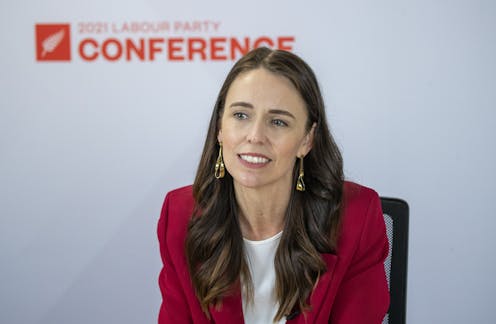
Might Jacinda Ardern stand down?
Despite a landslide 50% election victory in October 2020, the New Zealand Labour Party annual conference last weekend – apparently incongruously – made it easier for the party’s leader to be replaced[1].
The “main focus[2]” of the conference agenda was a remit that allows the party’s parliamentary caucus to elect a new leader (if two-thirds or more are in favour), bypassing a party-wide election process.
This got journalists speculating that it was about “replacing[3]” Ardern as party leader and prime minister, probably with her present deputy and minister of finance, Grant Robertson.
Ardern took over the party leadership just seven weeks before the 2017 election when it looked like Labour would hit another embarrassing low. That switch didn’t require a party-wide primary as it was so close to a general election. Labour’s rules allowed an exemption for caucus to decide on that occasion.
The results were remarkable. Ardern lifted Labour to 37% at the 2017 election, and then formed a governing coalition with New Zealand First, with support from the Greens. In 2020, having brought COVID-19 to a standstill, Labour won 50% and a parliamentary majority.
Delta politics
But no government gets away lightly in this pandemic. The delta variant has proven unbeatable and case numbers[4] have risen.
Difficult policy choices have been made about vaccinations, vaccine mandates, travel, quarantine, lockdowns and the enforcement of emergency rules. The government is now a target for protests[5] and Ardern has been hassled by small but “aggressive[6]” groups.
Read more: Protesting during a pandemic: New Zealand's balancing act between a long tradition of protests and COVID rules[7]
Polling[8], however, suggests she and the Labour Party are holding up well. Ardern is still close to 50% in preferred prime minister polls, well ahead of rivals, and the Labour Party is safely in the low 40s.
It’s worth noting, too, that polls in the final pre-election fortnight in 2020 were under-estimating Labour by 3.7 percentage points on average, outside their margins of error, and there’s no proof they’ve improved. Labour’s likely coalition partner, the Green Party, is also polling well.
Changing the rules
But the government’s approval rating is in decline. Could that help explain why the Labour Party made a mid-term leadership change easier?
In 2012, Labour introduced an internal primary election for the leadership. This involves a preferential vote, weighted 20% for caucus, 20% for affiliated trade unions and 40% for party members.
This process has been conducted twice. In 2013, it resulted in David Cunliffe being elected leader. He was backed by only one-third of caucus, but members and unions strongly supported him. Cunliffe led Labour to a dismal defeat in the 2014 general election with 25% of the vote.
Read more: New Zealand's mass vaccination event lifts uptake but highlights dangerous inequities as the country prepares to open up[9]
After he stood down, the next internal primary was won by Andrew Little who narrowly defeated Grant Robertson on a third round of preferences thanks to strong union support for Little. It was Little – backed by caucus – who persuaded Ardern to take the reins in 2017.
On past performance, then, the primary hasn’t delivered the most effective party leadership. The new amended rule doesn’t repeal the party-wide election, however, it just allows the caucus to switch leaders without it if two-thirds or more are in favour.
The party has now given back to the caucus the power to decide who leads in parliament – which sometimes may decide who’ll be prime minister.
Read more: ‘If you want summer, get vaccinated’ – Jacinda Ardern sets the target for re-opening New Zealand[10]
Given her electoral success, though, why on earth would Ardern stand down (let alone be rolled) as leader? One can only speculate, but that hasn’t prevented comparisons[11] being made with former National prime minister John Key who stood down[12] unexpectedly in December 2016.
Key’s situation differs from Ardern’s, but it does hint that quitting mid-term may not do your party any favours. In the 2017 election, National won the most seats but was unable to form a government.
No easy way out
The tough decisions taken by Ardern to deal effectively with the pandemic are compromising her social democratic ideals and her ethics of kindness, empathy and inclusiveness.
As the emotional and financial costs and the social divisions mount up daily in people’s lives, many turn their anger and frustration on the country’s leader. On the other hand, a sudden relaxation of restrictions and a rise in cases would also produce a public backlash and would do most harm to Māori[13].
Read more: Why Jacinda Ardern’s ‘clumsy’ leadership response to Delta could still be the right approach[14]
The state is obliged, and has the legal powers[15], to protect the population from deadly diseases. But there’s no simple or popular way to balance the public health, economic and political risks at the moment.
These tensions could become so glaring that a refreshed leadership is necessary in the interests of the party’s future election chances. The opinion polls suggest there’s no need for that – yet. In the meantime there’s a pandemic to deal with, and the next election is late 2023.
Thinking optimistically, when the pandemic subsides, surely Ardern would want to take the credit. Either way, she has said with typical political caution[16] that, for the time being at least, “I have no plans to change what I am doing.”
References
- ^ replaced (www.stuff.co.nz)
- ^ main focus (www.rnz.co.nz)
- ^ replacing (www.nzherald.co.nz)
- ^ case numbers (www.health.govt.nz)
- ^ protests (www.nzherald.co.nz)
- ^ aggressive (www.1news.co.nz)
- ^ Protesting during a pandemic: New Zealand's balancing act between a long tradition of protests and COVID rules (theconversation.com)
- ^ Polling (en.wikipedia.org)
- ^ New Zealand's mass vaccination event lifts uptake but highlights dangerous inequities as the country prepares to open up (theconversation.com)
- ^ ‘If you want summer, get vaccinated’ – Jacinda Ardern sets the target for re-opening New Zealand (theconversation.com)
- ^ comparisons (www.stuff.co.nz)
- ^ stood down (theconversation.com)
- ^ harm to Māori (www.1news.co.nz)
- ^ Why Jacinda Ardern’s ‘clumsy’ leadership response to Delta could still be the right approach (theconversation.com)
- ^ legal powers (ojs.victoria.ac.nz)
- ^ said with typical political caution (www.newshub.co.nz)