Tax Deductions Australians Are Missing – and the Claims That Could Land You in Hot Water
- Written by: H&R Block, Director of Tax Communications, Mark Chapman
Every tax season, Australians tend to fall into one of two camps.
There are those who are so nervous about attracting the attention of the Australian Taxation Office that they fail to claim legitimate deductions. Then there are those who regard their tax return as an opportunity to throw everything at the wall and see what sticks.
Both approaches can cost you.
Recent H&R Block research of 1,540 Australians found that 61 per cent second-guess whether they’re getting their tax return right, while almost half (48 per cent) have received an unexpected tax outcome. With working from home, investments, side hustles and multiple income streams adding to the complexity, it’s easy to see why.
The objective isn't to get the biggest possible refund. It's to get the biggest refund you're legally entitled to, and to be able to justify every dollar if the ATO asks questions.
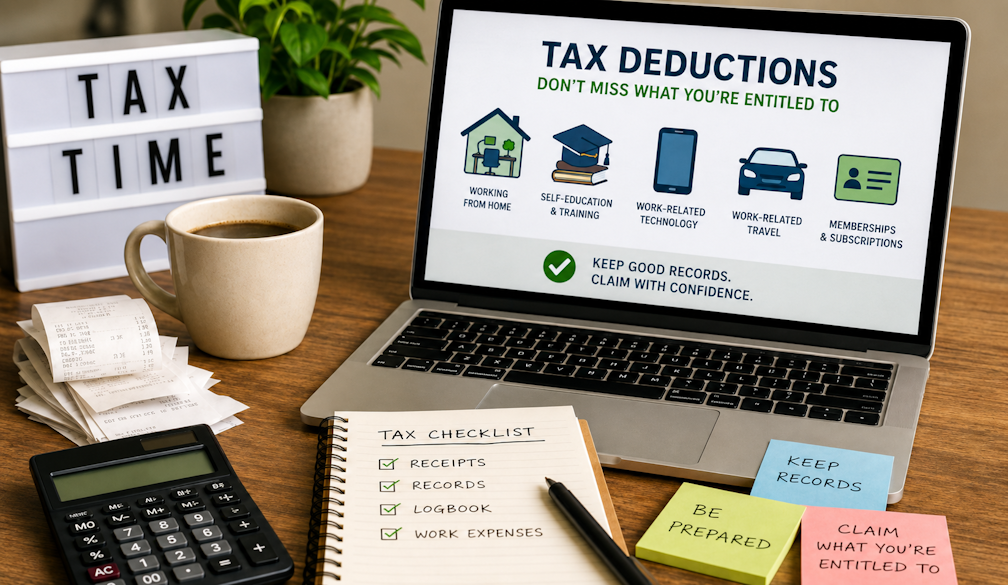
The deductions people often forget
One of the biggest areas is working from home. Working from the kitchen table for a day or two each week might not feel like a major expense, but if you're genuinely performing your employment duties from home, there can be a deduction available for the additional costs you incur.
Depending on the method used, that can encompass electricity and gas for heating, cooling and lighting, internet and phone usage, stationery and computer consumables. Work-related depreciation on items such as computers and office furniture can also potentially be deductible.
Another commonly overlooked category is professional memberships, subscriptions and registrations. If you need to maintain a professional accreditation or membership to do your job, or subscribe to a professional publication directly relevant to your work, there may be a deduction. The same can apply to union fees and certain work-related licences and checks.
Then there is self-education. People often assume education expenses aren't deductible because university fees and HELP repayments generally aren't. But courses, seminars and conferences that maintain or improve skills used in your current employment can be deductible.
That can extend beyond the course fee to textbooks, stationery, professional journals and, in appropriate circumstances, travel and accommodation. The catch is that the education must relate sufficiently to the job you already have. A course designed to qualify you for a completely new career generally won't qualify.
Work-related technology is another area worth reviewing. Laptops, software, mobile phones, internet costs and other equipment can generate deductions where they're genuinely used to earn your income.
The mistake is assuming that because something is occasionally used for work, the whole cost becomes deductible. If it's 60 per cent work and 40 per cent private, you're generally looking at the work-related proportion, not 100 per cent.
What does the ATO actually look for?
People sometimes imagine there is a secret list of deductions that automatically triggers an audit. The reality is more straightforward.
For a standard work-related expense, there are three basic questions: Did you spend the money yourself and weren't reimbursed? Does it directly relate to earning your income? And do you have the records required to substantiate it?
That's a very useful test to apply before putting anything into your return.
The ATO also has access to enormous quantities of data and can compare taxpayers against people in similar occupations and circumstances.
An unusually large claim doesn't necessarily mean it's wrong. But it does mean you should be particularly confident that you can explain it.
If you're a nurse who legitimately drove thousands of kilometres between workplaces, for example, don't reduce a valid claim simply because you're frightened that it looks large. Claim what you're entitled to and keep the evidence.
What you shouldn't do is manufacture a deduction simply because you've heard that "everyone claims it".
Where taxpayers get into trouble
Car expenses remain one of the classic danger zones. Driving from your normal home to your normal workplace is generally private commuting, however essential having a car might be to getting to work.
There are situations where travel between workplaces, to alternative work locations or carrying genuinely bulky equipment can produce a deduction, but the rules need to be satisfied.
And using the cents-per-kilometre method doesn't mean you can simply nominate a number of kilometres without any basis. The ATO can ask how you calculated your work-related travel.
Clothing is another perennial problem. A suit worn by an accountant doesn't become deductible because the accountant only wears it to the office. Ordinary business clothes, black trousers, conventional shoes and other everyday clothing generally remain private expenses even where an employer expects you to wear them.
Deductible clothing is much more likely to involve protective clothing, occupation-specific clothing or a qualifying uniform.
And be careful with laundry. The fact that you wash clothes you wear to work doesn't automatically turn the washing into a tax deduction.
The $300 myth
One of the most persistent tax myths is that everybody can claim $300 of work-related expenses without receipts. That's not what the rule says.
Under the existing substantiation rules, where total work-related expense claims are $300 or less, taxpayers generally don't need written evidence such as receipts. But they still need to have incurred the expense and be able to demonstrate how the claim was calculated.
It isn't an automatic $300 deduction.
Equally, once the relevant threshold is exceeded, don't assume you only need receipts for the amount above $300. The written evidence rules generally apply to the entire claim.
What should you feel comfortable claiming?
My rule is simple: don't be afraid of a deduction just because it's large. Be afraid of a deduction you can't explain.
If you genuinely incurred $4,000 of deductible expenses in earning your income and have the documentation to prove it, claim $4,000.
Taxpayers shouldn't voluntarily pay more tax because they're scared that claiming a legitimate deduction might attract attention.
On the other hand, be particularly cautious about expenses sitting on the boundary between work and private life.
Mobile phones, internet, laptops, cars, travel and working-from-home expenses are good examples because they frequently have both work and private components.
If something has mixed use, make a reasonable apportionment and keep a record showing how you arrived at it.
And remember one of the most fundamental principles in the tax system: spending $1 doesn't give you $1 back. A deduction reduces your taxable income. It doesn't reimburse the expense.
Never spend money purely to obtain a tax deduction unless buying that item makes commercial or personal sense in the first place.
How to maximise your return without attracting unwanted attention
The best tax strategy is often surprisingly boring: keep good records.
Save invoices and receipts as you go. Maintain a log of work-related car journeys. Keep records of the hours you work from home. Document the work-related percentage of your phone, internet and other mixed-use expenses.
Don't try to reconstruct 12 months of expenditure the night before lodging your tax return.
And don't rely on what your colleague claims.
Two people with identical job titles can legitimately have completely different deductions because their employment arrangements and actual expenditure differ.
The ATO publishes occupation-specific guidance precisely because entitlement depends on what you actually do and the circumstances in which you do it.
Finally, don't assume that a deduction appearing in last year's return means you're automatically entitled to claim it again. Circumstances change.
The ATO has previously highlighted work-related expenses and rental property deductions as areas of tax-time attention, including whether taxpayers are correctly distinguishing repairs from capital expenditure.
Ultimately, maximising your tax return isn't about being aggressive or conservative. It's about being accurate.
Claim everything the law allows you to claim. Don't claim what it doesn't. And make sure that if the ATO ever asks the simple question, "How did you arrive at this figure?", you've got a good answer.
That's the safest way to get every dollar you're entitled to without losing sleep over an ATO review.