What do we know about climate change? How do we know it? And where are we headed?
- Written by: Andrew King, ARC Future Fellow and Associate Professor in Climate Science, ARC Centre of Excellence for 21st Century Weather, The University of Melbourne
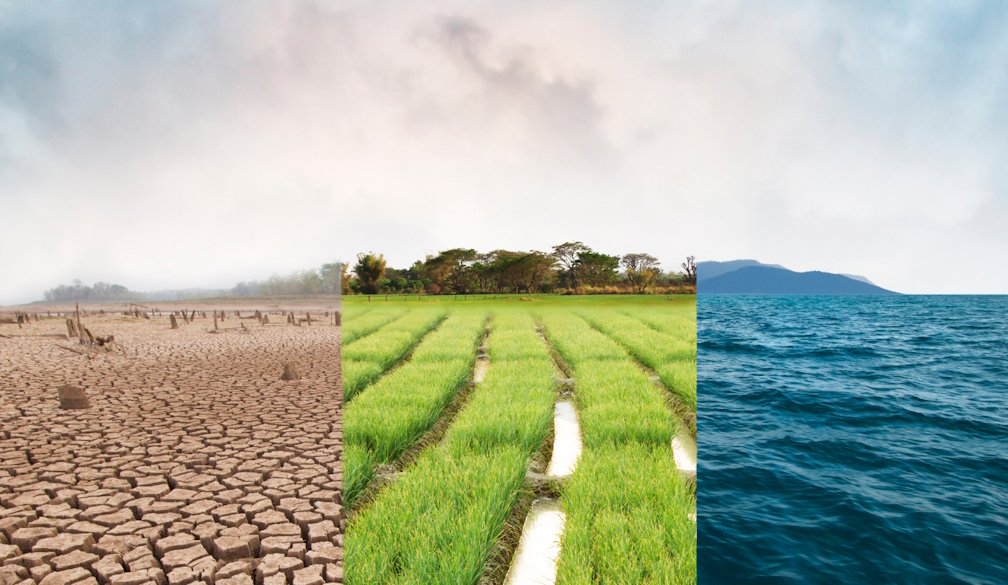
The 2025 United Nations Climate Change Conference (sometimes referred to as COP30) is taking place in Brazil.
Amid all the talk with politicians, policy experts and scientists, it’s worth reminding ourselves of the state of Earth’s climate – a kind of long-term average of weather conditions – what’s driving the changes we’re seeing, and where we’re heading next.
We have understood the fundamentals of Earth’s climate for many decades, but scientists like us are constantly working to extend our knowledge.
In 2025, we have seen plenty of advances, including the ability to more clearly link individual greenhouse gas emitters with the impacts of their emissions.
The how and why of Earth’s changing climate
The planet we inhabit is changing. That change, especially since the start of the industrial revolution[1] in the 18th century, is largely due to human activities.
Many different forms of data allow us to observe changes to the climate. We have long-running weather stations[2] we can use to track temperature and rainfall changes, as well as newer technologies such as satellite imaging, which helps us see how sea ice is changing in the Arctic and Antarctic.
We can also make estimates of changes over much longer timescales[3] using environmental indicators linked to temperature, such as tree ring growth, the air bubbles in ice cores, and coral formation.

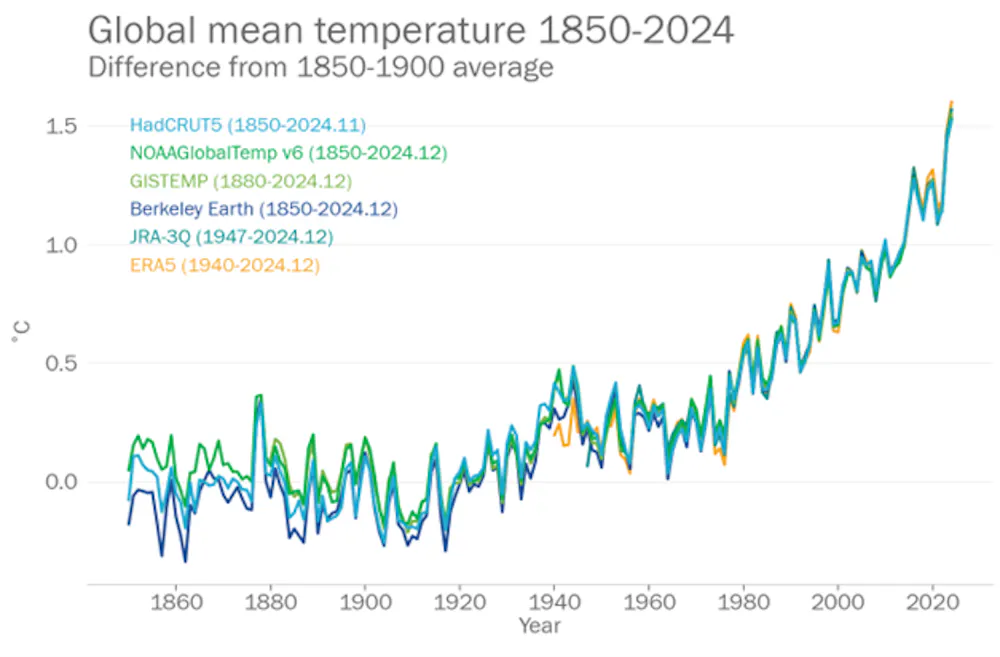
Taking all these lines of evidence together, we can see major changes in the Earth system. These changes have accelerated in recent decades as humanity burned more and more fossil fuels, which release carbon dioxide when they burn.
Fossil fuels are substances such as coal, oil and gas which were formed millions of year ago from the remains of plants and other living organisms.
Why is this happening? We have understood for a very long time that carbon dioxide is a greenhouse gas. This means when it is released into the atmosphere it acts to warm the planet because it traps heat, like a garden greenhouse.
Our fundamental understanding of the greenhouse effect came from the work of 19th century scientists including Eunice Foote[5], John Tyndall[6] and Svante Arrhenius[7]. Then, in 1938, Guy Callendar[8] used a collection of weather station data to identify warming of the planet. Since then, the scale of the changes in Earth’s climate have only become clearer.
Since the 1970s, scientists have proven the link[9] between our greenhouse gas emissions and global warming. Using observations and theoretical understanding, as well as newer tools such as computer models[10] that simulate the world’s climate, global warming has been conclusively traced to humanity’s greenhouse gas emissions[11].
Science is uncovering how much humans are affecting the climate
More recently, we have gathered more observational data, increased our understanding of the climate system, and improved our ability to simulate the climate using numerical models. This has only increased our confidence in the human fingerprint on the changes to Earth’s climate that we are seeing.
It is also now possible to link regional and local climate changes to human-caused greenhouse gas emissions. We can even see the mark of human climate change in extreme weather events and their impacts[12]. This is called event attribution[13].
These analyses are performed by using advanced weather and climate modelling that simulates these extreme events, then compares these extremes between sets of simulations with and without the effects of humans on the planet.
Just this year, scientists have gone further in showing not only that humanity’s collective greenhouse gas emissions are damaging the climate, but even company-level or individual project-level greenhouse gas emissions have detectable consequences. A trio of studies published in April[14], September[15] and October[16] this year linked emissions from fossil fuel companies and projects with big impacts.
The most recent of these papers showed that the approved Scarborough gas project off the coast of Western Australia is likely to result in hundreds of additional heat-related deaths and millions of lost corals[17], for example.
Where is our climate heading?
So the body of evidence that the climate is changing due to humanity’s actions is large and ever-growing. However, we haven’t yet taken the required steps to limit these changes by reducing our greenhouse gas emissions on a global scale.
In fact, our emissions remain at record high levels[18]. We are still shifting the planet’s climate further away from its pre-industrial state into dangerous new territory.
But it isn’t all doom and gloom. Since the Paris Agreement of 2015 we have seen a shift in course[19]. In the past decade, global greenhouse gas emissions haven’t increased as fast as they were expected to before 2015. Instead, it looks like emissions may be peaking and set to fall substantially through the 2030s.
So where does that leave us?
According to the latest UN Emissions Gap report[20], current policies still have us on a path for peak global warming of 2.8°C. If countries can fully enact their commitments to reducing emissions and reaching net zero, only then will peak global warming be limited to around 2°C.
Every time we avoid releasing greenhouse gases into the atmosphere, we reduce future climate impacts and risks and leave the planet more habitable for future generations.
Millions of people will be hoping the outcomes of COP30 and subsequent meetings see more ambition and more action to help limit global warming and its impacts.
References
- ^ the start of the industrial revolution (theconversation.com)
- ^ long-running weather stations (wmo.int)
- ^ over much longer timescales (doi.org)
- ^ Ed Hawkins (bsky.app)
- ^ Eunice Foote (www.scientificamerican.com)
- ^ John Tyndall (doi.org)
- ^ Svante Arrhenius (www.nobelprize.org)
- ^ Guy Callendar (doi.org)
- ^ proven the link (www.aps.org)
- ^ computer models (doi.org)
- ^ conclusively traced to humanity’s greenhouse gas emissions (doi.org)
- ^ extreme weather events and their impacts (interactive.carbonbrief.org)
- ^ event attribution (www.csiro.au)
- ^ April (doi.org)
- ^ September (doi.org)
- ^ October (doi.org)
- ^ hundreds of additional heat-related deaths and millions of lost corals (doi.org)
- ^ record high levels (doi.org)
- ^ we have seen a shift in course (unfccc.int)
- ^ latest UN Emissions Gap report (www.unep.org)