


FEV Analysis: TCO Cut by Up to 33 Percent Through Range Extender Trucks
AACHEN, GERMANY - Newsaktuell - 11 February 2026 - FEV has published new analysis results on the economic efficiency of electrified commercial vehicles as part of an internal research program. The evaluation of extensive techno-economic data shows: depending on the driving cycle, through trucks with range extender architecture (REEV/Hybrid BEV) the total cost of ownership (TCO) can be reduced by up to 33 percent compared to conventional diesel trucks – while also significantly reducing CO₂ emissions.
Even in the most unfavorable long-haul scenario, the TCO declined by approximately 14 percent.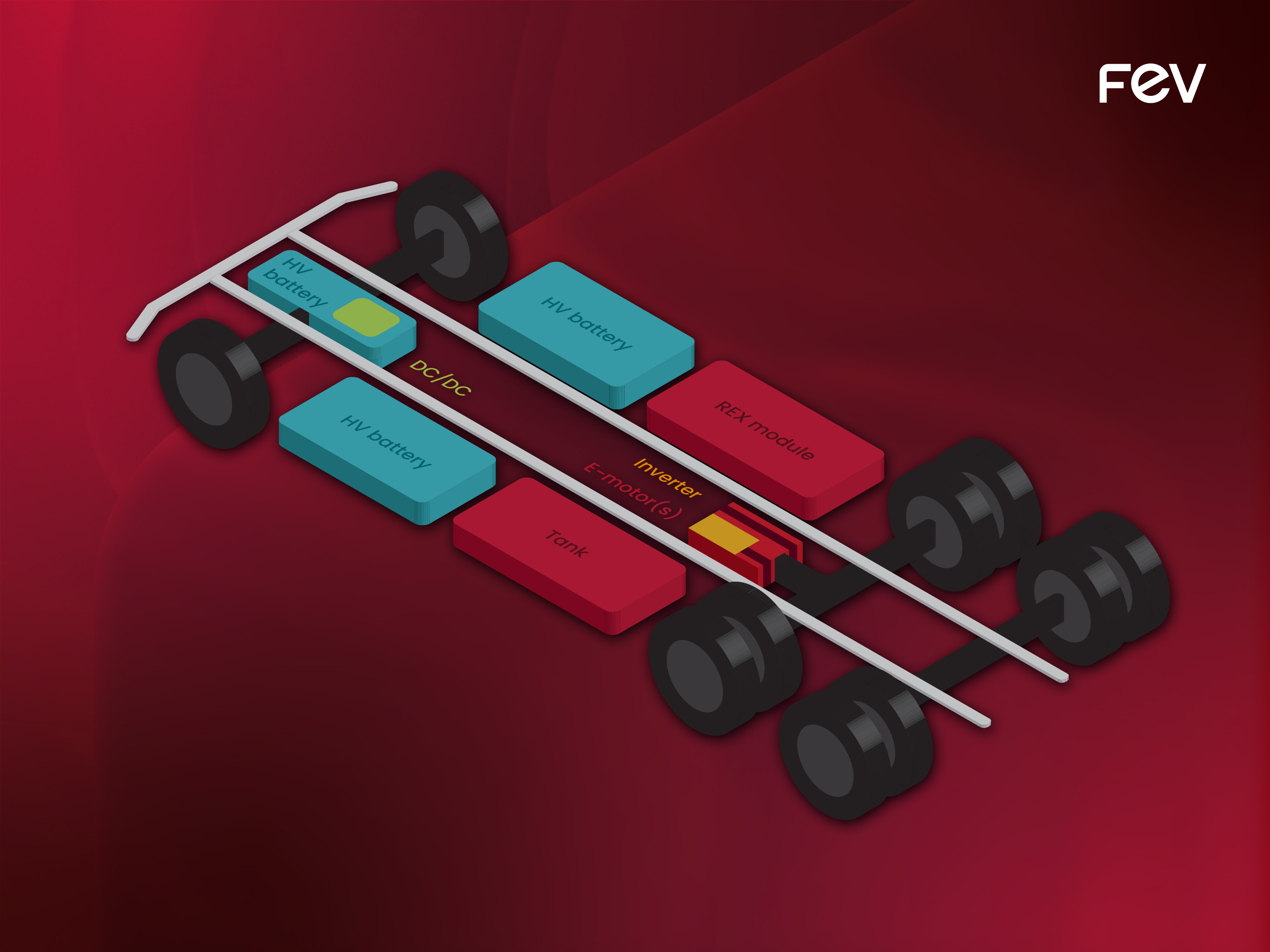
Depending on the driving cycle through range extender trucks TCO can be reduced by up to 33 percent. Source: FEV
Calculations are based on realistic European usage profiles with overnight charging at industrial electricity prices of around 19 cents per kilowatt hour. In regions with lower electricity costs, the advantage is correspondingly higher.
Cost-effectiveness without megawatt charging infrastructure
A key lever of the REEV architecture is the reduced battery size compared to purely battery-electric long-haul trucks. While typical BEV trucks require battery capacities of around 560 kWh, a REEV truck can manage with around 280 kWh. Even with slower AC charging at 22 kW, around 240 kWh can be recharged overnight – enough to power the vehicle almost entirely electrically for the next day. Thus, a megawatt charging infrastructure is not necessary for economical operation.Significant TCO advantage in the cost-critical commercial vehicle market
The economic advantage of the range extender architecture results from several factors. The smaller battery of a REEV truck reduces vehicle costs and weight while increasing payload. Also, the high proportion of electric driving enables low energy costs, especially when charging at depots at night at industrial electricity prices.Due to their low dependence on public high-performance charging infrastructure, REEV trucks can be seamlessly integrated into existing depot structures.
Hashtag: #FEV
The issuer is solely responsible for the content of this announcement.










