Asia’s Economic Rewiring and the Rise of Future Business Leaders
HKUST MBA prepares leaders for innovation, inclusion, and leadership in a fast growing region
HONG KONG SAR - Media OutReach Newswire - 14 October 2025 - The MBA has faced its share of skepticism in recent years, with some questioning whether it still holds relevance in today's fast-changing world.
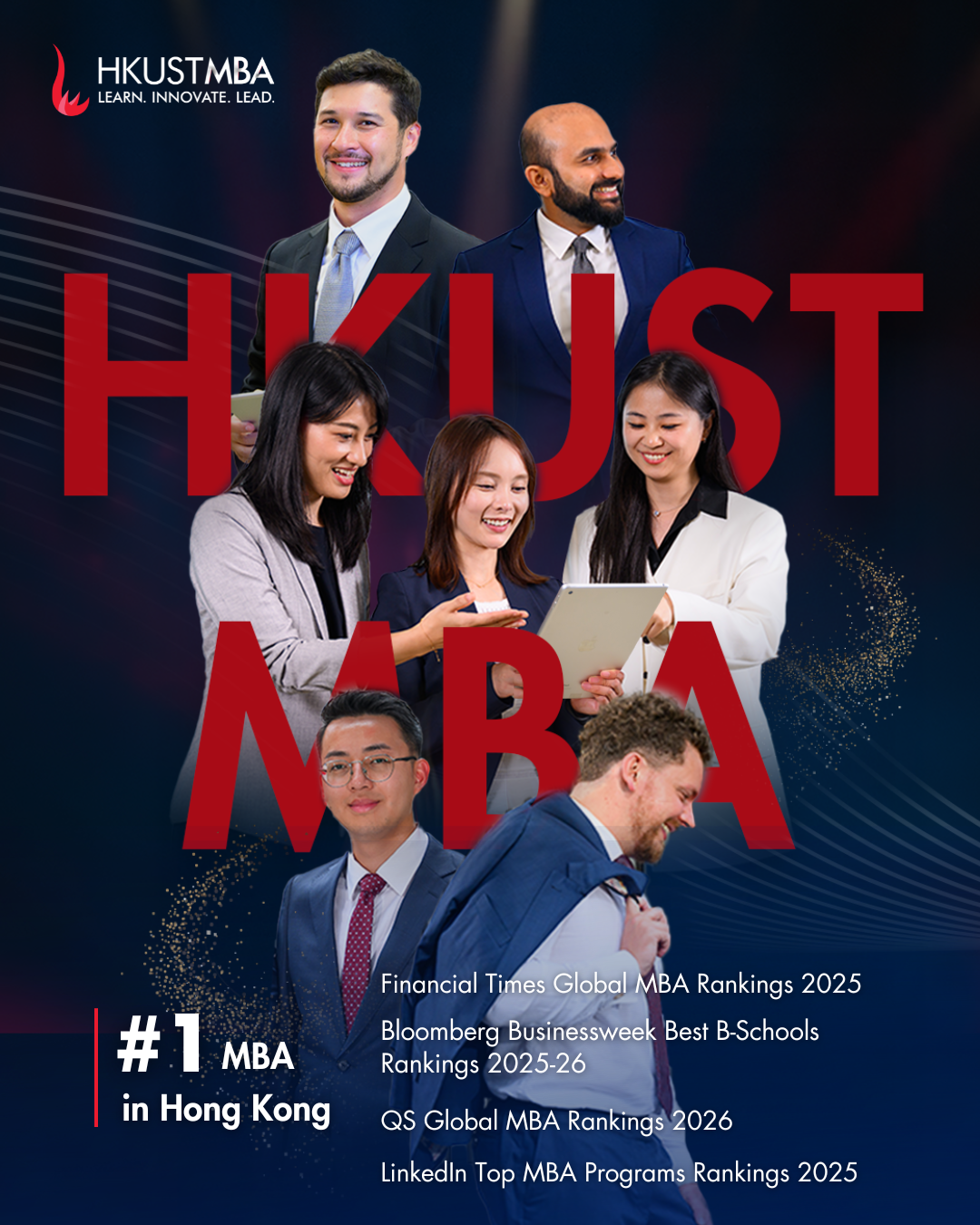
At the Hong Kong University of Science and Technology (HKUST), the answer is clear: it does— when it evolves. As Asia steps into a new era of economic leadership and traditional education models in the West face growing pressure, HKUST has reshaped its MBA to meet the moment. The program is now more inclusive, tailored for the fast-growing Asia region, more flexible, and more connected to innovation and global networks than ever before.
The HKUST MBA Full-Time Class of 2026 reflects this transformation. With 59% female representation, the program signals a new generation of inclusive leadership across the region. Students come not only from traditional business backgrounds but also from journalism, education, government, and the social sector—underscoring HKUST's commitment to professional diversity and public impact. A dedicated Social Sector award supports high- potential applicants from not-for-profits, NGOs, government, or social enterprises.
Asia's economic trajectory is central to HKUST's vision. For example, China's per capita GDP* reached $13,390 in 2023, with Forecasters expecting GDP to double by 2035 to double by 2035. Indonesia, with its young and fast-growing population, is emerging as a regional powerhouse.
Meanwhile, Hong Kong continues to serve as a vital hub for trade, finance, and innovation across Asia. HKUST's MBA curriculum is designed to align with these shifts, offering electives such as Practical AI for Business, Winning Strategies in the Digital World, Chinese Tech Strategy in the Global AI Era, and Doing Tech in Asia and China. The program's flexible structure allows students to personalize their learning by choosing among an extensive selection of elective courses, while the MBA audit program enables alumni to continue their lifelong learning.
While HKUST has long been recognized as a business research powerhouse, what's less well known is how its faculty integrate practical insight with academic rigor. Approximately two- thirds of HKUST's MBA courses are taught by faculty with significant business and industry experience. Many others have consulted on challenging topics with corporations and government organizations.
"Asia's business landscape is evolving at breakneck speed, and theoretical knowledge alone won't cut it," said Professor Paul Kitney, Professor of Business Practice at HKUST. "With over three decades in central banking, investment strategy, and hedge fund management, I've seen firsthand how markets reward those who can bridge insight with execution. At HKUST, we challenge MBA students to think like economists, act like strategists, and lead like entrepreneurs—equipping them to navigate complexity with clarity and confidence."
International exposure remains a cornerstone of the HKUST MBA experience. Over 200 students participated in global study programs last year, while the school welcomed 195 visiting students from partner institutions—a 42% increase from the previous year. HKUST now partners with 80 leading institutions worldwide, including recent additions in Japan, Germany, South Korea, France, and Austria. The Executive Exchange series brings global business insights directly to campus, with recent speakers including the Non-Executive Chairman of HSBC Hong Kong, the CEO of Cathay Group (owner of Cathay Pacific Airways), the Chairman of Schneider Electric, and the CEO of Bain & Company.
Innovation is deeply embedded across the program, with cross-campus collaboration driving new opportunities. HKUST's Unicorn Day connects students with Asia's most promising startups, while the university's Entrepreneurship Center offers hands-on support for venture creation and growth. During the recent Unicorn Day, several HKUST MBA startups—ranging from high-tech building materials to AI-enabled healthcare—pitched to investors.
"As new industries reshape the region's economy, the need for innovative, inclusive, and practical business leadership has never been greater," said Professor Stephen Shih, Associate Dean of the HKUST MBA Programs. "Our students are immersed in a curriculum that reflects Asia's economic dynamism and prepares them to lead with purpose."
David Carreno Cerrillo (HKUST MBA Intake 2020) from Spain chose Asia over Europe or North America for a reason. "Asia is one of the world's most important and rapidly growing areas. In some industries, it is no longer a region where companies simply offer their products and services, but an area in which innovation is happening and where the most well-known companies are based," he explains. "Companies such as Tencent, Alibaba, and Huawei are clear examples of this trend—and that's only considering China. The spectrum is wider if we include Korea, Japan, and Taiwan."
He adds, "The growth that the continent is experiencing made me decide to pursue my MBA in Asia, where I can gain a competitive edge in the labor market thanks to the cultural and operating knowledge acquired through being there."
For Carmen Chan (HKUST MBA Intake 2024), choosing Hong Kong was about embracing change. "I got a sense of 'itchy feet' and wanted a change of scene," she recalls, describing her decision to leave the UK for Hong Kong. The city's magnetic appeal lies in its unique blend of East-meets-West culture. From its renowned culinary scene to abundant hiking trails, Hong Kong offered the perfect backdrop for both professional growth and personal adventure.
With a diverse student body, a curriculum aligned with Asia's future, and a global network of partners and practitioners, the HKUST MBA is preparing the leaders who will define tomorrow.
*See, for example, China's Economic Transition – Debt, Demography, Deglobalization, and Scenarios for 2035 by Dinny McMahon, Andrew Polk
Hashtag: #HKUST #MBA
The issuer is solely responsible for the content of this announcement.