Why Productivity on a Mini Loader Depends on How Often You Step Off
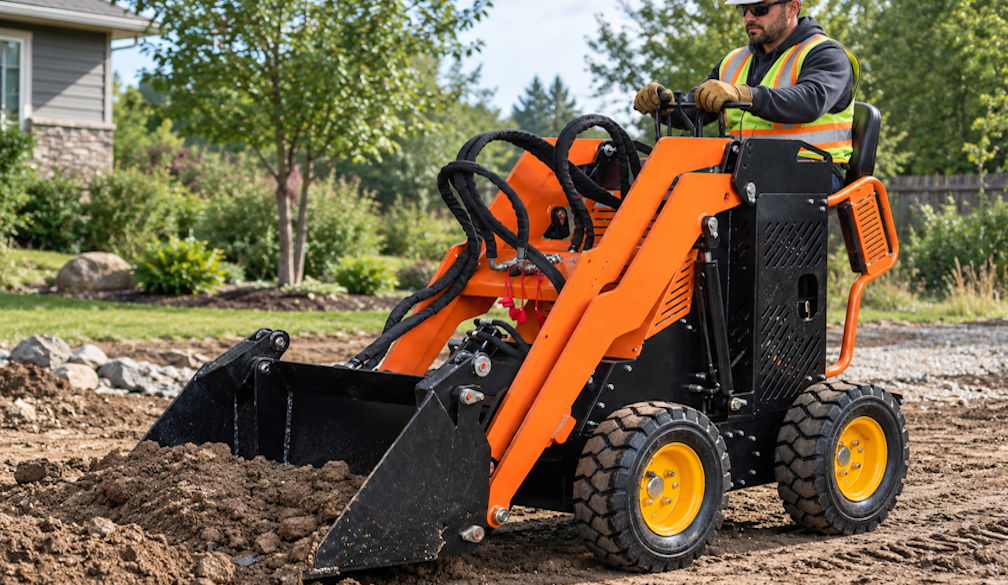
Loaders are compared on bucket width and breakout force, and those numbers describe what happens while the machine is moving dirt. On most small sites the machine is not moving dirt for a good part of the hour. A TMG Industrial wheeled stand-on skid steer earns its keep in the gaps between loads, which is where the time actually goes.
The arithmetic nobody runs
Count the mounts and dismounts on a typical landscaping or site clean-up job and the figure is startling. Shifting a hose, moving a stake, checking a level, opening a gate: each one is a dismount and a remount.
On a seated machine with a door and a belt, each cycle costs perhaps fifteen seconds in and out. Forty cycles in an hour is ten minutes of the hour spent getting on and off, and forty cycles is a quiet morning on a site with any detail work in it.
What a stand-on platform changes
Stepping off a rear platform takes two seconds. There is no door, no seat belt and no turning around, so the penalty for getting off to look at something drops to almost nothing and operators do it more often, which tends to improve the work rather than slow it.
Visibility changes as well. A standing operator sees over the attachment and down into a trench without leaning, which matters when placing material against a wall or working around services. A mini loader used for detail work gains more from that sightline than from any increase in capacity.
Where the platform costs you
Long travel runs are the obvious one. Standing for twenty minutes crossing a large site is tiring in a way that sitting is not, so a stand-on machine suits compact sites and loses to a seated one on acreage.
Rough ground is the other. A seated operator is isolated from some of the shock by the seat and its suspension, while a standing operator takes most of it through the knees and lower back. On broken ground the practical answer is simply to slow down, and that is a real productivity cost on a machine chosen in the first place for how quickly it moves between loads.
Wheels against tracks, decided by surface
Tracks spread weight and deliver traction on soft ground, and they are the right choice on mud or sand. They also scuff turf when turning, because a tracked machine turns by dragging, and they carry dirt onto any hard surface they cross.
Wheels turn by scrubbing far less, roll onto a finished driveway without marking it, and cost a fraction as much to maintain. On established turf, pavers and concrete, a wheeled skid steer loader is usually the better tool, and it is the standard choice for maintenance work on completed sites.
Ground pressure is not the only turf consideration
A low ground pressure figure describes a static load sitting still on level ground. Turf damage from a mini skid steer is mostly a function of turning, acceleration and whether the ground is holding water, and none of those three appear anywhere in that figure.
The useful habit is to plan turns onto hard surfaces or onto areas due for repair, rather than pivoting in the middle of a lawn. That single change does more for a finished surface than any choice between wheels and tracks.
Attachment changes and auxiliary flow
A small loader earns its cost through attachments, and the limit is usually auxiliary hydraulic flow rather than mounting. A four-in-one bucket, a leveller or a set of forks ask nothing of the hydraulics, while a trencher, a broom or an auger needs sustained flow at pressure.
Check the auxiliary flow figure against the attachment before hiring either. An attachment run below its required flow works slowly and heats the oil, which is the most common reason a hired tool seems faulty when the machine is simply not feeding it.
Transport weight decides the trailer and the licence
A machine at 1,630 kilograms plus a trailer and attachments climbs toward the limits of a standard car licence towing arrangement in Australia, and the exact figure depends on the trailer and the tow vehicle rather than on the loader alone.
This catches people out after purchase. Working out the combination weight before buying decides whether the machine can be moved by the people who will use it or whether every relocation needs a truck, and that answer changes the economics of a small machine completely.
Stability on ramps and against a load
A stand-on machine has a short wheelbase, which is what makes it manoeuvrable in tight spaces and also what makes it sensitive to load position. A full bucket carried high moves the centre of gravity forward and up at the same time.
Ramps concentrate the problem. Reversing up a ramp with a loaded bucket keeps the weight on the uphill side of the machine, and that single habit prevents most of the tipping incidents that happen during loading rather than during work.
What to check before committing to one
Five items settle most of the decision:
- Auxiliary flow against your intended attachments
- Combination weight against your towing limit
- Platform comfort on a long run
- Turning behaviour on finished turf
- Service access without lifting the machine
Service access is the one that gets skipped at a demonstration. A machine needing the operator platform removed for a filter change costs an hour each time, and on a stand-on loader that work happens where the operator stands.
Hire or buy, and what the numbers do not settle
A machine of this size is often hired before it is bought, and a day on site answers questions no specification does. Whether the platform suits the operator, whether the turning circle fits the gateways on regular jobs, and whether attachment changes are quick enough to be worth doing twice in a morning.
The counter-argument for buying is availability rather than cost. A stand on skid steer that is already on the trailer gets used for the half-hour jobs that would never justify a hire fee, and those small jobs are where a compact machine quietly replaces a good deal of shovel work.
Reading the specification sheet
Operating weight, bucket width and engine power describe the machine on paper. Auxiliary flow, transport weight and how quickly an operator gets on and off describe the day, and only the second set changes with how the machine is used.
TMG Industrial builds this one at 1,630 kilograms with a 420cc engine and a 762 millimetre bucket, which suits landscaping and confined site work rather than bulk earthmoving. A mini loader chosen for the gaps between loads will finish a detailed site ahead of a larger machine that is faster at everything except stopping.