Shieldworkz Advances AI-Powered Cyber-Physical Systems Security for Industrial Enterprises
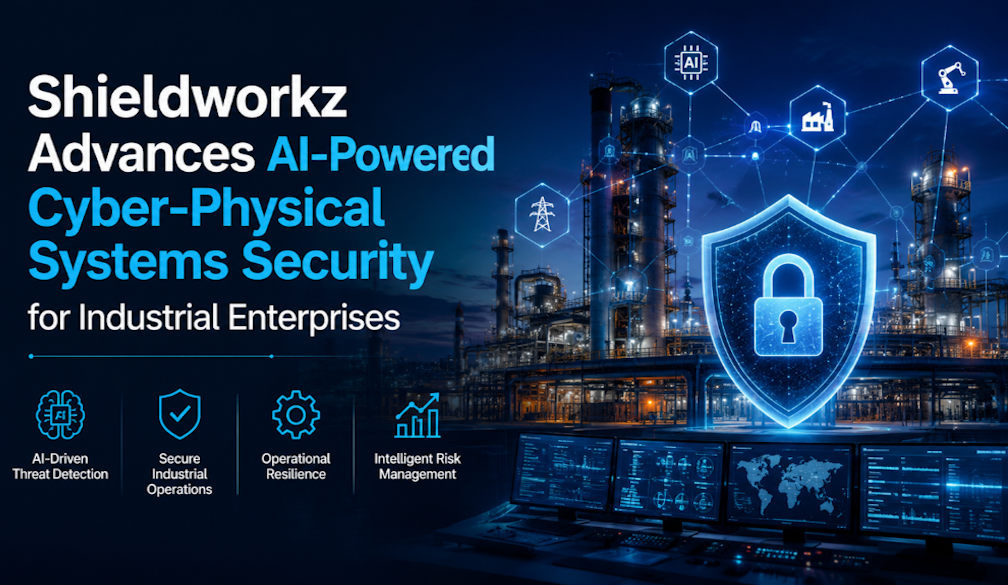
BONN / BENGALURU / ABU DHABI - In an industrial cybersecurity landscape where threat actors are now weaponizing artificial intelligence at scale, one company is betting that AI - deployed the right way - can also be the defense. Shieldworkz, the global OT cybersecurity firm operating what it describes as the world's largest OT and IoT threat intelligence facility, has been steadily expanding its end-to-end cyber-physical systems (CPS) security portfolio. At the center of this push is OThello, an AI-powered platform designed to compress what used to take weeks of manual security assessment work into hours.
The timing is not coincidental. Industrial operators worldwide are facing a perfect storm: regulatory deadlines are tightening, AI-accelerated attacks are surging, and the traditional gap between IT and OT security teams has never been more dangerous.
The Compliance Squeeze: Why Speed Matters Now
For industrial cybersecurity professionals, compliance is no longer a checkbox exercise - it's a board-level imperative with real financial and legal consequences. The European Union's NIS2 Directive, which entered into force in October 2024 with member state transposition deadlines pressing through 2025 and 2026, mandates stricter security requirements for critical infrastructure operators. In the United States, NERC CIP standards continue to evolve, with the new CIP-015 Internal Network Security Monitoring requirement adding fresh layers of obligation for electric utilities. And globally, IEC 62443 remains the de facto international standard for industrial control system security, with auditors increasingly expecting formal gap assessments and documented remediation roadmaps.
The problem? Traditional compliance assessments are manual, slow, and expensive. A full IEC 62443 gap assessment can consume weeks of consultant time, requiring teams to manually map hundreds of controls against operational reality, collect evidence, and produce risk-ranked recommendations. For asset operators already stretched thin by staffing shortages and escalating threat activity, this timeline is becoming untenable.
Industry analysts note that three regulatory drivers - NERC CIP, IEC 62443, and TSA security directives - are creating "genuine procurement urgency" for industrial cybersecurity platforms, with most critical infrastructure operators deploying two or three platforms rather than relying on a single vendor.
Enter OThello: AI That Reads Your Documents So You Don't Have To
Shieldworkz's answer is OThello Assess, an AI-powered risk assessment module that sits within the broader OThello platform. The product's pitch is straightforward: "You focus on what matters. The platform handles the rest."
Here's how it works in practice. An organization uploads its existing documentation - network diagrams, policy documents, previous audit reports, asset inventories - into the OThello platform. The system's AI engine automatically ingests and parses this material, maps evidence against IEC 62443 (or NIS2, or NERC CIP) compliance requirements, and surfaces gaps. Human experts are engaged only for critical inputs and risk decisions, not for the drudgery of document review and control mapping.
The output is a visual risk matrix showing inherent risk (the position before treatment) and residual risk (after applying recommended controls), computed using the IEC 62443-2-1 risk methodology. Users can drill down into individual gaps, see exactly which controls are missing or partially implemented, and generate audit-ready reports in a fraction of the time traditional assessments require.
The platform follows a six-step workflow: Upload Docs → Review & Confirm → Setup → Compliance → Results → Download Report. Each step is tracked via a progress indicator, and the final deliverable includes both the risk matrix visualization and a comprehensive written report.
For OT security teams, this represents a meaningful shift. Instead of spending weeks manually correlating spreadsheet rows with standard clauses, practitioners can redirect their expertise toward actually fixing problems - a distinction that matters when Shieldworkz's own threat intelligence shows that 44% of all logged OT attacks in 2025 were access abuse incidents, many enabled by precisely the kinds of configuration gaps and privilege management failures that compliance assessments are designed to catch.
Agentic AI: The Differentiator Shieldworkz Is Betting On
What separates OThello from generic compliance automation tools is Shieldworkz's emphasis on "agentic-AI powered infrastructure protection." This is not a buzzword - it's a deliberate architectural choice that reflects where the OT security market is heading.
Traditional AI in cybersecurity has been largely reactive: detect an anomaly, flag it for human review. Agentic AI, by contrast, is designed to take initiative - to ingest context, make decisions, and execute workflows with minimal human intervention, while still keeping humans in the loop for critical calls.
In OThello's case, this means the platform doesn't just identify that a control is missing; it understands the operational context of why it might be missing (legacy equipment constraints, maintenance windows, vendor dependencies), suggests compensating controls that align with IEC 62443's risk-based approach, and prioritizes remediation based on actual threat exposure rather than checkbox completeness.
This matters because, as Shieldworkz's 2026 Threat Landscape Analysis Report makes clear, the threat community is itself evolving at machine speed. The report, based on data from 80+ global honeypot nodes and 200 million+ daily signals, documents a structural shift: AI signals were detected in 28% of all attacks in 2025, up from just 4% in 2020. Threat actors are using AI to reverse proprietary industrial protocols in hours instead of months, generate device-specific firmware-aware malware, and orchestrate multi-actor campaigns at a scale previously requiring nation-state resources.
"AI is lowering the expertise bar for OT attacks from nation-state only to mid-tier criminal groups," the report warns. If defenders don't match that speed with AI-accelerated assessment and response, the asymmetry will only worsen.
The Broader Shieldworkz Portfolio: Beyond Assessment
OThello Assess is one component of a larger ecosystem. Shieldworkz positions itself as an end-to-end OT security partner, offering:
- Network Detection and Response (NDR) - OT-native deep packet inspection for industrial protocols like Modbus, S7, and EtherNet/IP
- Managed Security Services - SOC-as-a-Service staffed by OT-trained analysts
- Incident Response - Specialist teams for industrial breach containment
- Risk Assessments & Compliance Services - Both automated (via OThello) and consultant-led engagements
- SOC Build-Out - Design and deployment of dedicated OT Security Operations Centers
The company operates ISOCs and honeypot nodes across a global footprint spanning Seattle, Denver, Toronto, London, Spain, Portugal, Malta, Kuwait, Saudi Arabia, Dubai, Mumbai, Bangalore, Singapore, Hong Kong, Myanmar, Sydney, Johannesburg, Botswana, Ivory Coast, Mexico, and Qatar - a geographic spread that gives its threat intelligence unusual breadth.
This global presence is not incidental. Shieldworkz's 2026 report identifies the United States as the most targeted nation globally (2.9 million+ attacks per day), followed by the European Union (2.7 million+) and Japan (867,000+). Oil and gas refineries lead sector targeting at 19%, followed by utilities/power at 11% and batch manufacturing at 10%. Having sensors distributed across these high-risk regions means Shieldworkz's threat intelligence is grounded in live adversary activity, not theoretical models.
The CISA Perspective: Zero Trust Meets AI Governance
The regulatory and policy environment is reinforcing this trend. In April 2026, CISA published guidance on OT Zero Trust architecture that explicitly addresses the integration of AI into industrial operations. The guidance warns that "utilities and manufacturers are deploying AI-driven predictive maintenance systems, AI-powered anomaly detection platforms, and increasingly autonomous process optimization agents that interact directly with industrial control systems" - each introducing new attack surfaces that traditional security models weren't designed to protect.
CISA's companion guidance on AI in OT, published in December 2025, represents what analysts call "the most operationally specific guidance to date on treating AI governance as a structural component of industrial cybersecurity." The documents collectively signal that regulators expect organizations to treat AI not as a bolt-on feature, but as a governed, auditable capability with defined risk boundaries.
For platforms like OThello, this creates both opportunity and obligation. The opportunity: organizations need tools that can demonstrate AI governance in a compliance context. The obligation: the AI itself must be explainable, auditable, and aligned to the same standards it assesses against.
What Practitioners Should Watch
For industrial cybersecurity professionals evaluating AI-powered assessment and compliance tools, several factors merit attention:
1. Evidence Mapping Depth Does the platform merely check whether a control exists, or does it map actual evidence (network diagrams, policy documents, configuration files) to specific standard clauses? OThello's approach of ingesting raw documentation and auto-mapping it to IEC 62443 requirements addresses a genuine pain point, but practitioners should validate how well it handles edge cases - legacy systems with no documentation, custom protocols, or non-standard architectures.
2. Risk Methodology Transparency IEC 62443-2-1 defines a specific risk computation approach (likelihood × impact). Platforms should show their work: how is inherent risk calculated? How are recommended controls selected? How is residual risk derived? OThello's visual risk matrix appears to surface this, but organizations should verify the underlying logic aligns with their own risk appetite.
3. Human-in-the-Loop Design The most dangerous AI in OT security is the kind that makes changes to production environments without human approval. OThello's model - engaging humans "only for critical inputs and risk decisions" - suggests a deliberate boundary: the AI accelerates assessment, but remediation decisions remain human-gated. This is the right posture for critical infrastructure.
4. Integration with Operational Workflows Compliance assessments that produce beautiful reports but don't connect to ticketing systems, change management processes, or maintenance scheduling are shelfware. The real test of OThello's value will be how well its recommendations flow into operational remediation workflows.
5. Threat Intelligence Context A gap is more urgent if it's being actively exploited. Shieldworkz's global honeypot network and threat research labs give OThello a potential advantage here: the ability to weight compliance gaps by actual adversary interest, not just theoretical risk. Practitioners should ask whether the platform integrates live threat intelligence into its prioritization logic.
The Bottom Line
Shieldworkz is not the only player betting on AI to solve the OT security assessment bottleneck. But its combination of global threat intelligence infrastructure, end-to-end service capability, and a purpose-built AI assessment platform creates a differentiated position in a market where most vendors focus narrowly on either detection or compliance, rarely both.
For CISOs and OT security leaders, the broader lesson is clear: the days of manual, consultant-heavy compliance assessments are numbered. With regulatory deadlines accelerating, AI-accelerated attacks proliferating, and boards demanding faster evidence of risk reduction, automation is becoming table stakes. The question is no longer whether to adopt AI-powered assessment tools, but which ones can deliver both speed and rigor without introducing new risks of their own.
As Shieldworkz's own 2026 threat report concludes: "OT security is not a project with a completion date. It is a sustained capability that must evolve alongside a threat community that is itself continuously developing." Platforms like OThello represent one path toward that sustained capability - provided they're deployed as part of a broader strategy that includes governance, architecture hardening, and the human expertise that no AI can fully replace.