


Roof Trusses Melbourne: How Climate and Local Building Codes Shape Your Design Choices
If you are planning a construction project in Melbourne, the roof is one of the most critical structural decisions you will make. Selecting the right roof trusses in Melbourne involves far more than simply choosing a material or a price point. Melbourne's distinct climate conditions and Victoria's building code requirements both play a significant role in determining which truss design, material, and configuration will perform best over the long term.
This guide walks through the key environmental and regulatory factors every builder, architect, and homeowner in Melbourne should understand before specifying roof trusses for any residential or commercial project.
Understanding Melbourne's Climate and Its Impact on Roof Structure
Melbourne is well known for its unpredictable weather. Temperatures can swing dramatically within a single day, and the city regularly experiences intense UV radiation in summer, strong southerly wind changes, extended dry periods, and sudden heavy rainfall. For anyone specifying steel trusses or any structural roofing system, these conditions are not just inconvenient, they are engineering considerations.
Wind Loads and Structural Demands
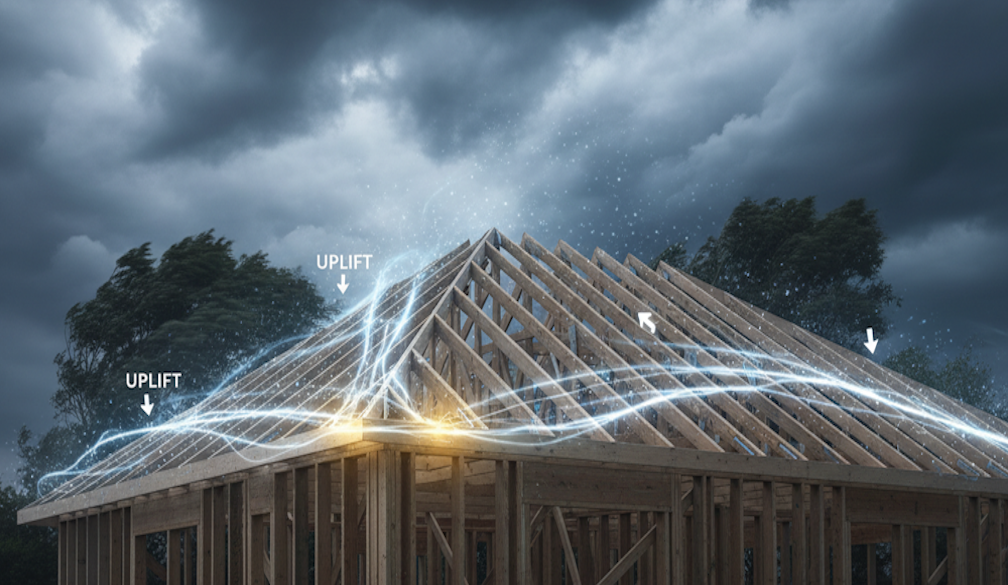
Melbourne's coastal position and topography mean that wind loads are a primary engineering concern. Roof trusses must be designed to withstand significant uplift forces, particularly in exposed locations. Steel frame systems perform exceptionally well under these conditions because of their high tensile strength and consistent dimensional accuracy. Truss manufacturers operating in Victoria typically use wind classification data derived from AS 4055 (Wind Loads for Housing) and AS/NZS 1170.2 (Structural Design Actions) to determine the load parameters for each specific site.
Temperature Cycling and Material Behaviour
Melbourne's temperature range, which can span from below 5 degrees Celsius in winter to above 40 degrees Celsius in summer, places repeated thermal stress on structural materials. Timber trusses are susceptible to expansion, contraction, warping, and splitting over time under these conditions. Steel trusses maintain dimensional stability across temperature extremes, which makes them a reliable long-term option for Melbourne roof frame design.
Moisture, Mould, and Termite Considerations
Victoria has a significant termite population, particularly in outer suburban and peri-urban areas. Steel frame systems are inherently termite-proof, which eliminates one of the most costly risks associated with timber construction. Steel trusses are also resistant to mould and rot, provided they are correctly specified, coated, and detailed to prevent moisture ingress at connection points.
Victorian Building Codes and Compliance Requirements
All construction in Victoria must comply with the National Construction Code (NCC), which is adopted and administered at the state level through the Building Act 1993 (Vic) and overseen by the Victorian Building Authority (VBA). Understanding how these regulations apply to roof trusses Melbourne is essential for anyone involved in the design, manufacturing, or installation of structural roofing systems.
The National Construction Code (NCC)
The NCC sets the minimum performance requirements for structural adequacy, fire resistance, and durability for all classes of buildings in Australia. For roof trusses, the relevant sections relate to structural loads, member design, connection design, and materials performance. Steel frame systems must be designed and documented in accordance with AS 4600 (Cold-Formed Steel Structures) for light gauge members, and AS 4100 (Steel Structures) for heavier structural steel applications.
Engineering Certificates and Documentation
In Victoria, prefabricated steel trusses supplied for construction projects typically require a Regulation 126 Certificate of Compliance. This certificate confirms that the structural components have been designed, manufactured, and inspected in accordance with the relevant Australian Standards. Builders and private building surveyors require this documentation before approving a building permit, so it is important to confirm that your chosen truss manufacturers can supply this certification as part of their standard delivery process.
Bushfire Attack Levels (BAL)
Some Melbourne outer suburbs and semi-rural areas fall within Bushfire Prone Areas as designated by the Victorian Government. For these sites, the NCC requires that structures are designed to a Bushfire Attack Level (BAL) rating under AS 3959 (Construction of Buildings in Bushfire-Prone Areas). Steel frame systems and steel trusses can be designed to meet BAL requirements more readily than many alternative materials, given steel's inherent non-combustibility.
Types of Steel Trusses and Their Suitability for Melbourne Projects
Not all steel trusses are the same, and selecting the right type for your project depends on the building class, span requirements, roof pitch, and site-specific load conditions. Below is an overview of the most common truss configurations used in Melbourne construction.
Prefabricated Steel Roof Trusses
Prefabricated trusses are manufactured off-site under controlled factory conditions, which ensures consistent quality and dimensional accuracy. For Melbourne projects, prefabrication also reduces time on site, which is an important advantage given Melbourne's variable weather during construction. Truss manufacturers can design prefabricated systems to meet site-specific wind, load, and fire requirements before delivery.
Lightweight Steel Roof Trusses
Light gauge steel trusses are widely used in residential construction and lower-load commercial projects across Melbourne. Their relatively low weight reduces demands on supporting walls and foundations while still delivering strong structural performance. They are especially well suited to modular and prefabricated building systems, which are growing in popularity across Victoria.
Commercial and Industrial Steel Trusses
Larger commercial and industrial buildings such as warehouses, childcare centres, and multi-unit residential developments require trusses capable of spanning greater distances and carrying heavier loads. Structural steel trusses for these applications are engineered to meet specific load calculations derived from Australian Standards and site assessments. Melbourne's growing construction pipeline makes demand for this truss category particularly strong.
How Steel Frame Systems and Roof Trusses Work Together
Steel frame systems are most effective when the wall framing and roof trusses are designed as an integrated structural solution. When a Steel Frame Melbourne project uses compatible framing and truss systems from the outset, the benefits compound across the build.
- Consistent load paths from roof to foundation reduce the risk of structural movement over time.
- Coordinated design using 3D BIM software allows potential clashes between structural, mechanical, and electrical elements to be identified before construction begins.
- Prefabricated steel frame systems and trusses can be delivered and installed in sequence, reducing crane time and labour costs on site.
- Compatibility between framing and truss systems simplifies the certification and inspection process for building surveyors.
What to Look for When Selecting Truss Manufacturers in Melbourne
Choosing the right truss manufacturers is one of the most important decisions in any construction project. Given Melbourne's specific climate and regulatory environment, there are several capabilities that reputable manufacturers should be able to demonstrate.
- Site-specific engineering: The manufacturer should conduct or commission load calculations based on your specific site, including wind classification, roof pitch, span requirements, and BAL rating if applicable.
- Australian Standards compliance: All truss designs should be certified under the relevant Australian Standards, and the manufacturer should be able to supply a Regulation 126 Certificate of Compliance.
- Design transparency: Reputable manufacturers will share detailed engineering drawings and 3D models with clients and their design teams before production commences.
- Material quality: Trusses manufactured from high-grade Australian steel with appropriate protective coatings will perform significantly better over Melbourne's long-term climate cycle.
- Installation capability: Many manufacturers offer installation services, which ensures accountability from design through to completion and reduces the risk of site errors.
Cost Considerations for Roof Trusses in Melbourne
Steel trusses typically carry a higher upfront cost compared to timber alternatives, but the long-term financial case is strong for Melbourne projects. The key factors that affect the cost of roof trusses Melbourne builders should be aware of include:
- Span and pitch: Longer spans and steeper pitches require more material and more complex engineering, which increases cost.
- Roof style: Gable roofs are typically the most cost-effective to truss. Hip and skillion configurations require additional design input.
- Site-specific requirements: BAL ratings, high wind zones, and unusual load conditions will add to engineering and material costs.
- Lead times: Projects with tight timelines may incur priority manufacturing costs, so planning ahead is important.
Over the life of a building, steel trusses generally outperform timber on total cost of ownership, with lower maintenance requirements, no pest treatments needed, and a longer structural lifespan.
Final Thoughts
Designing roof trusses for Melbourne is not a one-size-fits-all exercise. The combination of Melbourne's variable climate, wind exposure, termite risk, and Victorian building code requirements means that every project demands careful engineering consideration from the outset.
Steel trusses and steel frame systems are increasingly the preferred choice for Melbourne builders because they address these challenges directly. They are dimensionally stable, termite-proof, compliant with Australian Standards, and capable of meeting Melbourne's wind and bushfire requirements without compromise.
Whether you are working on a residential extension, a large commercial project, or a modular build, partnering with experienced truss manufacturers who understand the local regulatory environment will make the difference between a smooth build and a costly one. Take the time to ask the right questions early, review your engineering documentation thoroughly, and ensure your roof trusses Melbourne specification is driven by the conditions of your specific site, not just general industry practice.










