Xi-Biden meeting is cordial, but will anything change between the superpowers?
- Written by: Tony Walker, Vice-chancellor's fellow, La Trobe University
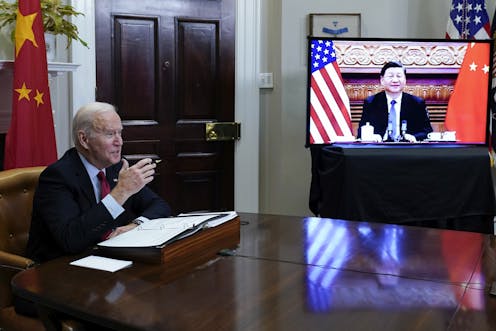
American-Chinese summit diplomacy comes and goes, but there will not be a much more consequential meeting[1] between two leaders than the latest of Joe Biden and Xi Jinping’s consultations.
If a measure was needed of how transformational the relationship between the US and China has become, one only needs go back to the first post-revolution summit between Richard Nixon and an ailing Mao Zedong in 1972[2].
Then, no-one could have predicted that within a generation the two countries would be locked in strategic competition. Nor would they have foreseen China surging forward economically to become the world’s second largest economy.
They also would not have forecast the leaders of the world’s most powerful countries meeting virtually, in contrast to the staged audience Mao conducted with Nixon in Beijing’s fortified leadership compound[3] a half century ago.
As always, US-China summits are framed by the Shanghai Communique[4] signed in 1972 by Nixon and then Premier Zhou Enlai. This acknowledged a “one-China” policy and set aside the issue of Taiwan.
In his virtual discussions with Xi, Biden reiterated America’s acceptance of “one China”[5], while re-stating Washington’s insistence the status quo in the Taiwan Strait not be altered by force.
While it is much too soon to talk about a reset in US-China relations, a reasonable conclusion is that Biden and Xi have at least got the relationship more or less back on track after the chaotic Trump era[6].
Read more: Xi Jinping sends message to US on China's rising power in Boao address[7]
Comments from the two sides on the encounter, which stretched over three-and-a-half hours, indicate that not much was off the table. Both emphasised the need for ongoing dialogue.
A White House readout[8] indicated that Biden emphasised strong US opposition to China’s attempt to throw its weight around.
President Biden underscored the United States will continue to stand up for its interests and values and together with our allies and partners, ensure the rules of the road for the 21st century advances an international system that is free, open, and fair.
From an Australian perspective, given the bad state of relations between Canberra and Beijing, these expressions of support for “allies and partners” will be welcome,
In another significant intervention, Biden called for greater cooperation to avoid possible conflict.
President Biden also underscored the importance of managing strategic risks. He noted the need for commonsense guardrails to ensure that competition does not veer into conflict […]
The Chinese “readout[9]” came via Foreign Ministry spokesperson Hua Chunying, who said the meeting was “wide-ranging, in-depth, candid, constructive, substantive and productive”.
Chinese state media quoted Xi as describing the talks as a “new era” in which the principles of “mutual respect, peaceful coexistence and win-win cooperation should be followed”.
Both Biden’s and Xi’s words indicated a wish to improve the relationship through more frequent communication.
Biden’s remarks[10] before the two leaders began the talks suggested he was keen to establish a less combative relationship. He said
It seems to be our responsibility as the leaders of China and the United States to ensure that the competition between our countries does not veer into conflict whether intended or unintended, rather than simple, straightforward competition.
Xi responded by calling Biden an “old friend” and expressed the wish to “work with you, Mr President, to build consensus, take active steps and move China-US relations forward in a positive direction”.
The above sentiments expressed by both sides could be regarded as nothing more nor less than what might be expected in exchanges between US and Chinese leaders in a summit setting. But there is at least a chance that a more constructive relationship will emerge from these talks.
In a complex world in which both the US and China are facing immense challenges domestically, it is in neither’s interest for relations to spiral.
Indeed, it is in their collective interest for a more workable relationship to emerge. Agreement between Washington and Beijing at the recent COP26 climate summit to work constructively towards climate targets[11] is an example of the sort of collaboration that serves each other’s interests.
However, it would be extremely naïve to believe the world is about to enter a new and more benign phase following the Biden-Xi talks. Multiple structural differences between the competing powers are such that it is inevitable the two will continue to be at odds on a range of issues.
Read more: China's global diplomatic approach is shifting, and Australia would do well to pay attention to it[12]
Most concerning for America and its friends, one of those issues is China’s continuing military build-up[13]. This includes additions to its nuclear arsenal and the development of space-enabled hypersonic missiles that would pose a serious threat to US military supremacy in the Indo-Pacific.
China’s military buildup in the East and South China Seas, despite assurances provided by Xi to President Barack Obama that Beijing’s intentions were benign, represents a significant concern for the US and its allies. This includes Australia.
Read more: What would a Biden presidency mean for Australia?[14]
China’s use of its cyber capabilities in a provocative manner is another cause for concern. Its intellectual property theft weighs heavily on relations with Washington. Its human rights abuses represent another serious drag on the relationship.
All that said, personal diplomacy between Xi and Biden may serve to smooth off some of the rougher edges of a relationship that will continue to be tested. This is because of the simple reality that China, as a rising power, will continue to disrupt the US and its allies on many different fronts.
The question that should be asked about this latest attempt to restore a level of equilibrium to the relationship is whether there is reasonable expectation a more constructive partnership will develop.
There are reasons why relations might become less contentious. On the other hand, there are compelling arguments for why deep and aggravating differences are such that a dysfunctional relationship remains likely.
References
- ^ consequential meeting (www.nytimes.com)
- ^ Richard Nixon and an ailing Mao Zedong in 1972 (www.nytimes.com)
- ^ Mao conducted with Nixon in Beijing’s fortified leadership compound (foreignpolicy.com)
- ^ Shanghai Communique (history.state.gov)
- ^ reiterated America’s acceptance of “one China” (www.whitehouse.gov)
- ^ chaotic Trump era (www.theguardian.com)
- ^ Xi Jinping sends message to US on China's rising power in Boao address (theconversation.com)
- ^ readout (www.whitehouse.gov)
- ^ readout (www.cnbc.com)
- ^ remarks (www.afr.com)
- ^ work constructively towards climate targets (www.state.gov)
- ^ China's global diplomatic approach is shifting, and Australia would do well to pay attention to it (theconversation.com)
- ^ military build-up (www.ft.com)
- ^ What would a Biden presidency mean for Australia? (theconversation.com)