The RBA is not a law unto itself — an external review would be good for it
- Written by: Richard Holden, Professor of Economics, UNSW
The testimony[1] from Reserve Bank of Australia governor Philip Lowe to the House of Representatives’ Standing Committee on Economics[2] last week seemed familiar.
The committee’s deputy chair, the Labor Party’s Andrew Leigh, asked Lowe a series of pointed but important questions. Lowe tried to duck them, with limited success.
The most interesting exchange concerned the possibility of a wholesale review of the central bank by outside parties.
Leigh referred to a series of articles about the bank by journalist Shane Wright[3] that note the bank and its policy objectives haven’t been reviewed in 40 years.
Many were calling for a fundamental review of monetary policy, Leigh said. Such reviews had been done by the US Federal Reserve, the European Central Bank, the Bank of England, the Bank of Canada, the Bank of Japan, the Reserve Bank of New Zealand and Germany’s Reichsbank. He asked Lowe:
Would you support a review of monetary policy, a review into the RBA?
Predictably, but disappointingly, Lowe replied:
When people say that there should be a review of the Reserve Bank, I’m not sure what they’re calling for — a review of the legislation, the mandate, the way the government appoints people to the board, the type of people they put on the board, or how we’ve done our job; we haven’t done our job effectively. All those things get conflated.
The obvious response to this is: so what?
Reviewing the job the RBA has done — or failed to do — seems entirely appropriate from time to time. Who the government appoints to the board and why could also do with a little scrutiny.
What Lowe called “conflated” reasons I think are all good reasons.
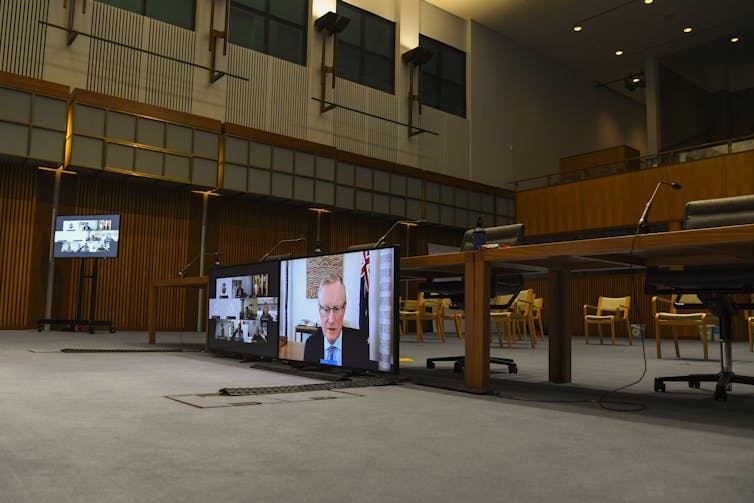 Reserve Bank of Australia governor Philip Lowe appears before the House of Representatives Standing Committee on Economics via video link on August 6 2021.
Lukas Coch/AAP
Reserve Bank of Australia governor Philip Lowe appears before the House of Representatives Standing Committee on Economics via video link on August 6 2021.
Lukas Coch/AAP
Reasons to review the central bank
Lowe went on to ask (rhetorically):
I just wonder, when people want a review, what they actually want to review — other than that they’re not happy with the decisions we’re making.
Following this, Leigh was perhaps a little too polite, pivoting to questions about what is minuted in RBA board meetings.
Being less encumbered by such considerations, I would have replied to Lowe’s question as follows.
I can’t speak for others, but I want a review to look into why you have made the decisions you have made and how you might have made better ones.
I want a review into how the central bank has missed its self-imposed inflation target since 2015, for the entire time you have been governor. I want a review into what institutional failures have led to this.
I want a review into whether the inflation-targeting regime is still preferable to a nominal GDP target.
I want a review into the degree to which dissenting views are aired in board meetings. I want your international peers — like former governors of the US Federal Reserve — to tell how the RBA can serve the Australian people better.“
Read more: Vital Signs: RBA governor Philip Lowe's dangerous game on interest rates[4]
Steward to the nation
On one level, I understand Lowe’s opposition to a review. Nobody enjoys a performance review all that much. Even less so when it’s likely to highlight some "areas for improvement”.
But Lowe is wearing two hats.
His first hat is as governor of the RBA, responsible for its successes and failures while he’s in the chair.
He’s responsible for taking too long to cut interest rates from the 1.5% level they were stuck at for meeting after meeting. He’s responsible for saying bizarre things from time to time, from innocuous “off-piste” comments about light rail[5] to flat-out incorrect statements[6] about migration having suppressed wages. This is something that someone with a PhD from MIT ought to know better about, particularly given the research contradicting the claim presented at the RBA’s own conference in 2019[7].
Read more: Top economists say cutting immigration is no way to boost wages[8]
His second hat is even bigger, as the steward of one of Australia’s most important economic institutions. In the same way the Chief Justice of Australia not only writes opinions but is a steward of the court, the RBA governor has a broader responsibility to the nation.
You would need go a long way to find someone more opposed than me to agendas like that of the so-called “Democratize the Fed[9]” movement. But that doesn’t mean I think the RBA could not be more democratically accountable.
The RBA rightly has a strong degree of independence. It needs that to make credible policy. But that doesn’t mean it’s infallible.
The central bank should want to get better. It should want to offer itself up for peer review.
That would, ironically, do the most to reduce the amount of criticism it receives.
References
- ^ testimony (parlinfo.aph.gov.au)
- ^ Standing Committee on Economics (www.aph.gov.au)
- ^ by journalist Shane Wright (www.smh.com.au)
- ^ Vital Signs: RBA governor Philip Lowe's dangerous game on interest rates (theconversation.com)
- ^ light rail (www.smh.com.au)
- ^ statements (www.rba.gov.au)
- ^ the RBA’s own conference in 2019 (www.rba.gov.au)
- ^ Top economists say cutting immigration is no way to boost wages (theconversation.com)
- ^ Democratize the Fed (www.peoplesworld.org)
Authors: Richard Holden, Professor of Economics, UNSW