Was the violent Sydney protest avoidable, and what can police and demonstrators learn?
- Written by: Simon Bronitt, Professor of Law, University of Sydney
The police role as a “thin blue line” between public order and chaos was tested in Sydney’s CBD on Monday night.
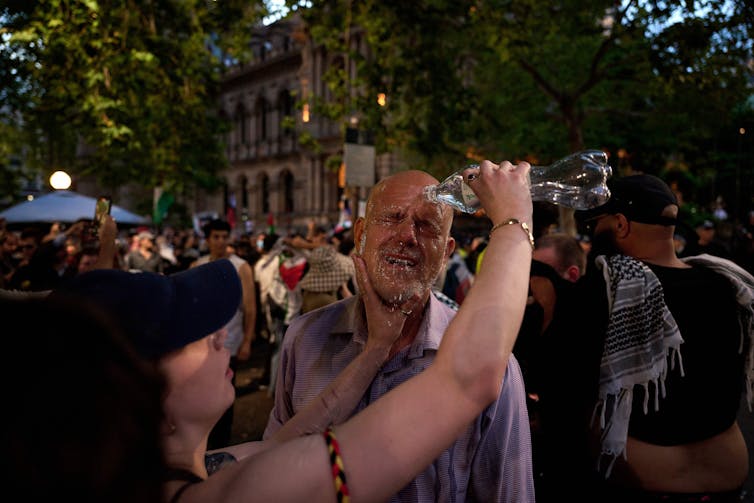
Videos have captured the violent clashes between police and some of the thousands of protesters who gathered at the Town Hall to protest the presence of Israeli President Isaac Herzog in Australia.
One video shows a police officer repeatedly punching a man lying prone on the street, his hands pinned behind him.
New South Wales Premier Chris Minns has defended the actions of the police in Sydney, saying they faced an “impossible situation”.
No doubt, there will be investigations into the legality and reasonableness of the police response. But what’s also needed to prevent a repeat of Monday’s violence is a rethink of police training and protocols in NSW that are explicitly based on a respect for human rights, or what policing scholars call “human rights policing”[1].
Chaos erupting at the Sydney protest outside Town Hall as police clash with demonstrators.‘Major event’ declaration
The NSW government declared Herzog’s visit to be a “major event” under state law. This gave police sweeping powers[2] to issue move-on orders, close specific locations and search people in a designated area of the city. Essentially, it created a protest exclusion zone.
These laws, which exist in many jurisdictions, are typically used to ensure public order during major political and sporting events, such as Queensland’s prototype Major Events Act[3] enacted before the 2014 G20 summit in Brisbane and the 2018 Commonwealth Games on the Gold Coast.
While these acts restrict otherwise lawful peaceful protests, they are limited in both time and place.
In Sydney, the NSW Supreme Court rejected a challenge[4] to the government declaration just minutes before Monday’s protest was due to take place.
This suggested that, in the eyes of the state government and the court, public order and safety outweighed the rights of protesters, in this instance, to march through the CBD as they wished.
But the expanded legal powers of the police in these situations do not render declared public spaces “human rights-free zones”.
And public order was clearly not maintained in Sydney since the situation at Town Hall quickly devolved into violence.
So what went wrong? And how does policing need to change?
How policing in these situations can work
Policing is especially challenging in cases where two or more opposing groups seek to exercise the same rights to protest in the same public space, or the location or size of a protest raises concerns about public safety or potentially interferes with other lawful rights.
The G20 summit and Commonwealth Games in Queensland, both of which took place without significant incidents of disorder, show how this can be successfully done. These events provide a model for human rights policing – what worked well, and why.
My international review of policing the G20 summit and other major events a decade ago, conducted with two leading policing scholars, David Baker and Philip Stenning, was based on extensive empirical research[5]. It identified several important lessons:
1) Police play a key role in upholding human rights. Balancing competing interests requires respectful dialogue between police and protest organisers and other affected community stakeholders before an event takes place
2) Framing police powers expressly within a statutory human rights framework is desirable. However, Queensland police’s own policies, practices and training were key to upholding human rights. As the public safety policy manual stated:
When possible, police will attempt to negotiate with all groups wanting to march or to use a particular space. In managing the use of public space, police will be impartial, and will use their discretion to facilitate the lawful activities of all parties
3) Policing protests also benefits from the presence of independent legal observers. They can assist in clarifying the rights and responsibilities of protesters, and help de-escalate tense situations.
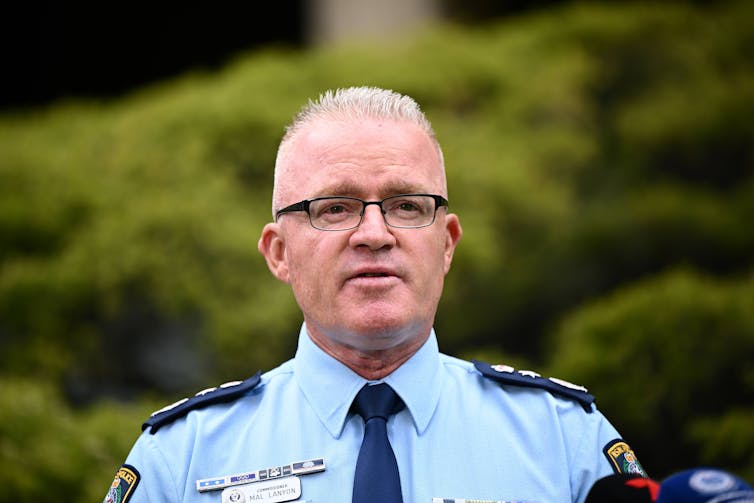
Senior police officials said[6] there had been discussions with the Palestine Action Group before Monday’s protest, in which they encouraged protesters to move to Hyde Park outside the exclusion zone.
However, there is always a risk that dialogue between police and protest organisers ahead of a demonstration does not work as planned. There can be miscommunication, mistrust and unexpected departures from agreed plans and protocol.
Large protests also attract diverse groups of people that organisers have no control over, including those who willingly engage in violent confrontations with police or opposing groups.
That said, allowing time for proper dialogue with protest organisers and community representatives can help anticipate potential flashpoints and identify the points when police will have to intervene. This dialogue can generate better understanding of:
-
when police give protesters a reasonable direction to disperse from an area
-
what constitutes a “reasonable time” to leave that area
-
what legal steps (arrest and removal) might be taken by police against those who refuse to comply
-
the range of “reasonable force” police will use to disperse crowds or arrest those who don’t comply.
Reasonable force generally depends on the situation. Above all, physical force and deployment of pepper spray must be consistent with police training and policies, and as with any coercive powers, should be used as a matter of last resort.
What needs to be done?
Proportionate and accountable policing needs to be founded in a respect for human rights to the maximum extent possible.
But it’s also important to note that human rights are rarely absolute. As a result, a person’s freedom to protest may legitimately be restricted in the interest of public safety and to safeguard the rights of others (such as using or moving freely in public spaces).
So, is human rights policing, then, practical or realistic?
NSW policymakers should examine how policing practice has changed in jurisdictions that have enacted human rights legislation (notably the United Kingdom, ACT, Victoria and Queensland).
These laws delineate when and how people’s rights to engage in peaceful public protest should be protected, and when and how far they can be restricted on public safety grounds.
The NSW government should also prioritise a reconsideration of the Human Rights Bill[7] introduced to parliament late last year.
And learning lessons from the policing of major events in Queensland a decade ago would help move towards a more robust model of human rights policing and prevent a repeat of Monday’s violent disorder.
References
- ^ what policing scholars call “human rights policing” (www.tandfonline.com)
- ^ sweeping powers (theconversation.com)
- ^ Major Events Act (www.legislation.qld.gov.au)
- ^ rejected a challenge (theconversation.com)
- ^ empirical research (www.tandfonline.com)
- ^ said (www.theguardian.com)
- ^ Human Rights Bill (www.parliament.nsw.gov.au)