Albanese finally summons national cabinet to consider antisemitism epidemic
- Written by: Michelle Grattan, Professorial Fellow, University of Canberra
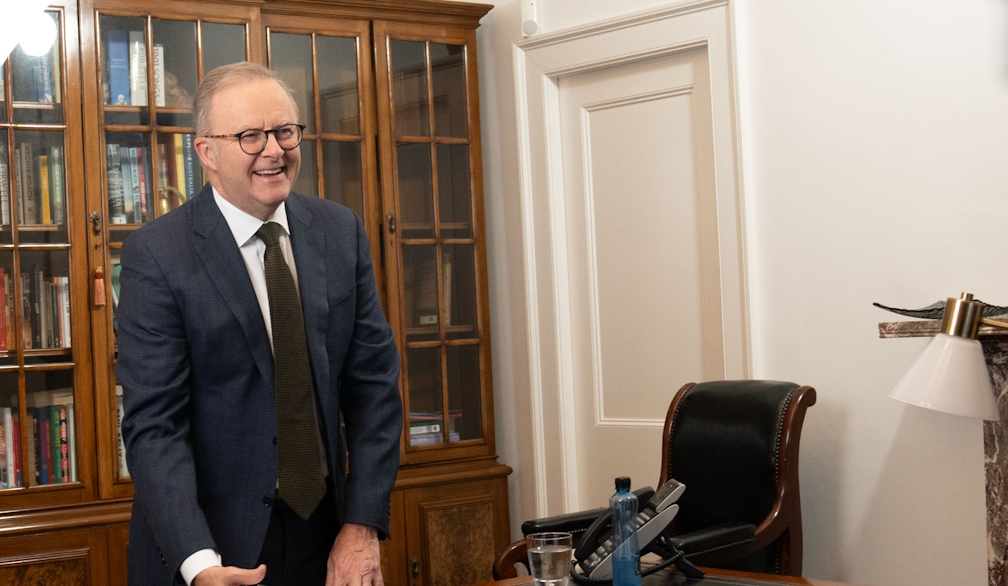
After rejecting calls for months, Prime Minister Anthony Albanese finally summoned a Tuesday national cabinet meeting to discuss Australia’s rising wave of antisemitic attacks and other incidents.
This followed the torching of a childcare centre in Maroubra in Sydney overnight, which saw anti-Jewish graffiti sprayed on the building.
In a statement after the national cabinet, Albanese said Australian Federal Police Commissioner Reece Kershaw had briefed leaders on the latest police intelligence, and the leaders had agreed to establish a national database to track antisemitic crime and behaviours. “Best practice” is to be shared across governments in fighting antisemitism.
The AFP says it is investigating whether local criminals might be being paid from overseas to commit antisemitic acts.
According to the latest figures, since AFP Operation Avalite was set up late last year, the AFP has received 166 reports, with 15 under investigation. One person has been arrested so far.
Under NSW’s Strike Force Pearl, three men – aged 20, 19 and 21 – have been charged after ten vehicles and buildings were damaged in Woollahra in November.
Thirty-six people have been charged with antisemitic related offences, including eight charged with 59 offences.
Four men – aged 31, 27, 40 and 26 – were charged after fires at two businesses in Bondi in October.
A woman aged 34 was charged after vehicles and buildings were damaged in Woollahra in December.
Under Operation Park in Victoria, 70 arrests have been made.
Albanese said the leaders “unequivocally condemn antisemitism and reaffirmed to stamp it out in Australia”.
Kershaw said in a Tuesday statment: “There is no doubt there is an escalation of antisemitism in Australia.
"I know many people feel they want more action to go with words, ” he said, outlining what had been done and what was being considered.
“We are looking into whether overseas actors or individuals have paid local criminals in Australia to carry out some of these crimes in our suburbs,” he said.
“We are looking at if – or how - they have been paid, for example in cryptocurrency, which can take longer to identify.
"We are looking into whether any young people are involved in carrying out some of these crimes, and if they have been radicalised online and encouraged to commit antisemitic acts.
"We are regularly talking to our Five Eyes and trusted international partners about these issues.”
He said that on Wednesday he would meet with state police commissioners across the country. “I will raise whether there are other tactics or matters we can consider.”
Last week, the prime minister met the premiers of Victoria and NSW on the antisemitism issue while dismissing pressure for a national cabinet, which was coming from, among others, the Executive Council of Australian Jewry and Australia’s Special Envoy to Combat Antisemitism, Jillian Segal.
Opposition leader Peter Dutton said the PM had been “dragged kicking and screaming” to call the national cabinet meeting. “We are having rolling terrorist attacks in our community,” Dutton said.
Appearing on Tuesday morning at a news conference with NSW Premier Chris Minns, Albanese condemned the Maroubra attack as a “vicious crime”. “This is something that people in this great multicultural city of Sydney should never wake up to.”
Minns said to see the torched childcare centre – which is not Jewish but is near a synagogue and a Jewish school – “is completely heartbreaking”. “These bastards” would be rounded up by NSW Police, he said.
“These antisemitic attacks are the opposite of the kind of country that we all want to live in.”
Minns also defended the record of the NSW Police in catching and prosecuting those responsible for the string of hate crimes in NSW. Police resources are being increased to combat the attacks.
The federal opposition this week pledged a Coalition government would introduce mandatory minimum sentences of at least six years for Commonwealth terrorism offences.
The Faith Affairs Council of NSW called on religious and community leaders “to condemn this anti-religious act of violence, and proactively promote harmony and understanding across our multicultural and multifaith communities”.
Meanwhile Israel is continuing its pressure on Australia over antisemitisim.
After Attorney-General Mark Dreyfus’s trip to Israel to try to rebuild relations, Israel’s Deputy Minister for Foreign Affairs, Sharren Haskel, posted on social media this week that she had expressed to Dreyfus “our deep concern regarding the shocking rise in antisemitism in Australia and the clearly ineffectual response from the Australian government and state governments.
"There is no doubt this has been caused in part by the Australian government’s ongoing campaign against Israel,” she said.
“I expressed my expectation and hope that Australia’s policy towards Israel will return to reflecting our long-standing relations based on shared values and interests.”
The federal government plans to have two cabinet ministers lead the Australian delegation to the commemoration in Poland next week marking 80 years since the last people were freed from Auschwitz.
When parliament returns early next month it will consider the government’s legislation to crack down on hate speech.