Leaders trade barbs and well-worn lines in unspectacular third election debate
- Written by: Joshua Black, Visitor, School of History, Australian National University
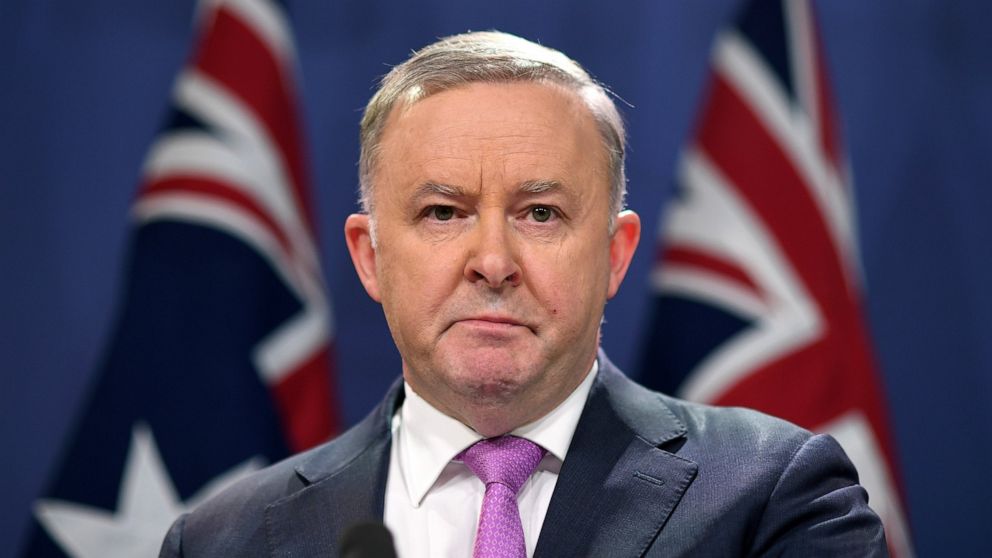
Anthony Albanese and Peter Dutton have met for the third leaders’ debate of this election campaign, this time on the Nine network. And while the debate traversed much of the same ground as the first two, the quick-fire set up of the debate allowed for some more animated exchanges less than two weeks from election day.
Three expert authors give their analysis of how the two leaders performed.
Joshua Black[1], Australian National University
Tonight’s leaders’ debate was a marked improvement on the appalling spectacle[2] Nine hosted three years ago. Anthony Albanese and Peter Dutton had clearly taken advantage of the reduced campaign activity in recent days to prepare themselves for this contest.
The problem? There was nothing new worth saying. Viewers were treated instead to the greatest hits of an election campaign that has so far not been especially great. Dutton once again paid homage to Howard and Costello’s liberalism (read: “I’m not Trump”), while Albanese repeated his hardly seamless mantra: “no-one held back and no-one left behind” (read: “I’m not Dutton”).
For all of the lofty soundbites, the debate hinged on pedantry. The semantic argument from the first debate about the 2014 budget and health and education spending came up again. (Were there cuts, or did these “line items” simply not grow as fast as promised?)
Both leaders repeated banal explanations about why they were best placed to deal with the Trump White House. There was plenty of tired campaign rhetoric about looming recessions and “talking Australia down”. Even an exchange from last week between Albanese and the ABC’s moderator David Speers seemed to be repeated tonight: why isn’t the government’s energy relief for households means-tested?
At times, this debate was self-indulgent on the part of Nine Entertainment. Ally Langdon (who opened the debate by welcoming “a bit of theatre”) routinely cast her own judgement, condemning Albanese and Dutton for merely “patching cracks” and not proving their “fiscal responsibility” sufficiently.
Interestingly, media policy was one of the few things on which the two leaders could agree. Nine’s political editor Charles Croucher asked the leaders to state their attitude toward the News Media Bargaining Code, which prompts global tech giants to pay Australian news providers for access to their content. Both leaders tripped over themselves to assure the panel they were on a “unity ticket” to protect local media companies (including Nine Entertainment) from being “cannibalised” by multinational tech giants. (Of course, a fair playing field for local media providers is clearly in the national interest[3].)
This was Dutton’s best debate showing so far. That’s hardly a win. The prime minister managed to reel off a list of his government’s more popular policies, subtly compare his compassionate approach to leadership with Dutton’s darker obsession with order and the threat of disorder, and remind people of the opposition leader’s history of unpopular statements and policies. A modest win for Albanese, if not grounds for inspiration.
Andrea Carson[4], La Trobe University
Coinciding with the first day of early voting, the third leaders’ debate was more like a game of speed chess – with 60 seconds for leaders’ answers, and 30 seconds for rebuttals. The result was too often a word salad.
While voters may be feeling debate fatigue — and little wonder with a fourth showdown looming on Channel 7 on Sunday — this one could have mattered. With about half of Australians casting their votes early, these televised match-ups represent a potential last chance to shape opinions before May 3.
Instead, questions often focused on personal qualities: trust and lies, and less on policy – poorly serving viewers as answers became a tit-for-tat affair. The countdown of the clock only re-enforced leaders’ rehearsed answers to well-worn topics of cost of living, energy prices, Medicare bulk billing rates, immigration, housing crisis and tax cuts, barely exposing key policy differences for undecided voters. Even their matching blue suits and pale ties made them look less like opponents and more like political twins.
Dutton seemed more assured than Albanese from the start.
Typically, campaign messages get more negative as we move closer to polling day. Studies have shown fear campaigns can “work”, but they can also turn off voters, particularly women. So, unsurprisingly, Dutton’s emphasis was on law and order framed in the language of fear, promising to “keep people safe in their home and communities […] in very uncertain times”. He also promised to cut migration, couched as bringing down housing prices.
The former policeman seeking to be prime minister kept with the law and order theme to sway voters offering a $A750 million package to stamp out illegal drugs and tobacco.
In a similar vein, the Labor leader Anthony Albanese used every chance he had to pivot questions back to Labor’s policy home ground advantage: health, education (free TAFE and reduced HECS debt) and low-cost childcare.
Asked by journalist Deborah Knight if he was “too soft” as a leader, Albanese strove to offer voters hope over fear, replying: “kindness isn’t weakness […] we raise our children to be compassionate”, arguing he can still hold firm when dealing with autocratic leaders to protect Australia’s national interest.
As Dutton listed his top legislative priorities if elected, promising a 25% fuel levy tax, Albanese scored a zinger, pointing out that that policy expires in a year, chortling “you better do it quickly before it disappears”. Overall, it was a flat event, lacking atmosphere and detailed information.
Zareh Ghazarian[5], Monash University
The “Great Debate”, as it was called by the broadcaster, started on a solemn tone as both leaders mourned the passing of Pope Francis. The format of the debate was geared towards a quick-fire approach. Time limits of one minute per response to questions ensured the debate covered a lot of ground. Policies from cost of living to international affairs were discussed.
The leaders played their roles effectively. Opposition Leader Peter Dutton demonstrated a laser-like focus on critiquing the government, while highlighting the Coalition’s policies. Prime Minister Anthony Albanese defended the track record of his government while also taking opportunities to criticise the previous Morrison government. Both leaders stayed true to advancing the core messages of their campaign.
Cost of living was central to the debate and provided ample opportunity for Dutton and Albanese to put forward their views on the measures they believe would address the issues. Energy policy, and the divide between nuclear and renewable energy sources, also emerged. There was also a moment of unity as both leaders took pride that Australia had implemented a social media ban for under-16s.
After the only break of the night, the host gave both leaders the opportunity to spell out the values that underpinned their policy approach. Dutton focused on restating policy goals, such as a reduction in fuel excise. Albanese returned to “no one left behind, but no one held back” as his key message, a concept he had also mentioned in his victory speech in 2022[6].
On the whole, and considering the stakes, the debate was a model of civility. Both leaders presented as being in command of the details regarding their policies. Gaffes about figures, costings, and promises were virtually non-existent. Whether it added anything new about the leaders or their policy platforms, however, is debatable.
References
- ^ Joshua Black (theconversation.com)
- ^ appalling spectacle (theconversation.com)
- ^ national interest (www.afr.com)
- ^ Andrea Carson (theconversation.com)
- ^ Zareh Ghazarian (theconversation.com)
- ^ victory speech in 2022 (www.abc.net.au)