Australian researchers use a quantum computer to simulate how real molecules behave
- Written by: Ivan Kassal, Professor of Chemical Physics, University of Sydney

When a molecule absorbs light, it undergoes a whirlwind of quantum-mechanical transformations. Electrons jump between energy levels, atoms vibrate, and chemical bonds shift — all within millionths of a billionth of a second.
These processes underpin everything from photosynthesis in plants and DNA damage from sunlight, to the operation of solar cells and light-powered cancer therapies.
Yet despite their importance, chemical processes driven by light are difficult to simulate accurately. Traditional computers struggle, because it takes vast computational power to simulate this quantum behaviour.
Quantum computers, by contrast, are themselves quantum systems — so quantum behaviour comes naturally. This makes quantum computers natural candidates for simulating chemistry.
Until now, quantum devices have only been able to calculate unchanging things, such as the energies of molecules. Our study[1], published this week in the Journal of the American Chemical Society, demonstrates we can also model how those molecules change over time.
We experimentally simulated how specific real molecules behave after absorbing light.
Simulating reality with a single ion
We used what is called a trapped-ion quantum computer. This works by manipulating individual atoms in a vacuum chamber, held in place with electromagnetic fields.
Normally, quantum computers store information using quantum bits, or qubits. However, to simulate the behaviour of the molecules, we also used vibrations of the atoms in the computer called “bosonic modes”.
This technique is called mixed qudit-boson simulation. It dramatically reduces how big a quantum computer you need to simulate a molecule.
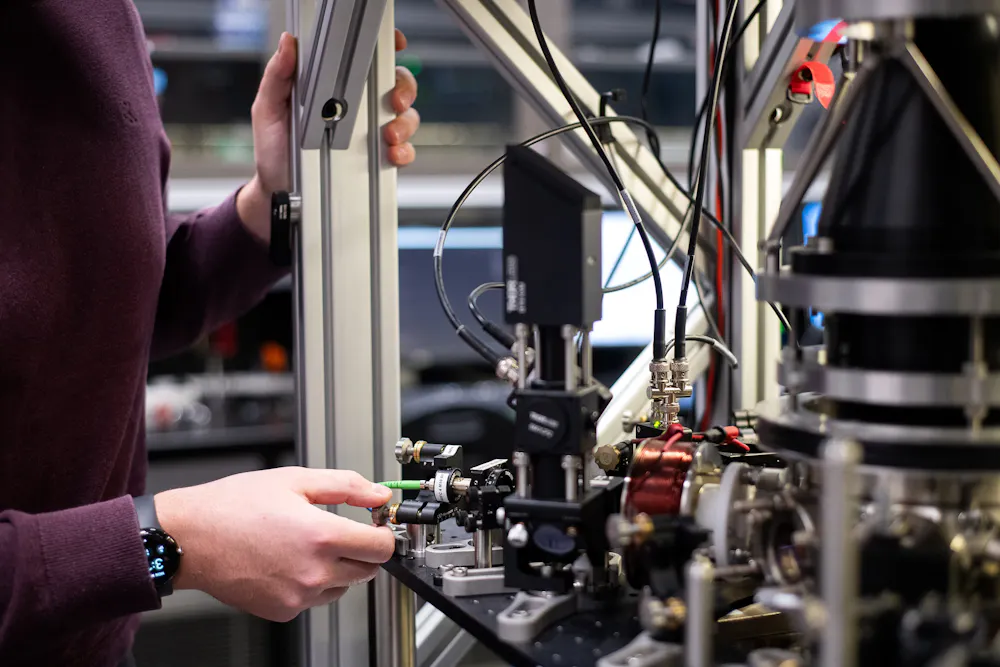
We simulated the behaviour of three molecules absorbing light: allene, butatriene, and pyrazine. Each molecule features complex electronic and vibrational interactions after absorbing light, making them ideal test cases.
Our simulation, which used a laser and a single atom in the quantum computer, slowed these processes down by a factor of 100 billion. In the real world, the interactions take femtoseconds, but our simulation of them played out in milliseconds – slow enough for us to see what happened.
A million times more efficient
What makes our experiment particularly significant is the size of the quantum computer we used.
Performing the same simulation with a traditional quantum computer (without using bosonic modes) would require 11 qubits, and to carry out roughly 300,000 “entangling” operations without errors. This is well beyond the reach of current technology.
By contrast, our approach accomplished the task by zapping a single trapped ion with a single laser pulse. We estimate our method is at least a million times more resource-efficient than standard quantum approaches.
We also simulated “open-system” dynamics, where the molecule interacts with its environment. This is typically a much harder problem for classical computers.
By injecting controlled noise into the ion’s environment, we replicated how real molecules lose energy. This showed environmental complexity can also be captured by quantum simulation.
What’s next?
This work is an important step forward for quantum chemistry. Even though current quantum computers are still limited in scale, our methods show that small, well-designed experiments can already tackle problems of real scientific interest.
Simulating the real-world behaviour of atoms and molecules is a key goal of quantum chemistry. It will make it easier to understand the properties of different materials, and may accelerate breakthroughs in medicine, materials and energy.
We believe that with a modest increase in scale — to perhaps 20 or 30 ions — quantum simulations could tackle chemical systems too complex for any classical supercomputer. That would open the door to rapid advances in drug development, clean energy, and our fundamental understanding of chemical processes that drive life itself.