


Emmy Noether faced sexism and Nazism – 100 years later her contributions to ring theory still influence modern math
- Written by: Tamar Lichter Blanks, PhD Candidate in Mathematics, Rutgers University
When Albert Einstein wrote an obituary[1] for Emmy Noether in 1935, he described her as a “creative mathematical genius[2]” who – despite “unselfish, significant work over a period of many years” – did not get the recognition she deserved.
Noether made groundbreaking contributions to mathematics at a time when women were barred from academia and when Jewish people like herself faced persecution in Nazi Germany, where she lived.
The year 2021 marks the 100th anniversary of Noether’s landmark paper[3] on ring theory, a branch of theoretical mathematics that is still fascinating and challenging mathematicians like me[4] today.
I remember the first time I learned about Noether and the surprise I felt when my professor referred to the brilliant ring theorist as “she.” Even though I[5] am a woman doing mathematics, I had assumed Noether would be a man. I was surprised at how moved I was to learn she was a woman, too.
Her inspiring story is one that not many people know.
A rare woman in mathematics
 Emmy Noether earned a doctorate in mathematics in 1909, but women were not allowed to work as professors at that time in Germany.
Mathematical Assoc, iabutit onat ofth Aatme triimcae, v ia WikimediaCommons[6]
Emmy Noether earned a doctorate in mathematics in 1909, but women were not allowed to work as professors at that time in Germany.
Mathematical Assoc, iabutit onat ofth Aatme triimcae, v ia WikimediaCommons[6]
Noether was born in 1882 in Erlangen, Germany[7]. Her father was a math professor, but it must have seemed unlikely to a young Noether that she would follow in his footsteps. At the time, few women took classes at German universities, and when they did they could only audit them[8]. Teaching at a university was out of the question[9].
But in 1903 – a few years after Noether graduated from a high school for girls – Erlangen University started to let women enroll[10]. Noether signed up and eventually earned her doctorate in mathematics there[11].
That doctorate should have been the end of her mathematical career. At the time, women were still not allowed to teach[12] at universities in Germany. But Noether stuck with mathematics anyway, staying in Erlangen and unofficially supervising doctoral students[13] without pay. In 1915, she applied for a position at the prestigious University of Göttingen[14]. The dean at the university, also a mathematician, was in favor of hiring Noether, although his argument was far from feminist.
“I think the female brain is unsuitable for mathematical production,” he wrote[15], but Noether stood out as “one of the rare exceptions.”
Unfortunately for Noether, the Prussian Ministry of Education would not give the university permission[16] to have a woman on their faculty, no matter how talented. Noether stayed in Göttingen anyway and taught courses listed under the name of a male faculty member[17].
During those years, she kept doing research. While she was still an unofficial lecturer, Noether made important contributions[18] to theoretical physics and Einstein’s theory of relativity. The university finally granted her lecturer status[19] in 1919 – four years after she applied.
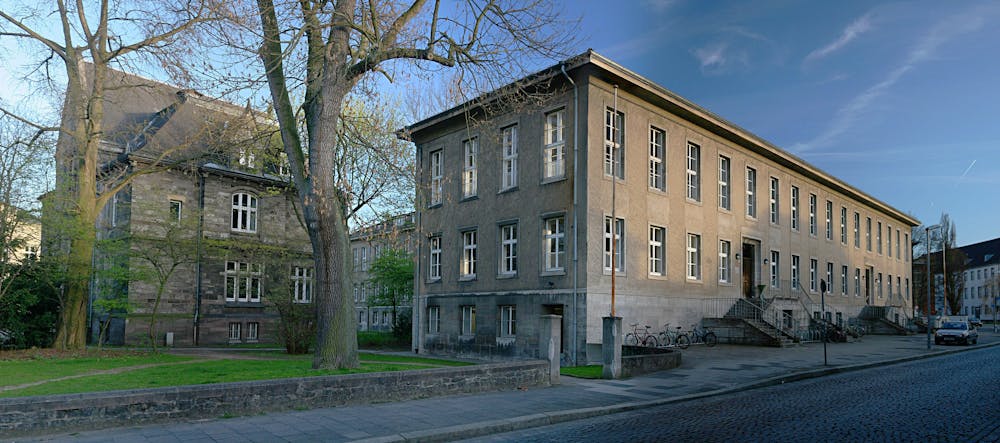 The University of Göttingen, seen here, was unable to hire Noether as a professor, so she taught courses under a male colleague’s name.
Daniel Schwen/WikimediaCommons, CC BY-SA[20][21]
The University of Göttingen, seen here, was unable to hire Noether as a professor, so she taught courses under a male colleague’s name.
Daniel Schwen/WikimediaCommons, CC BY-SA[20][21]
A revolution in ring theory
In 1921, only two years after becoming an official lecturer, Noether published revolutionary discoveries in ring theory[22] that mathematicians are still pondering[23] and building upon today. Noether’s work in ring theory is the main reason that I, like many mathematicians today, know her name.
Ring theory is the study of mathematical objects called rings. Despite the name, these rings[24] have nothing to do with circles or ring-shaped objects – theoretical or otherwise. In mathematics, a ring is a set of items you can add, subtract and multiply and always get another object that is in the set.
A classic example is the ring known as Z. It is made of all the integers – positive and negative whole numbers like 0, 1, 2, 3, -1, -2, -3 and so on – and it is a ring because if you add, subtract or multiply two integers, you always get another integer.
There are infinitely many rings, and each one is different. A ring can be made of numbers, functions, matrices, polynomials or other abstract objects[25] – as long as there’s a way to add, subtract and multiply them.
One reason rings are so interesting to mathematicians is that often it is possible to tell something is a ring, but it’s difficult to know much about the specifics of that particular ring. It’s like seeing a croissant at a fancy bakery. You know you are looking at a croissant, but you might not know whether it’s filled with almond paste, chocolate or something else altogether.
Instead of focusing on one ring at a time, Noether showed that a whole class of easy-to-identify rings[26] all share a common internal structure, like a row of houses with the same floor plan. These rings are now called Noetherian rings, and the structure they share is like a map that guides the mathematicians who study them.
Noetherian rings show up all the time in modern mathematics[27]. Mathematicians still use Noether’s map today, not just in ring theory, but in other areas such as number theory and algebraic geometry.
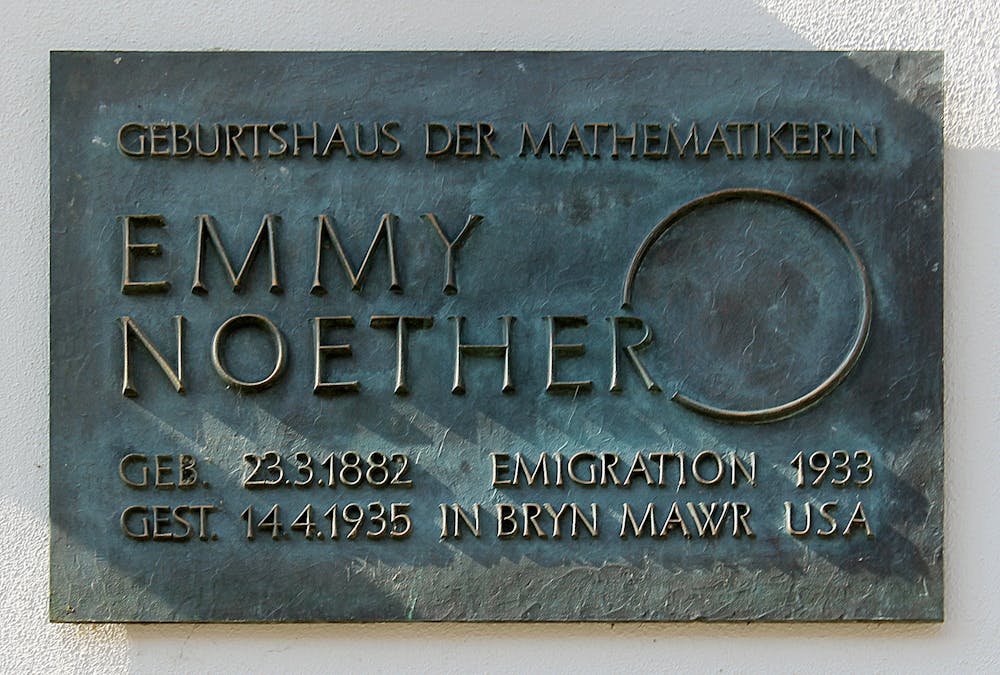 A plaque in her home town of Erlangen honors Emmy Noether and mentions her immigration to the U.S.
Norman Rönz/WikimediaCommons, CC BY-SA[28][29]
A plaque in her home town of Erlangen honors Emmy Noether and mentions her immigration to the U.S.
Norman Rönz/WikimediaCommons, CC BY-SA[28][29]
Escape from Nazi Germany
Noether published her famous ring theory paper and other important results in mathematics[30] while she was a lecturer in Göttingen from 1919 to 1933. But in the spring of 1933, the University of Göttingen received a telegram: Six faculty members – including Noether – had to stop teaching immediately[31]. The Nazis had passed a law barring Jews from professorship.
Noether’s response, it seems, was calm. “This thing is much less terrible for me than it is for many others,” she wrote[32] in a letter to a fellow mathematician. But she was out of a job, and no university in Germany could hire her.
Help came from the United States. Bryn Mawr, a women’s college in Pennsylvania, offered Noether a professorship[33] through a special fund for refugee German scholars[34]. Noether accepted the offer and, as a professor at Bryn Mawr, she mentored four younger women[35] – one doctoral student and three postdoctoral researchers – in advanced mathematics.
Noether’s time at Bryn Mawr was, tragically, short. In 1935 she had surgery to remove a tumor and died unexpectedly[36] four days later.
At Noether’s funeral, mathematician Hermann Weyl compared her sudden passing to “the echo of a thunderclap[37].” In her short life, Noether shook up mathematics. She kept teaching and learning even when women and Jews were not welcome. One hundred years later, her mathematical genius and “unbreakable optimism[38]” are qualities to admire.
[Understand new developments in science, health and technology, each week. Subscribe to The Conversation’s science newsletter[39].]
References
- ^ Albert Einstein wrote an obituary (www.nytimes.com)
- ^ creative mathematical genius (mathshistory.st-andrews.ac.uk)
- ^ landmark paper (doi.org)
- ^ like me (www.math.rutgers.edu)
- ^ Even though I (sites.math.rutgers.edu)
- ^ Mathematical Assoc, iabutit onat ofth Aatme triimcae, v ia WikimediaCommons (commons.wikimedia.org)
- ^ Erlangen, Germany (mathshistory.st-andrews.ac.uk)
- ^ could only audit them (doi.org)
- ^ out of the question (doi.org)
- ^ let women enroll (doi.org)
- ^ doctorate in mathematics there (mathshistory.st-andrews.ac.uk)
- ^ not allowed to teach (doi.org)
- ^ unofficially supervising doctoral students (doi.org)
- ^ University of Göttingen (theconversation.com)
- ^ he wrote (doi.org)
- ^ would not give the university permission (doi.org)
- ^ under the name of a male faculty member (mathshistory.st-andrews.ac.uk)
- ^ important contributions (mathshistory.st-andrews.ac.uk)
- ^ granted her lecturer status (doi.org)
- ^ Daniel Schwen/WikimediaCommons (commons.wikimedia.org)
- ^ CC BY-SA (creativecommons.org)
- ^ discoveries in ring theory (doi.org)
- ^ still pondering (bookstore.ams.org)
- ^ these rings (www.wiley.com)
- ^ abstract objects (www.wiley.com)
- ^ whole class of easy-to-identify rings (arxiv.org)
- ^ all the time in modern mathematics (arxiv.org)
- ^ Norman Rönz/WikimediaCommons (commons.wikimedia.org)
- ^ CC BY-SA (creativecommons.org)
- ^ important results in mathematics (mathshistory.st-andrews.ac.uk)
- ^ stop teaching immediately (doi.org)
- ^ she wrote (mathshistory.st-andrews.ac.uk)
- ^ offered Noether a professorship (doi.org)
- ^ special fund for refugee German scholars (archives.nypl.org)
- ^ four younger women (doi.org)
- ^ died unexpectedly (mathshistory.st-andrews.ac.uk)
- ^ the echo of a thunderclap (mathshistory.st-andrews.ac.uk)
- ^ unbreakable optimism (doi.org)
- ^ Subscribe to The Conversation’s science newsletter (theconversation.com)













