Beyond Your Phone: The Growing World of Artificial Intelligence
- Written by: The Times

Artificial intelligence has quickly become part of everyday life. Many Australians already use AI without giving it much thought, whether it is helping to write an email, summarise a document, search the internet or organise a calendar.
For millions of people, AI arrives automatically. Android phones include Google's Gemini, iPhones increasingly feature Apple Intelligence and Siri, Windows computers offer Microsoft Copilot, and many Apple computers include built-in AI features.
What many people do not realise is that these are only the beginning.
A growing number of independent AI services are available through a web browser or a dedicated app, giving consumers the freedom to choose the assistant that best matches their needs rather than relying solely on the software bundled with their device.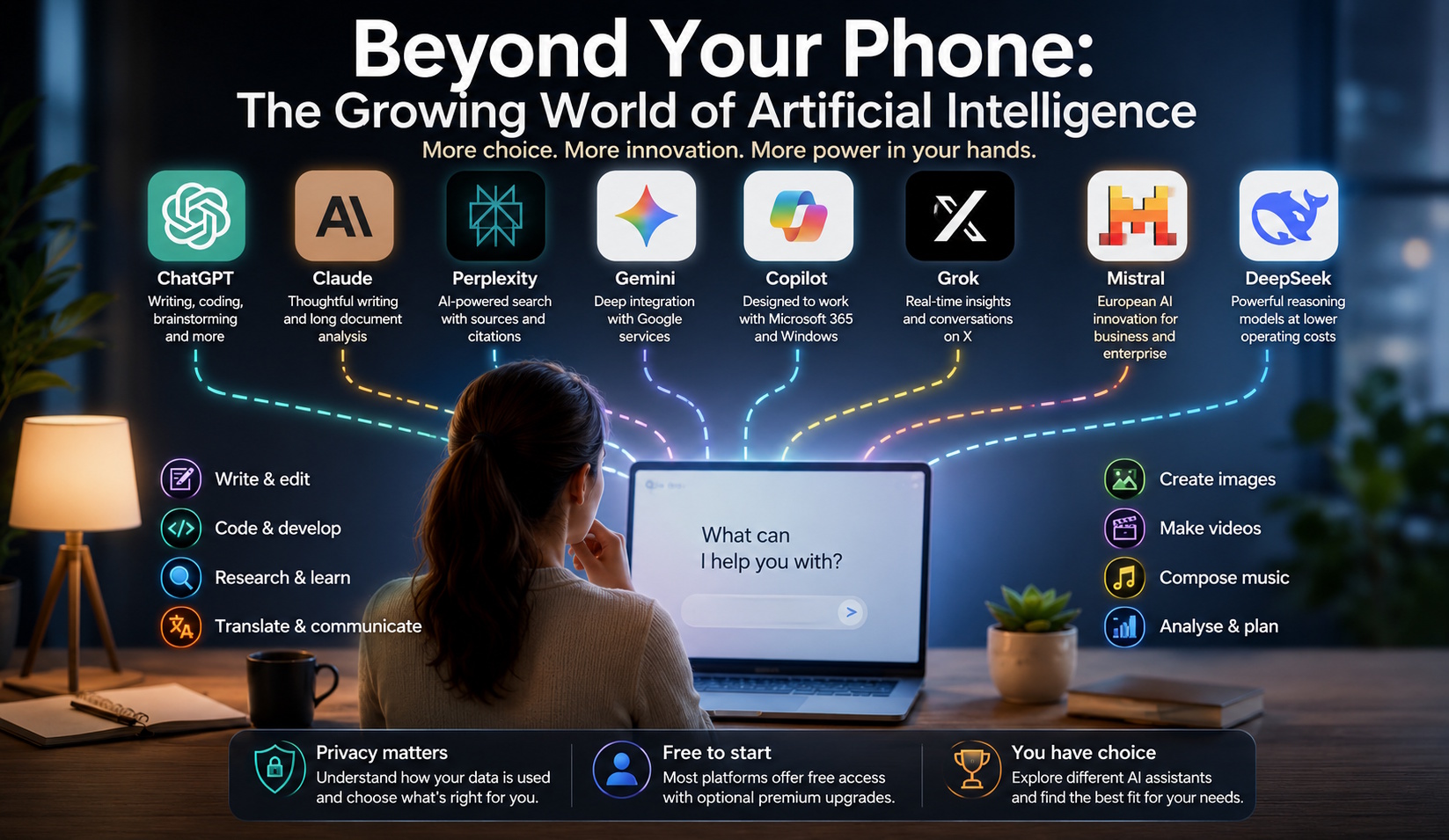
More Choice Than Ever
Just as internet users can choose between Chrome, Safari, Firefox or Edge, today's AI users can choose from a range of competing platforms.
Each has developed its own strengths.
ChatGPT has become one of the world's most widely recognised AI assistants. It is used for writing, explaining complex topics, programming, brainstorming ideas, language learning and everyday questions.
Claude has earned a reputation for thoughtful writing and analysing lengthy reports, making it popular among professionals, researchers and businesses.
Perplexity approaches AI differently by combining conversational answers with internet searches and source citations. For many users it serves as an intelligent research assistant rather than simply a chatbot.
Gemini integrates closely with Google's search engine, Gmail, Maps and Android ecosystem, making it convenient for people already using Google's services.
Microsoft Copilot is designed to work alongside Word, Excel, Outlook and other Microsoft applications, helping businesses automate routine tasks.
Grok, developed for users of the X platform, focuses heavily on current discussions and real-time information.
Mistral, based in Europe, has attracted attention for its enterprise products and commitment to developing advanced AI models outside the United States.
DeepSeek, developed in China, has surprised many industry observers by producing powerful reasoning models while keeping operating costs comparatively low.
Different Tools for Different Jobs
No single AI platform is the best at everything.
Some excel at creative writing.
Others specialise in programming.
Some are designed to search the web efficiently.
Others focus on analysing documents, creating images or assisting businesses.
The best choice often depends less on which company built the software and more on what the user hopes to achieve.
Free or Paid?
Most major AI platforms offer free access, allowing users to explore their capabilities before deciding whether additional features are worthwhile.
Paid subscriptions generally provide access to more advanced models, faster responses, higher usage limits and premium features aimed at professional users.
For many Australians, however, the free versions already provide enough capability for everyday use.
Privacy Matters
As AI becomes more common, privacy is becoming increasingly important.
Each provider has its own policies covering how conversations are stored, whether information may be used to improve future models and what controls users have over their data.
Businesses handling confidential information should understand those policies before uploading sensitive documents.
Competition Benefits Everyone
Perhaps the most significant development is not which AI is currently the most capable.
It is that genuine competition now exists.
Technology companies are investing billions of dollars to improve speed, reasoning, creativity and accuracy. As competition intensifies, users gain access to better products, lower prices and a wider range of specialised tools.
Only a few years ago, artificial intelligence seemed like a technology for researchers and software engineers.
Today it is becoming as common as web browsers, email and search engines.
Consumers are no longer limited to the AI that comes with their phone or computer. They have the freedom to explore a growing marketplace of digital assistants designed for education, business, creativity and everyday life.
The Times View
Artificial intelligence is moving beyond being a built-in feature of smartphones and computers. It is becoming a competitive marketplace where consumers can choose the assistant that best suits their needs. As more companies compete to build better AI, the greatest beneficiary is likely to be the user, who gains more choice, stronger capabilities and greater value than ever before.