Diplomacy wins out as Australia and the EU sign a free trade agreement
- Written by: Philomena Murray, Professor, School of Social and Political Sciences, The University of Melbourne
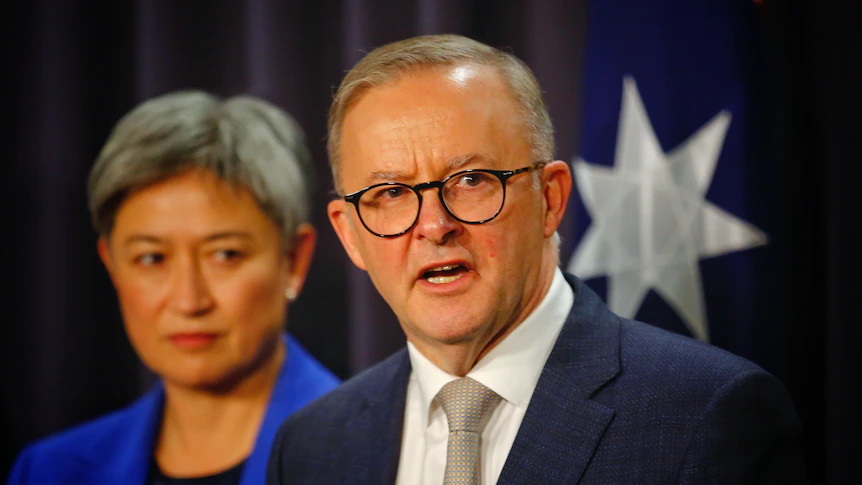
After an often acrimonious relationship over more than half a century, Australia and the European Union have signed a Free Trade Agreement[1] (FTA).During a visit to Canberra by European Commission President Ursula von der Leyen, the FTA has come to fruition after many years of negotiations and stalled talks. It marks a major step forward in economic relations between Australia and the EU, a market of 450 million people.
Such an agreement had not always been on the cards with Australia’s key trading partner, as pointed out by Prime Minister Anthony Albanese in his welcome to von der Leyen.
Rather, there were decades during which the possibility of a free trade agreement would have been considered unattainable. Although much of the friction between Australia and the EU was about access for agricultural goods to the EU single market[2], particularly beef and lamb, there was also considerable antipathy expressed by many Australian politicians to the EU. This was based in part on the fact the EU was considered protectionist and counter to Australia’s interests.
A narrow view
This antipathy, coupled with a lack of understanding of the benefits for Australia of the single market, was also due to the overreliance of Australian officials and politicians on certain British Eurosceptic views towards the EU.
This tended to render Australia’s understanding of the EU somewhat skewed, given the United Kingdom had long been an awkward partner in the EU and often out of step with some of its objectives[3].
British prime ministers such as Margaret Thatcher recognised the need for the EU’s single market of goods, services, capital and labour. But there was a reluctance to perceive the EU as in any way a community of social policies and political initiatives. This determination to view the EU as a protectionist economic bloc was also evident in Australian official thinking for some years.
This narrow view of the EU as an economic bloc only, and a protectionist one at that, yielded few tangible benefits for Australia. In fact, it was not uncommon for Australian leaders to attack the EU’s protectionist common agricultural policy[4], while not fully appreciating other aspects of its role and the economic and political heft the EU had. This meant Australia failed to identify areas where it might engage with the EU for some decades.
Increasingly, however, especially from the 1990s, Australia developed an incremental appreciation of the benefits of access to EU markets. Canberra began to negotiate a range of agreements that were beneficial to both Australia and the EU.
The first agreement the EU signed on science and technology was with Australia. This recognised Australia’s excellence in these areas, particularly but not exclusively in medical research. This was followed by mutual recognition agreements[5] and wine agreements[6], among others. At the same time, Australian policy makers recognised that trade policy for all 27 member states of the EU is initiated and negotiated by the European Commission in Brussels.
Fixing the ‘missing link’
By the time the UK’s Brexit referendum came about in 2016, Australia had developed a multi-policy and all-of-government approach to the EU. This culminated in the coming into force of a framework agreement[7] that was broad and deep, covering many policies. Yet, what remained to be enacted was an agreement on free trade. Indeed, many politicians in Australia regarded the lack of an FTA with Europe as a “missing link”.
For its part, the EU was keen to deepen its relationship with an important partner in the Asia-Pacific and to complete an FTA with Australia. This would complement agreements it had with Japan, South Korea and many ASEAN states.
Formal negotiations between Australia and the EU commenced in June 2018. They stalled in October 2023, in large part due to Australia’s concern that it was not being allocated adequate beef access to the lucrative EU market.
Yet these suspended talks were revived in 2025 in the context of the Trump administration’s imposition of tariffs across the globe. The unpredictable nature of the Trump administration’s use of tariffs on global trade opened the way for Australia and the EU to recommence trade negotiations.
Australia no longer relies on the UK as its principal market within Europe. Germany, France and Italy, especially, have became more important across a range of policy areas.
Australia enhanced a strategy of engaging with the 27 national capitals as well as the EU institutions, mainly based in Brussels. Increasingly, Australian diplomacy involves gaining access to EU decision-making at different entry points across these institutions.
There has also been enhanced security cooperation between Australia and Europe, cooperating in response to US President Donald Trump’s handling of NATO and its allies. Australia’s decades-long security dialogue with the EU will be further enhanced by a security and defence cooperation agreement[8]. This partnership strengthens cooperation on intelligence, cybersecurity, crisis management and critical minerals, among others.
Engagement will continue to deepen
The United States under Trump is no longer committed to multilateralism, including the United Nations. Australia and the EU have repeatedly reiterated their commitment to multilateralism and, with other like-minded countries and regional bodies, will continue to call for adherence to it.
The relationship between Australia and the EU certainly has come a long way. The rancour of the past is no longer a key feature of the relationship. It is likely there may be tensions regarding priorities and interests in the future. Yet each side agrees on the need to continue to engage with each other as “like-minded partner and trusted friend”, as von der Leyen put it[9]. The FTA represents a significant step in the further consolidation of collaborative ties between Australia and the EU.
References
- ^ Free Trade Agreement (www.pm.gov.au)
- ^ EU single market (single-market-economy.ec.europa.eu)
- ^ out of step with some of its objectives (openresearch.surrey.ac.uk)
- ^ common agricultural policy (agriculture.ec.europa.eu)
- ^ mutual recognition agreements (single-market-economy.ec.europa.eu)
- ^ wine agreements (ec.europa.eu)
- ^ framework agreement (www.dfat.gov.au)
- ^ security and defence cooperation agreement (ec.europa.eu)
- ^ von der Leyen put it (www.pm.gov.au)