Russia wanted a new world order. This wasn’t the one it had in mind
- Written by: Mark Edele, Hansen Professor in History, The University of Melbourne
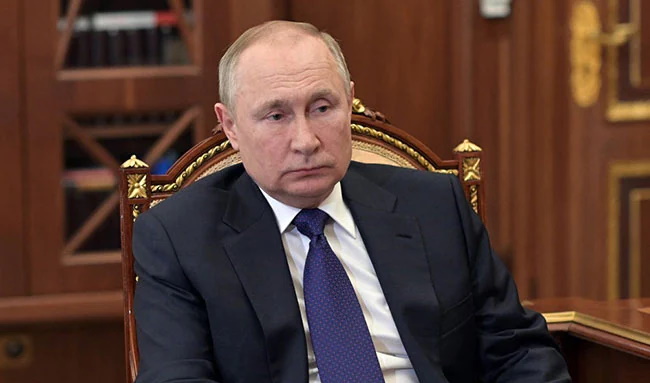
Four years ago, Vladimir Putin escalated his war against Ukraine[1] to an all-out assault. The plan was for a quick and lively campaign and a speedy takeover of a country the Russian president thought[2] shouldn’t exist.
Victory would reassert Russia’s status and hasten a shift from a unipolar to a multipolar world; instead of one great power (the United States), we’d have several. Russia would, of course, become one of the “greats”.
So, how’d that go?
Four years on, Russia has not found itself among fellow great powers willing to divide up the globe.
A middle power despite its great power cravings, Russia has instead been forced into a growing dependence on China while having to deal with a multitude of hostile middle powers, which often thwart its ambitions.
A greater failure is hard to imagine.
Careful what you wish for
In recent days, Russia had to watch on helplessly as the US and Israel – following Russia’s playbook – ignored international law[3] and attacked Iran, a close Russian ally[4].
When Iran’s foreign minister asked[5] his Russian counterpart for help, Sergei Lavrov sounded[6] more like a European politician than an advocate for a new world order.
He condemned[7] the “unprovoked act of armed aggression […] in direct violation of the fundamental principles and norms of international law”. He called for a “peaceful solution based in international law, mutual respect and a balanced consideration of interests”.
As The Guardian put it, Russia has found out[8] a
rejection of the old rules of geopolitics have not necessarily played into its favour.
Russia underestimated the extent to which the old order gave it room to manoeuvre. Then, as long as others played by the rules, breaking them could give Russia a tactical advantage.
But once others also opted for raw power, the limits of Russia’s abilities became obvious.
Reality checks
The first reality check came on the battlefield.
Russia lost the battle of Kyiv, had to retreat from much of what it had occupied in the north of Ukraine, and was forced into a grinding war of attrition in the east.
Ukraine lost big swathes of territory[9] in the south, which allowed Russia to establish a land bridge between Donbas and Crimea (which it illegally occupied in 2014).
But Ukraine’s government retained control of 80%[10] of its territory. It also held onto its use of the Black Sea[11], a vital link to world markets.
Unable to advance meaningfully on the ground, Russia tried a criminal air war targeting civilian infrastructure, hoping to freeze Ukraine into submission.
Such tactics rarely work[12], but do cause untold misery and suffering for civilians.
Meanwhile, Ukraine is fending off Russia’s attempt to enforce Ukraine’s capitulation at the negotiating table[13].
Being a great power isn’t cheap
All Russia’s efforts are complicated by the emerging multipolar world order[14] it had so desperately hoped to conjure into being.
Ukraine has been supported by a coalition of middle powers that are slowly finding their feet[15] in this new reality.
Russia has discovered the hard way that its geopolitical fantasy of being a great power in this new multipolar world order comes with one tiny problem: it can’t afford it[16].
Its population is both declining and ageing. Its GDP[17] (adjusted to purchasing power) is in the same ballpark as that of Japan or Germany (rather than the much larger India, to say nothing of the US or China).
And its economy is dominated by hydrocarbon exports destined for a bleak future in a quickly decarbonising[18] world.
As one of the most consequential middle powers[19] of the Euro-Asian landmass, with a permanent seat on the UN Security Council, and a sizeable military armed with nuclear weapons, it could cause significant damage trying to assert its desired great power status.
But the results were opposite to intentions.
From bad to worse
Unable to subdue Ukraine, Russia’s power projection suffered elsewhere. Its once-close relationship with Israel[20] is on the rocks. It lost its foothold in Syria and has proved unable to support its allies in Iran and Venezuela.
In a lawless international order, it is too inconsequential to dictate the play.
While US President Donald Trump at times treats Putin as an equal[21], nobody else does.
True, China has celebrated a “no-limits partnership[22]” with Russia, its biggest neighbour.
But it neither took clear sides in Russia’s Ukraine war, nor sent weapons. Instead, Beijing used Russia’s isolation to cement a relationship in which it clearly has the upper hand.
India[23] increased its purchase of Russian oil (now at a steep discount) and continued to buy Russian weapons, but as part of a multi-vector geopolitical strategy.
Rather than a fellow great power, India saw Russia as an opportunity to be exploited in its ongoing quest for an autonomous foreign policy[24].
Fantasy and reality
Ukraine, meanwhile, lost the clear support from the US it had enjoyed at the start of the war, but has been supported financially and militarily by a flexible coalition of middle powers.
According to the latest data[25], the nearly US$75 billion (A$105 billion) in military aid the US has provided since the start of the war has amounted to only 30% of the total tally.
The remaining 70%, and all ongoing military support in the past 12 months, came from middle and smaller powers, led by Germany (20%), the United Kingdom (9%), Norway (8%) and Sweden (7%).
Thus, Russia’s war on Ukraine did hasten the emergence of a multipolar world.
It just wasn’t the one Russia had in mind.
References
- ^ war against Ukraine (www.simonandschuster.com.au)
- ^ thought (en.kremlin.ru)
- ^ ignored international law (theconversation.com)
- ^ close Russian ally (theconversation.com)
- ^ asked (mid.ru)
- ^ sounded (mid.ru)
- ^ condemned (mid.ru)
- ^ found out (www.theguardian.com)
- ^ territory (www.bbc.com)
- ^ 80% (www.aljazeera.com)
- ^ Black Sea (www.navalnews.com)
- ^ rarely work (theconversation.com)
- ^ negotiating table (www.bbc.com)
- ^ world order (insidestory.org.au)
- ^ finding their feet (www.weforum.org)
- ^ can’t afford it (www.lowyinstitute.org)
- ^ GDP (data.worldbank.org)
- ^ decarbonising (iea.blob.core.windows.net)
- ^ middle powers (power.lowyinstitute.org)
- ^ Israel (www.internationalaffairs.org.au)
- ^ as an equal (theconversation.com)
- ^ no-limits partnership (www.cna.org)
- ^ India (www.csis.org)
- ^ autonomous foreign policy (asialink.unimelb.edu.au)
- ^ latest data (www.kielinstitut.de)
Read more https://theconversation.com/russia-wanted-a-new-world-order-this-wasnt-the-one-it-had-in-mind-277195