Labor is set for a big win in the South Australian election. But will One Nation cause ructions?
- Written by: Rob Manwaring, Associate Professor, Politics and Public Policy, Flinders University
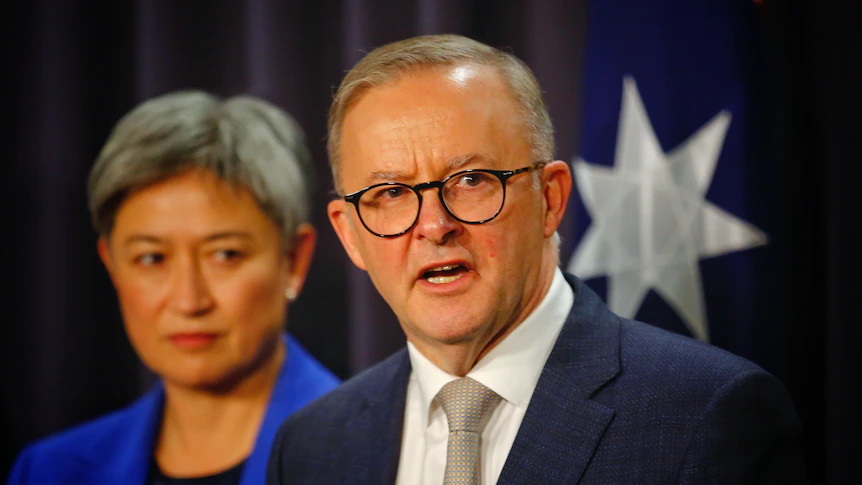
South Australians head to the polls on March 21, with Premier Peter Malinauskas’s Labor Party on track to win by a landslide[1].
But while a predicted landslide in a state election would not normally garner deep national attention, the SA election will be closely watched this time as a microcosm of the changing dynamics of Australian politics.
The headline two-party preferred figure of 61–39%[2] in favour of Labor is masking the broader splintering of the right side of politics. The Liberals are haemorrhaging votes to One Nation, which leads them on the primary vote by 20–19%.
Liberal woes
While the federal Liberals are suffering from leadership and coalition instability, the SA branch has its own systemic problems. The state Liberals have been a party of almost perpetual opposition, only forming government when Labor is plagued by scandal and longevity in office. The Liberals have only won five elections out of 17 since 1965.
SA does not have a coalition, as the Liberal and Country parties merged in 1932. There has been only sporadic Nationals representation in parliament, with the most recent Nationals MP, Karlene Maywald, controversially serving in the Rann Labor Cabinet[3] from 2004–10.
Geography is a major contributor to Liberal electoral woes, with much of their vote traditionally being concentrated in rural and regional seats. One Nation is running candidates in all lower house seats, and would be most hopeful of picking up some of the more regional Liberal seats, such Hammond[4]. Six of the Liberals’ 13 current seats might be under threat, along with two or three of the crossbench seats such as Mount Gambier[5].
More pointedly, the party has also long been bedevilled by factional infighting[6] and the regular defection of rural members to the crossbench. These rural defectors have demonstrated an ability to “dig in” across usually safe Liberal seats. Rural and regional MPs disproportionately dominate the Liberal caucus, which skews its ability to appeal to more metropolitan seats.
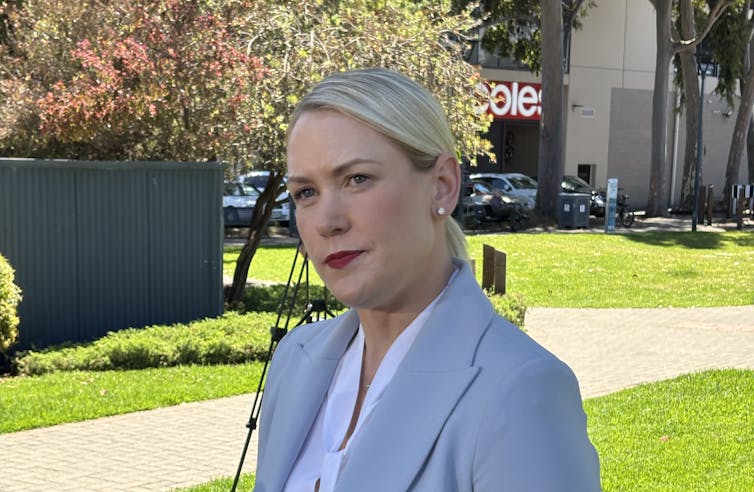
The Liberals are suffering from leadership churn. Liberal leader Ashton Hurn[7], who was a media advisor to former Liberal Premier Steven Marshall, took over from Vincent Tarzia in December 2025. Tarzia had only served as leader since August 2024, having taken over from David Speirs, who was convicted[8] for supplying a controlled substance.
Under this tumult, Labor consolidated its lead by picking up two crucial byelection wins[9] in Dunstan and Black. The Liberals currently hold a nominal 13 of the 47 seats in the lower House – a record low. Current polling indicates[10] they will lose more seats at the March election, and there is even a chance they will be left without a single lower house MP.
One Nation and the far right in SA
One Nation is a late entrant to SA politics, and has only elected one member, Sarah Game, to the Legislative Council in 2022. One Nation has historically been organisationally weak in the state – it even failed to register its candidates in time for the 2018 state election. Game subsequently resigned from the party[11] in late 2025, following a preselection dispute with Hanson – a common occurrence in One Nation’s history.
Hanson recently announced former senator Cory Bernardi[12] would head the party’s upper house ticket in 2026.
Bernardi served as a Liberal senator for SA in 2006–17, before forming the short-lived Australian Conservatives party between 2017–19. Sharing a similar Christian Conservative values base, the party merged with the pre-existing Family First party – a morality-focused conservative party with an enduring presence in SA politics.
Bernardi is a polarising figure with lower popularity in the state than Hanson. So there is a question about whether his conservative credentials will add to One Nation’s electoral support.
One Nation’s prospects
The election campaign to date has been relatively uncontroversial, despite lingering issues of ambulance ramping, the algal bloom and the cancellation of the Adelaide Writer’s Week[13] being potential weaknesses for the government. Malinauskas and Labor have been emphasising their “building” credentials, pointing to major infrastructure projects such as the North-South Corridor, and promising significant urban expansion.
Campaign activity has tended to be focused in Liberal-held seats. These range from urban marginals such as Morialta, Unley and Colton to usually more secure regional areas such as Ngadjuri, Hammond and Kavel, which are being encroached on by Adelaide’s urban sprawl.
The Liberals are struggling to offer a policy narrative. For example, there is confusion over their signature stamp duty policy[14], which has changed in the switch from Tarzia to Hurn.
The electoral conditions seem ideal for a One Nation surge. However, there are reasons to temper expectations. One Nation tends to poll most strongly in rural seats. Several rural electorates in SA already have independent incumbents, or high-profile independent candidates who have been in the field for months. This may complicate One Nation’s path to victory in these areas.
Crisis on the centre-right
The Malinauskas government is poised for an emphatic win on election night. Yet, the foundations of the results are grounded less in Labor’s policy record than in the deepening crisis of the centre-right in Australia.
In common with countries such as the United Kingdom, France, Sweden and Germany, there is a growing fragmentation of the right. A recent academic study[15] of state politics shows how these dynamics play out in very specific and localised ways in Australia.
At the heart of this is an ideological splintering, with a more assertive conservative politics increasingly at odds with the more socially liberal but economically classical traditions. The SA result may offer insight into how deep this fracture is.
References
- ^ landslide (theconversation.com)
- ^ 61–39% (www.abc.net.au)
- ^ Rann Labor Cabinet (www.smh.com.au)
- ^ Hammond (en.wikipedia.org)
- ^ Mount Gambier (en.wikipedia.org)
- ^ factional infighting (www.abc.net.au)
- ^ Ashton Hurn (www.indailysa.com.au)
- ^ convicted (www.abc.net.au)
- ^ byelection wins (antonygreen.com.au)
- ^ indicates (theconversation.com)
- ^ resigned from the party (www.abc.net.au)
- ^ Cory Bernardi (www.abc.net.au)
- ^ Adelaide Writer’s Week (www.theguardian.com)
- ^ signature stamp duty policy (www.abc.net.au)
- ^ academic study (link.springer.com)