Albanese will pitch to blue collar men with heavy warnings on Dutton’s workplace policies
- Written by: Michelle Grattan, Professorial Fellow, University of Canberra
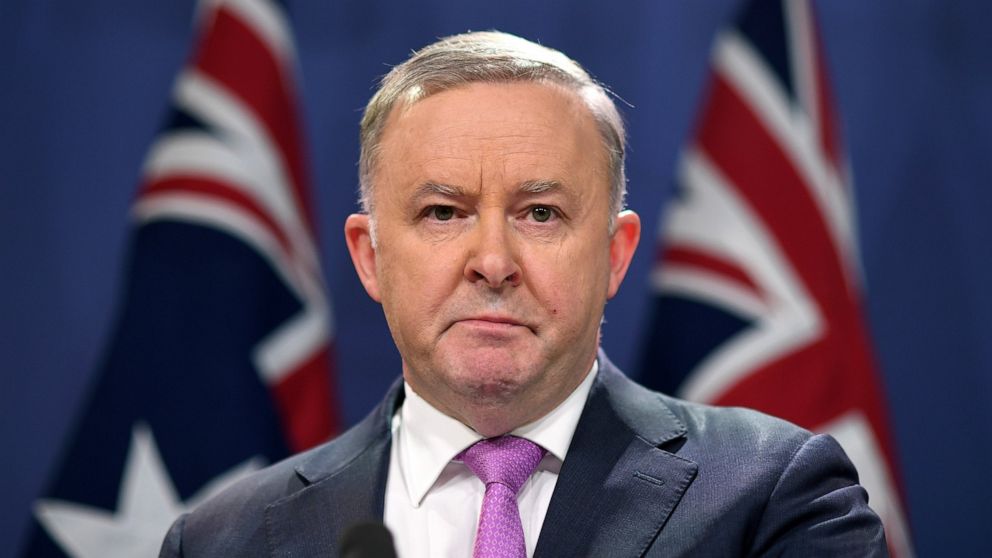
Prime Minister Anthony Albanese in conversation with Michelle Grattan.
Anthony Albanese has outlined his pitch to improve his and his government’s standing among men, as he insists he can hold onto majority government at the election to be held in April or May.
In a wide-ranging interview on The Conversation’s Politics podcast[1], canvassing both his plans and current issues, the prime minister addresses the gender voter gap the polls have been showing, which is worrying Labor strategists[2].
On a two-party basis, a December Essential poll had the Coalition on 51% among men, and Labor on 44%, with 4% undecided. Among women, Labor was on 49% and the Coalition on 46%, with 5% undecided.
In a Resolve poll on preferred prime minister, Peter Dutton polled 40% among men, and Albanese 34%. Among women, Albanese was on 36% and Dutton on 31%.
Albanese tells the podcast: “One of the things that we will be really campaigning very hard on is the impact on blue collar workers of the Coalition promises to get rid of same job, same pay [law], the definition of casual in employment [and] their plan to essentially go back to wages going backwards, not forwards.”
Targeting younger voters
As Labor crafts its election policy, Albanese also flags he is looking to do more for young people.
Asked who he feels is being “left behind” in Australia at the moment, he points to the issue of “intergenerational equity”.
“I think that young people feel like they’ve got the rough end of the pineapple compared with previous generations,” he says. This is “something I’m really conscious of”.
Outlining what the government has done or announced already on student debt, housing supply, schools, the universities accord and free TAFE, he suggests there will be further policies targeted towards younger voters.
The likeliest election dates
Albanese confirms he has not locked in an election date. “We make decisions when we finalise them and I’ll consult,” he says.
“But I’ve always said […] one of the problems with three year terms is that they are too short.”
The speculation is the election will be either April 12, or one of the first three Saturdays in May, with May 17 the last practical date.
April 12 would mean scrapping the scheduled March 25 budget. “We certainly are working to hand down a budget in March,” Albanese says. “The ERC [Expenditure Review Committee] will be meeting this week, as it met last week.”
Asked whether he is confident he could still deliver his program if the election resulted in a minority Labor government, Albanese says: “I’m confident that we can achieve an ongoing majority government at this election. I think there are seats that we currently hold that we have good prospects in.”
He names two Victorian Liberal seats he had just visited – Menzies and Deakin – among those he believes Labor can win from the Coalition. (After the redistribution, Menzies is notionally a Labor seat by a tiny margin.)
Watching for a rate cut and trade wars
Asked when Australia might come out of the present per capital recession, Albanese says things are “heading in a positive direction”, but does not nominate a time.
He sounds confident about interest rates falling soon:
All of the economic commentators are saying that that is the most likely prediction of markets. It’s not up to me as prime minister to tell the independent Reserve Bank what to do, but I’m certain that we have created the conditions through, as well as our responsible economic management, producing two budget surpluses – the massive turnaround that we have seen, compared with what the Morrison 2022 budget handed down by the Coalition […] was predicting.
Prompted about the Reserve Bank’s next meeting on February 18, he says “I’m certainly conscious of that date”.
With United States President Donald Trump slapping tariffs on Canada, Mexico and China[3] while foreshadowing wider tariffs, Albanese recalls his phone conversation after Trump was elected, in which he reminded the incoming president that America has a trade surplus with Australia. Australia would “put our arguments forward very clearly” if it faced the threat of tariffs, Albanese says.
Looking ahead
Looking ahead to this fortnight’s parliamentary sitting, Albanese confirmed to The Conversation[4] that he will not proceed with the Nature Positive legislation. It had been strongly opposed by the Western Australian government, which has its election on March 8.
But he hopes the Senate will pass the legislation for political donation and spending caps, indicating the government is willing to compromise[5] to get the bill through.
Looking to a second term, Albanese highlights in particular the opportunities presented by the energy transition.
“We are positioned better than anywhere else in the world to benefit, in my view, from this transition that’s occurring.”
He contrasts Dutton’s energy plan, which he describes as a “myopic vision” to make Australia smaller.
“I want Australia to be more successful, to be enlarged in our optimism and our vision. And I want to lead a government that does that.”
References
- ^ The Conversation’s Politics podcast (theconversation.com)
- ^ worrying Labor strategists (theconversation.com)
- ^ tariffs on Canada, Mexico and China (theconversation.com)
- ^ confirmed to The Conversation (theconversation.com)
- ^ willing to compromise (theconversation.com)