
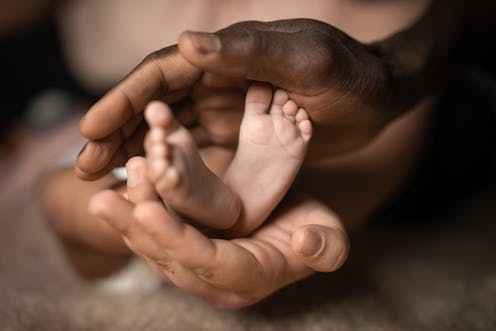
Babies infected with syphilis are part of a growing tragedy – one that could be easily prevented
- Written by Skye McGregor, Epidemiologist, The Kirby Institute, UNSW Sydney
Data just published online[1] shows a worrying increase in infectious syphilis cases in women living in Australia aged 15–44 (referred to as “reproductive age”) and a subsequent rise in transmission from pregnant parent to child. This is called congenital syphilis[2].
Congenital syphilis is easily prevented through timely testing and treatment of syphilis during pregnancy. Left untreated, congenital syphilis can have devastating outcomes[3] in more than 50% of cases including miscarriage, stillbirth, neonatal death and permanent disability.
We reviewed all cases of congenital syphilis in Australia between 2011 and 2021 and found tragically 25% were stillborn. For the birthing parent of babies with congenital syphilis, we found less than 40% were tested for syphilis in pregnancy. Nearly half had no record of receiving any antenatal care.
Experts have been aware of the resurgence of syphilis in Australia[4] for some time. But ours is the first analysis that reveals significant gaps in antenatal care, leading to devastating outcomes.
Syphilis cases have been rising for a decade
Between 2011 and 2021, the rate of infectious syphilis[5] rose by more than 500% in women aged 15–44 years, from 141 in 2011 to 902 in 2021. This reflects an increase more broadly among young people[6].
Prior to 2011, infectious syphilis was rare. When cases began to rise, it was initially in men with male sexual partners in metropolitan areas, and young heterosexual people in remote Aboriginal and Torres Strait Islander communities. Health departments increased testing and initiated public health campaigns to decrease transmission.
Despite these efforts, syphilis cases have continued to rise[7], and the initial outbreaks have expanded across Australia. There has been significant investment by federal, state and territory governments to enhance syphilis detection and treatment including community-based screening, mass media campaigns, health workforce education, and rapid test results through point-of-care testing[8].
Cases of congenital syphilis have also been steadily rising in Australia, mirroring international trends[9].
Between 2011 and 2019 there was a median of four congenital syphilis cases per year[10] in Australia, increasing to 17 cases in 2020, and 15 in 2021 and 2022. There were 20 cases reported in 2023.
These numbers might seem small. But without action, this upward trend will lead to more deaths and permanent disability in babies with congenital syphilis – a preventable disease.

What can we do about it?
It’s time for a direct focus on reducing syphilis transmissions, and particularly the impact of syphilis in pregnancy.
Testing during pregnancy range from one test at the first antenatal appointment to five tests throughout pregnancy, if the pregnant person is considered high risk or lives in an outbreak area in remote Australia. Recommendations are provided by state and territory health departments, and vary across Australia, but work is underway to make guidelines consistent.
But in many instances no screening is taking place at all.
Increases in infectious and congenital syphilis are likely associated with social social determinants of health[12] (the non-medical factors that influence health outcomes) including homelessness, unstable housing, poverty, domestic violence, mental illness, drug and alcohol use, cultural barriers or language, racism, and discrimination in health care.
Our study[13] found Aboriginal and Torres Strait Islander women reported 35 times higher rates of syphilis than non-Indigenous women. This is likely due to the lasting effects of colonisation, along with structural barriers and access to health care.
To reverse the current trend of increasing numbers of babies with congenital syphilis we urgently need to:
explore accessible models of care for pregnant women wherever they engage with the health system
enhance partner testing and treatment
improve surveillance on testing in pregnancy.
 Syphilis tissue under the microscope.
Shutterstock[14]
Syphilis tissue under the microscope.
Shutterstock[14]
Not just medical check ups
For pregnant women, we need to ensure a holistic approach to care co-designed in partnership with affected communities. For Aboriginal and Torres Strait Islander women, this could include greater access to Birthing on Country programs[15].
The World Health Organization (WHO) also recommends partners are routinely tested for syphilis[16] to achieve elimination of congenital syphilis.
And we need better monitoring of syphilis testing during pregnancy. The WHO has set a global goal of elimination of congenital syphilis with a target of 95% of pregnant people tested for syphilis during pregnancy. Currently in Australia there is no way to know how close or far away we are from this goal.
Congenital syphilis is entirely preventable, and it is a tragedy any pregnancy results in this outcome.
The authors would like to acknowledge the contribution of Lorraine Anderson of Kimberley Aboriginal Medical Services, who provided guidance on the study on which this article is based.
References
- ^ just published online (doi.org)
- ^ congenital syphilis (www.cdc.gov)
- ^ devastating outcomes (www.ncbi.nlm.nih.gov)
- ^ aware of the resurgence of syphilis in Australia (www1.racgp.org.au)
- ^ rate of infectious syphilis (www1.racgp.org.au)
- ^ among young people (www.kirby.unsw.edu.au)
- ^ continued to rise (www.kirby.unsw.edu.au)
- ^ point-of-care testing (www1.health.gov.au)
- ^ international trends (www.bbc.com)
- ^ congenital syphilis cases per year (www.kirby.unsw.edu.au)
- ^ Shutterstock/fizkes (www.shutterstock.com)
- ^ associated with social social determinants of health (www.mdpi.com)
- ^ study (doi.org)
- ^ Shutterstock (www.shutterstock.com)
- ^ Birthing on Country programs (www.thelancet.com)
- ^ partners are routinely tested for syphilis (iris.who.int)