How do I make sure my child’s school backpack is safe and healthy?
- Written by: Sai Praneeth Jasti, Researcher, Deakin University
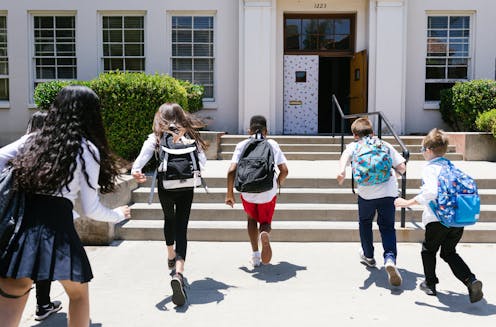
As a new school year approaches, many families will be heading to the shops or to their school’s uniform store to buy backpacks.
While children can have firm ideas about how their school bags look – and schools have practical requirements about what students need to carry – it is vitally important bags are also safe and healthy.
What does the research evidence tell us about school bags?
Why school bags matter
Students are often not just carrying books to and from school, but technology, sports and musical equipment as well. Studies have noted[1] problems occur when students carry bags that weigh more than 20% of their body weight.
This excessive weight can cause students to adopt a forward-leaning posture to compensate, leading to chronic back pain[2] and other postural deformities[3].
But it’s not just the weight alone, how students carry their bags is also important.
Slinging the bag over one shoulder can lead to an uneven distribution of weight, causing muscle imbalances and spinal misalignment. Some studies (such as this one from Brazil[4] and and this one from Malta[5]) suggest this is more common in female students, who are more likely to carry their bags this way.
If school bags do not have ergonomic features, this exacerbates the problem. Poorly designed straps, lack of adequate back support and improper weight distribution within the bag itself all contribute to the strain on a student’s back and shoulders.
A 2021 study conducted in Karachi[6] on primary school-aged students also showed heavy backpacks can lead to increased fatigue, harming the concentration of children in school.
So we need backpacks based on ergonomic principles, that cater to different body types and carrying habits.
What should you look for in a backpack?
Here are some research-based[9] tips for choosing a backpack for your child:
choose backpacks with wide, padded straps to distribute weight evenly across the shoulders, minimising the risk of strain and discomfort
look for other ergonomic features such as adjustable shoulder, hip and chest straps, along with back padding
ensure the backpack can be positioned high on the back, with the bottom aligned at waist level.
How should your children be carrying things to school?
Studies have shown[10] education about the right way to wear a backpack can reduce pain in school students. Once you have the right bag, also make sure your child is using it correctly:
check the backpack’s weight is no more than 10-15%[11] of the child’s body weight (you may need to monitor this as they take different things to and from school)
for heavy items such as musical instruments or sports equipment, choose alternative carrying options such as wheelie bags
try to ensure your child uses both shoulder straps to maintain balance and symmetrical posture (and do not carry bags on one shoulder or in one hand)
pack heavy items close to the body, as this helps maintain better posture by aligning the load with the body’s centre of gravity.
Read more: Back-to-school blues are normal, so how can you tell if it's something more serious?[12]
Schools can also help
Schools can also help this issue, by considering what students are required to take to and from school each day.
Perhaps this means more locker space at school or digital resources, so students aren’t having to carry textbooks around.
Parents and schools can also educate students about the proper way to pack and carry their bags.
Read more: Having ‘good’ posture doesn't prevent back pain, and 'bad' posture doesn't cause it[13]
References
- ^ noted (journals.lww.com)
- ^ back pain (www.nature.com)
- ^ postural deformities (journals.lww.com)
- ^ Brazil (scielo.pt)
- ^ Malta (journals.sagepub.com)
- ^ Karachi (archives.palarch.nl)
- ^ Mary Taylor/ Pexels (www.pexels.com)
- ^ CC BY (creativecommons.org)
- ^ research-based (www.sciencedirect.com)
- ^ have shown (www.nature.com)
- ^ 10-15% (jccponline.com)
- ^ Back-to-school blues are normal, so how can you tell if it's something more serious? (theconversation.com)
- ^ Having ‘good’ posture doesn't prevent back pain, and 'bad' posture doesn't cause it (theconversation.com)
Read more https://theconversation.com/how-do-i-make-sure-my-childs-school-backpack-is-safe-and-healthy-220654