Dunkley contest sees Albanese donning skates on cost of living as Morrison’s exit sets up Cook byelection
- Written by: Michelle Grattan, Professorial Fellow, University of Canberra
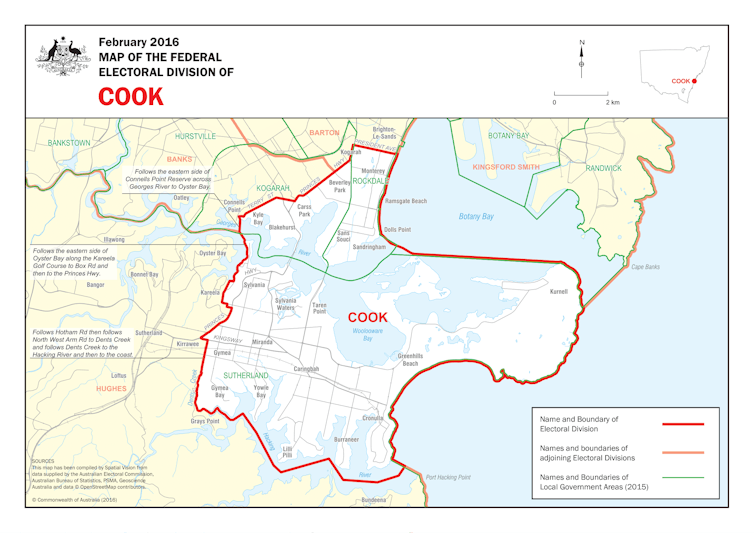
Just as government and opposition are contemplating the uncertainties they face in the byelection in the Melbourne seat of Dunkley, Scott Morrison’s Tuesday announcement he’ll quit parliament next month has set up a subsequent contest in the Sydney electorate of Cook.
Morrison said in his statement “now is the time to move on”. Some, if not many, of his colleagues wish he’d have done that a long time ago. The ABC Nemesis series on the Liberal years, starting next week, will reinforce the point.
The former PM said he would be “taking up a series of global strategic advisory and private boards, focused on the US and Indo-Pacific”, drawing on his “networks in the region, in particular through AUKUS and the Quad”.
Morrison’s resignation has been long anticipated; it was thought only to await satisfactory employment opportunities.
His Sydney seat is on a solid 12.4% margin. Morrison said he hoped there would be a strong field of candidates for preselection, and he looked forward to supporting whoever won in their local campaign.
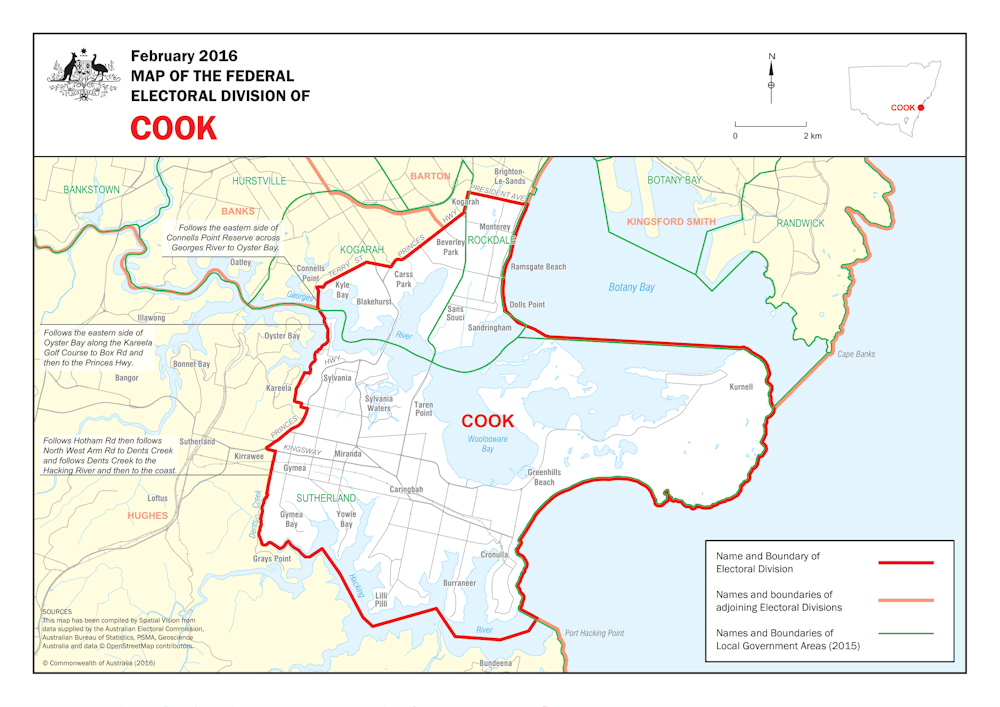
Cook pales in comparison with Dunkley, in political interest. It’s a shoo-in for the Liberals – the last time Labor won it was 1974.
In the normal course of events, we’d have expected Jim Chalmers’ third budget, in May, to have delivered the Albanese government’s cost-of-living relief package.
But the March 2 Dunkley contest, caused by the death of Labor’s popular Peta Murphy, has accelerated the timetable for addressing the issue that’s been undermining the government’s support.
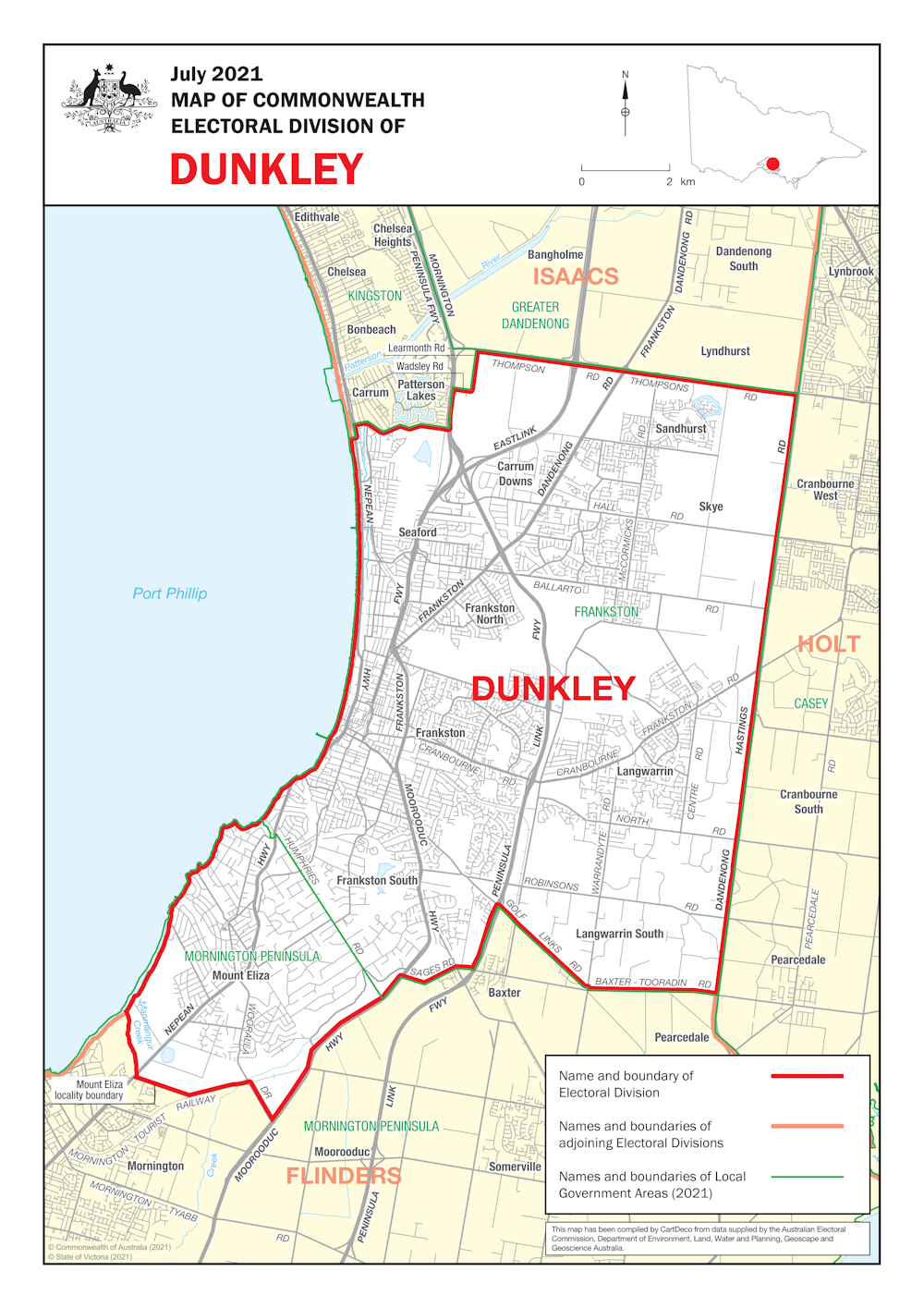 Map of the electoral division of Dunkley, Victoria.
AEC[2]
Map of the electoral division of Dunkley, Victoria.
AEC[2]
Anthony Albanese could not afford to delay action. He’s already been under fire for not paying enough attention to the issue. On the other hand, taking action carries its own risks.
The bayside electorate, based around Frankston in Melbourne’s south-east, sits on a 6.3% margin, giving Labor a solid but not impregnable buffer. In recent decades the seat has been held by both sides of politics. Murphy won it from the Liberals in 2019 and increased her margin in 2022.
It’s a seat of aspirational workers, rather than university-educated professionals – the sort of electorate that should indicate just how deeply rising living costs are biting politically.
More ambitiously for the Coalition, it can be seen as a seat to test Peter Dutton’s theory – aka hope – the Coalition might be able to reach power via the outer suburbs and the regions, without winning back “teal” seats.
Albanese is on a slim majority, 78 seats (including Dunkley) in the 151-member House of Representatives. His numbers – 77 after the 2022 election – were augmented by one with last year’s stellar victory in the Aston byelection, when Labor seized a seat from the opposition.
Losing Dunkley would have more implications than just forfeiting that gained number. It would reinforce the impression of late last year that the government was in trouble and suggest that trouble was more than just a short, mid-term slump.
Byelections can be important markers but are not necessarily pointers. Bill Shorten won a super-Saturday of 2018 byelections only to lose the 2019 general election. But they affect the political mood, boosting or depressing morale. When the Howard government, in a slump at the time, retained Aston at a 2001 byelection, it was the start of its fight back.
Albanese only has to hold Dunkley; any anti-government swing short of a loss can be explained away by resorting to one of several statistics relating to previous byelection swings.
ABC election analyst Antony Green notes there have been 52 byelections since the 1983 election of the Hawke government, 28 of them Labor-Coalition contests “The average anti-government swing for these byelections was 3.5%. Subdivided by party in power, the swing was 4.7% in 17 contests during Labor governments, and 2.3% in 11 contests with the Coalition in office.”
To achieve a respectable result Dutton would need to run Dunkley extremely close, given his claims about public disillusionment with Labor about the cost of living. A minimal swing or a swing against the Liberals would be a serious setback for the opposition leader, although not a threat to his leadership given there is no credible alternative.
To get momentum from the byelection Dutton would need to win it.
Dutton is hampered by the contest being in Victoria where he is unpopular and the Liberals generally are extremely weak.
The Liberals have avoided the mistake they made in Aston last year of parachuting in an outsider, who was well-qualified on paper but not “one of us” as far as local voters went.
Their candidate, Nathan Conroy, 31, who was brought up in Ireland (and retains his brogue) is the mayor of Frankston, which gives him name recognition. He is a highly active campaigner, but has clashed with some residents, such as the well-known Tim Costello, for his support for high-rise development. His Labor opponent Jodie Belyea is also a local in Frankston, with a background in community and welfare advocacy.
Albanese’s desire to quickly placate voters exercised about the cost of living is understandable but hard to deliver satisfactorily.
Expectation have been hyper-charged by the PM calling a special caucus meeting for Wednesday but that means they can be easily disappointed, leading voters to say, “is that all there is?”. In whatever it does, the government has to avoid fuelling inflation, which would just undermine the relief provided.
Possible areas that have been canvassed for targeting include tax, housing (rent relief), energy bills, health costs, and food prices. Action in any of them presents difficulties. The prospect of more relief for energy bills has been hosed down. The package seems likely to revolve around one central measure.
Any fiddling with the stage 3 tax cuts (which many commentators repeatedly urge) would open the issue of a “broken promise”, which would play into Dutton’s hands, and weeks of parliamentary sittings in February would amplify the attack.
On the other hand, the government could add to stage 3. On Tuesday Albanese said: “I support tax cuts and everyone will be getting a tax cut. […] Look, what we need to do across the board, what we’re doing is looking at how we can help lower and middle income earners. Middle Australia particularly, is doing it really tough.”
By late Tuesday, it was being widely reported that the government would re-calibrate the stage 3 tax cuts as part of providing broader tax relief.
When the government produces its cost-of-living response this week, the question for Dutton will be how to respond. Flat rejection wouldn’t go down well.
If Dutton says the government isn’t doing enough, he’ll face the question, “well, what more should it do?” That question would be hard to avoid in a byelection context, but not easy to answer either, without making himself, rather than the government, the target.