From deadly jaws and enormous strength to mushroom farming, Ant-Man is only tapping into a portion of the real superpowers of ants
- Written by: Tanya Latty, Associate professor, University of Sydney
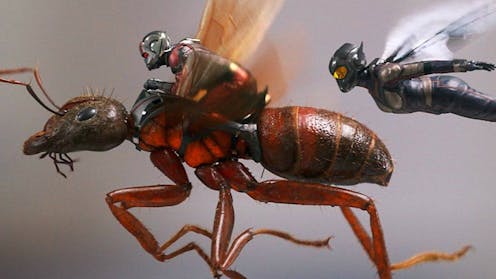
Ant-Man and The Wasp: Quantumania[1] is the latest film in the ever-expanding Marvel Cinematic Universe.
The ant-filled film follows the adventures of Scott Lang (AKA Ant-Man), Hope Van Dyne (AKA The Wasp) and Cassie Lang (AKA The Stinger), who all use science-derived technology to give them ant-like powers. In the Ant-Man films, Ant-Man also has the ability to direct the actions of several ant species, each with its own unique set of characteristics.
Tiny ants might seem like unlikely inspirations and sidekicks for a superhero, but real-life ants have astonishing superpowers that make them formidable allies.
Super strength
Ant-Man and The Wasp both wear suits that allow them to shrink and also give them the proportionate strength of an ant.
Ants are well known for their super-strength, with some workers being able to carry up to 50 times their own body weight. Since ants – like other insects – have their skeletons on the outside, their muscles do not have to support much of their body weight, leaving them free to apply more strength to lifting.
In addition, smaller animals tend to have greater strength relative to their body weight. Even ants’ joints are strong: the neck joints[2] of the common field ant Formica exsectoides can withstand 5,000 times the ant’s body weight[3].
Read more: How do Olympic athletes stack up against invertebrates? Not very well[4]
Super speed
Ant-Man and The Wasp don’t have super speed – but real-life ants certainly do!
Saharan silver ants (Cataglyphis bombycina[5]) can travel 100 times their body length in a second, making them one of the fastest animals on the planet. That’s like a 180-centimetre human running at 200 metres per second (or 720km per hour)! Usain Bolt[6], the all-time fastest person in the world, could only hit a maximum speed of 47km per hour.
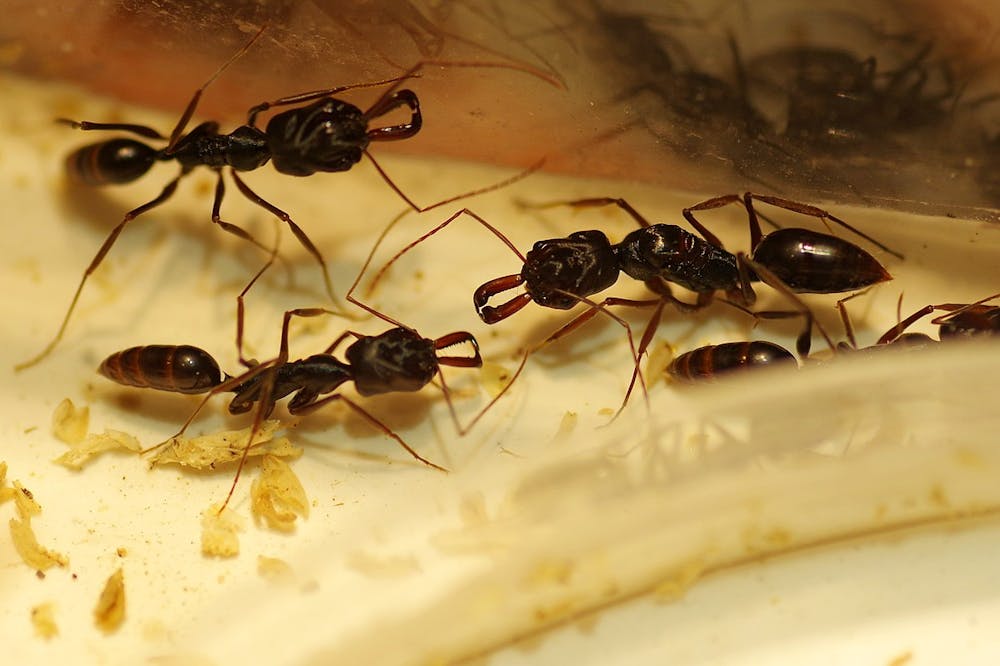
Ants are not just fast runners – they can move other parts of their bodies with mind-boggling speed. Trap jaw ants (Odontomachus bauri) can slam their jaws shut at an incredible 137km per hour[7], one of the fastest movements in the animal kingdom. Trap jaw ants use their super-fast mandibles[8] to catch their favourite prey: termites.
The jaws of trap jaw ants are also impressive defensive weapons and can be used to stun attacking predators such as spiders. These ants can even make a rapid retreat by striking their jaws against the ground. This “bouncer defence” throws the ant an astonishing 8cm into the air, the equivalent of an average-sized human jumping 40 metres.
Strength in numbers
What ants lack in size, they make up for in sheer numbers. A recent study estimated that there are more than 20 quadrillion[9] ants alive at any one time – there are many more ants on Earth than stars in the Milky Way galaxy.
Argentine ants (Linepithema humile) build some of the largest supercolonies on Earth, containing billions of workers spread over 6,000 square kilometres[10].
By working together in overwhelming numbers, ants can successfully attack animals many times bigger than themselves. Army ant swarms can take down large prey[11] such as lizards, frogs and even scorpions. Like the Ant-Man comic character Cassie Lang, some ant species possess a stinger capable of delivering painful venom. South American bullet ants (Paraponera clavata) have one of the world’s most painful stings[12]. It’s no wonder they were featured as “attack ants” in the first Ant-Man movie.
No leaders necessary
Throughout the Ant-Man films, the heroes use communication devices to lead colonies of ants. However, there are no leaders in a real ant colony.
Worker ants are responsible for tasks such as hunting, cleaning and rearing larvae, while queens lay eggs to keep the colony stocked with workers. You might think a society containing millions of tiny-brained animals with no leader would be chaos, but by working together, ants can achieve feats that far exceed the brain power of any individual – this is called “swarm intelligence”.
Argentine ants, for example, can find the shortest path between nests[13], while fire ants escape flooding by linking their bodies together to form enormous living life rafts[14]. In the First Ant-Man movie, Scott Lang uses the coordinated skills of fire ants to break into Pym Headquarters.
Super sized societies
In the latest movie, a colony of ants accidentally enters the mysterious quantum realm where they undergo 1,000 years of evolution, resulting in a society of highly intelligent ants living in a futuristic society.
But modern-day ants have already evolved exceptionally complex societies. Some ant species have even evolved forms of agriculture by tending to and protecting herds of sap-sucking aphids[15]. Aphids respond to their ant farmers by producing droplets of a sugary substance called “honeydew” which the ants harvest as food.
Read more: Tiny Game of Thrones: the workers of yellow crazy ants can act like lazy wannabe queens. So we watched them fight[16]
Amazingly, leaf cutter ants in South America care for immense underground fungi gardens which they grow for food[17]. The ants feed the fungus leaves and are able to select the leaf species that maximise fungal growth. Ants weed the garden by removing weedy fungi species, and can even use antibiotics[18] to protect the fungi from disease.
Given their super strength, incredible speeds and amazing swarm intelligence, Ant-Man is lucky to have ants on his side!
References
- ^ Ant-Man and The Wasp: Quantumania (en.wikipedia.org)
- ^ neck joints (www.insidescience.org)
- ^ 5,000 times the ant’s body weight (theconversation.com)
- ^ How do Olympic athletes stack up against invertebrates? Not very well (theconversation.com)
- ^ Cataglyphis bombycina (www.google.com)
- ^ Usain Bolt (www.google.com)
- ^ 137km per hour (www.pnas.org)
- ^ super-fast mandibles (www.youtube.com)
- ^ 20 quadrillion (www.google.com)
- ^ 6,000 square kilometres (www.pnas.org)
- ^ large prey (www.youtube.com)
- ^ world’s most painful stings (www.nhm.ac.uk)
- ^ shortest path between nests (cosmosmagazine.com)
- ^ living life rafts (www.youtube.com)
- ^ tending to and protecting herds of sap-sucking aphids (www.nationalgeographic.com)
- ^ Tiny Game of Thrones: the workers of yellow crazy ants can act like lazy wannabe queens. So we watched them fight (theconversation.com)
- ^ fungi gardens which they grow for food (www.nationalgeographic.com)
- ^ antibiotics (www.smithsonianmag.com)