what do end of year music wrap-ups say about our listening habits?
- Written by: Timothy Byron, Lecturer in Psychology, University of Wollongong
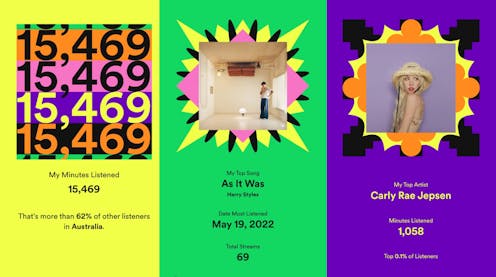
Now that we’ve hit December, many people looking on their social media feeds will be seeing end-of-year listening roundups like Instafest[1], Spotify Wrapped[2] and Apple Music Replay[3]. These roundups analyse your music listening for the year to generate a fancy, shareable social media post, and they sometimes have some fascinating insights about our listening.
We increasingly live in a social media world where now is prioritised – with the constant torrent of new posts and tweets and reels and Tiktoks, trying to find something from even a couple of weeks ago can be a challenge - especially because our memories are not so accurate.
This means part of the fascination with these listening roundups is that they’re a stocktake of the year. But also, they have insights into the way that we listen to music that might surprise some people.
We don’t get tired of our favourite songs
In the last decade or so, the singles charts in Australia have moved from being based on sales, to being based largely on plays on streaming services like Spotify, Apple Music and Tidal[4].
The charts have become increasingly static as a result of being based on plays – for example, Heat Waves by Glass Animals is currently at #13 in its 103rd week in the ARIA charts. Because the charts are based on plays, this fairly clearly shows that a lot of people continue to keep Heat Waves on their streaming playlists years later – they’re seemingly not bored of the song yet.
Part of what explains the continued endurance of such songs in people’s playlists is what social psychologist Robert Zajonc dubbed the Mere Exposure Effect[5]. In a research program started in the 1960s, Zajonc has found consistently that our preference for stimuli is influenced by our familiarity with those stimuli – in other words, we are inclined to like what’s familiar. Chances are that, if we know a song fairly well, we like it. And if we like it, we don’t remove it from our playlists.
Of course, this isn’t the whole story. We obviously often get sick of songs, and we’re not purely robots programmed to like things based on familiarity. Mind you, if I look at my listening stats for the year, my top artist – the one I listened to the most – turns out to be the Beatles.
This is a band in some of my earliest musical memories. Surely, decades after I first heard it, I should be very tired indeed of their song I’m So Tired – but it appears that I am not. Which means some people looking at their roundups might be surprised just how long some songs and artists actually have lasted in their playlists.
We love to remember our favourite music from the year
We human beings often don’t remember very much, when it comes down to it. In an 1885 book, German psychologist Hermann Ebbinghaus describes experiments he conducted on his memory, trying to remember a list of nonsense syllables (ZUG or KUS, etc.): he discovered the “forgetting curve”. An hour after learning the syllables, he could remember around 40%. Nine hours later, he could remember about 30%. Six days afterwards, his memory for the nonsense words was at about 20%, which is where it stayed afterwards.
And Ebbinghaus was deliberately trying to remember those nonsense syllables. Most of the time when you listen to music, you’re probably not even paying attention to it, let alone trying to remember it. Personally, my memory of what music I was listening to six days ago is definitely less than 20%! This might be one reason that we genuinely don’t realise that we’ve spent so much of the year listening to that Lizzo song.
In contrast, streaming service algorithms record every second you spend listening to music (not least because counting it up is a neat fact for all the social media posts we’re seeing right now).
We love different music for different situations
Research[6] suggests that when the average person listens to music, they’re mostly wanting background music to accompany various tasks – driving, doing the dishes, exercising, studying, hanging out with friends, etc. However, when we think about the music we listen to, I suspect we often think about music we actively listen to - so sometimes the music that we passively listen to in our earbuds when nobody else can hear can be surprising.
Music is also inherently a social activity[7] – it says something about how we relate to the broader society around us if we choose to listen to metal or to indie rock or K-pop; genres of music are usually related to subcultures and movements within society.
The tension between the two – that the music that is good at accompanying drudgery might not always be the music that expresses who we are – can lead to some interesting insights into other people when we look at their end-of-year roundups.
We love hooks
And of course, sometimes a song transcends social setting, where we can’t resist a hook even if we do find it to be a guilty pleasure. Hooks are those musical moments that stand out and are easily remembered – they’re most likely the bits that get stuck in our head, that we anticipate when we listen to the music, and they’re integral to pop music[8].
These days, producers like Max Martin[9] carefully structure pop songs like Shake It Off[10] by Taylor Swift to maximise the sheer amount of attention-grabbing musical moments, and we’re often powerless to resist getting them stuck in our heads after a few listens. Of course, if you’re a guy with long hair wearing an Iron Maiden t-shirt, why would anyone suspect that you’re listening to Taylor Swift’s Anti-Hero in your earbuds?
One way to look at it is that “It’s me, hi, I’m the problem, it’s me” – one line in Anti-Hero[11] by Taylor Swift, the current #1 single in Australia – is clearly a memorable hook for a lot of listeners. That hook meant people noticed the song, and they added it to a playlist or two. Where it stayed, becoming familiar, becoming a part of life.
Finally, because of our typically porous human memories, we often don’t realise how often things end up in our ears. And so, when that Iron Maiden t-shirt guy posts his Spotify Wrapped on social media, he’s as surprised as anyone else that Anti-Hero is up amongst his top songs, next to Run To The Hills.
This is perhaps what is interesting about such roundups - they give an insight into the everyday listening habits of our friends, about what they listen to when we’re not looking.
References
- ^ Instafest (www.cosmopolitan.com)
- ^ Spotify Wrapped (www.spotify.com)
- ^ Apple Music Replay (music.apple.com)
- ^ being based largely on plays on streaming services like Spotify, Apple Music and Tidal (www.aria.com.au)
- ^ Mere Exposure Effect (thedecisionlab.com)
- ^ Research (eprints.whiterose.ac.uk)
- ^ a social activity (www.cambridge.org)
- ^ integral to pop music (link.springer.com)
- ^ Max Martin (www.newyorker.com)
- ^ Shake It Off (www.youtube.com)
- ^ Anti-Hero (www.youtube.com)