How Dan Andrews pulled off one of the most remarkable victories in modern politics
- Written by: Shaun Carney, Vice-Chancellor's professorial fellow, Monash University
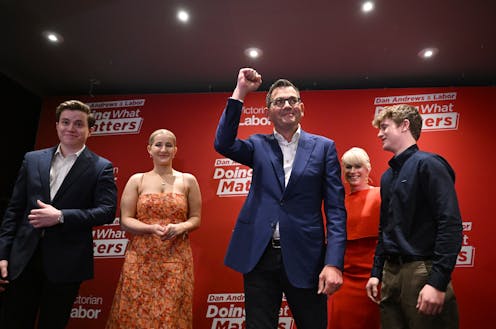
As the 2022 Victorian election campaign moved into its final days late last week, the consensus within the major parties, various community independent candidates, new little parties furious about lockdowns, and the mainstream media was that the election was a referendum on the premier, Daniel Andrews.
Curiously, no-one publicly made the obvious point that if this were so, it was also by definition a referendum on the opposition leader, Matthew Guy. If Andrews, seeking re-election for a third term, was putting the Yes case, then Guy was running the argument for No.
Only two hours after the last vote was cast at 6pm on Saturday, it was clear that Andrews and the Labor government he has headed for eight years had got Yes over the line. Not just over the line, way past it. Labor went into the election with a notional post-redistribution of 56 out of a total of 88 lower house seats. By the close of counting on Saturday night, there was a possibility the ALP could come out of this election with as many as 52 seats.
Read more: Labor easily wins Victorian election; Greens on track to win four lower house seats[1]
Given the level of vituperation directed at the government and Andrews in particular – the reflexive resort to the “Dictator Dan” appellation by his opponents in the community, the shoulder-to-the-wheel campaign by the Herald Sun to bury the premier in attacks and innuendo, Guy’s constant portrayal of Andrews as a divisive leader – this was one of the most remarkable victories in modern politics.
Few, if any, recent election contests have more starkly demonstrated the importance for mainstream political parties to refresh their positions and personnel, and to try, in the face of declining party memberships, to sustain links to the communities. Labor in Victoria has done this; the Liberals have failed abysmally. The proof of this is in the state’s recent political history. In the 40 years since John Cain led Labor into power, the ALP has produced three leaders who have taken the party to three consecutive election wins: Cain, Steve Bracks and Andrews.
Victoria has changed dramatically in that period – socially, economically and politically. In 1982, a post-war electoral settlement still held, with the working class suburbs of Melbourne’s inner city, the west and the north hewing closely to the Labor Party, while the city’s middle class eastern and southern suburbs plus the regional cities of Geelong, Bendigo and Ballarat largely favoured the Liberals. Unionised manufacturing areas backed Labor, white-collar areas went to the Liberal Party.
Gentrification, the decline of manufacturing, the rise of the knowledge worker, the emergence of health services and tertiary education as important industries, digital communications, rising waves of Asian immigration – all of these have taken place over those 40 years. The Labor Party has managed to adapt to the state’s transformation much more effectively than the Liberals. The ALP has lost and is losing its grip on the inner suburbs but it is strong in the regional cities and in the eastern and bayside suburbs that used to belong to the Liberals.
Neither party could be said to have stellar preselection processes. Labor’s is rigid and in the hands of a small number of faction bosses; the Liberals’ is driven far too much by a party membership that is too narrow and subject to branch stacking.
Hence in the seat of Mulgrave in Melbourne’s south-eastern suburbs, held by Andrews, the party put up a candidate who accused the premier of the “murder of 800 people”. This should, by rights, be a contestable seat for the Liberals or at least a place where someone who is potential future frontbencher material is tried out and given a profile. On Sunday, the candidate was on a primary vote of 15%.
If the 2018 election, which produced the so-called Danslide, giving the ALP a two-party preferred vote of 57.3%, was a disaster for the Liberals, this election amounts to a catastrophe. True, progressive counting[2] on Sunday suggested Labor’s vote after preferences had fallen by three points to 54.2%.
But historically, a number like that would be regarded as a landslide. Labor’s primary vote does appear to have fallen to 37% – almost 6% down on what it secured in 2018. But the coalition’s vote looks to be stalled at 35%, similar to what it attracted four years ago. It’s worth noting too that Labor’s primary vote in Victoria at last May’s federal election was 32.8%.
Does Labor have problems? Certainly. As happened at the federal election, there were massive drops in its primary vote in the northern and western suburbs. But because it held the seats by hefty margins, this was not enough to cause it to lose them. What’s not clear yet is how much of this is structural – a change in the political complexion of these booming suburbs – and how much is due to anger at the effect of lockdowns and the failure of the long-running state Labor government to give its most faithful supporters a better range of services: effectively, more comfortable lives.
Conversely, the eastern suburbs swung slightly to the ALP, a reward for the government’s provision of services and construction on that side of town, including the controversial Suburban Rail Loop.
Labor also looks set to lose a small number of inner-city seats, formerly Labor strongholds, to Greens. The Greens are presenting this[3] as a “Greenslide” but that’s a bit hyperbolic. The Greens vote looks to have increased barely from 10.7% to 11%. If these seats do fall into the Green column, that will be because of the Liberals deciding to preference the Greens as part of its desperate and wrong-headed “Put Labor last” strategy. The overall effect is for the Liberals to deliberately make the Victorian lower house more left-wing.
Read more: 'A political force of nature': despite scandals and a polarising style, can 'Dan' do it again in Victoria?[4]
But that only serves to underscore just how badly the Liberals have played this election. Having stood down after leading the Liberals to the shocking 2018 defeat, Guy was reinstalled last year, to little effect. There appeared to be no convincing reason, in terms of policy or approach, to reinstate him and ditch the quietly spoken Michael O’Brien.
Ahead of the election, Guy went on a wild spendathon while also promising to reduce debt without raising taxes. This played directly into Labor’s portrayal of him as “the Liberal cuts guy”. It led to a horrible denouement on Thursday when, during a press conference after the final accounting of the parties’ policies by the parliamentary budget office, Shadow Treasurer David Davis could not give a total figure for the coalition’s promises.
That summed up yet another tone-deaf campaign by a party that struggles to keep up with a changing state. And all too often, it convinces itself the loathing its rusted-on supporters and media backers have for its political opponents represents wider community sentiment.
References
- ^ Labor easily wins Victorian election; Greens on track to win four lower house seats (theconversation.com)
- ^ progressive counting (www.abc.net.au)
- ^ are presenting this (www.theage.com.au)
- ^ 'A political force of nature': despite scandals and a polarising style, can 'Dan' do it again in Victoria? (theconversation.com)