


Netanyahu on track to win in Israeli election – but there are many challenges ahead
- Written by: Ran Porat, Affiliate Researcher, The Australian Centre for Jewish Civilisation, Monash University
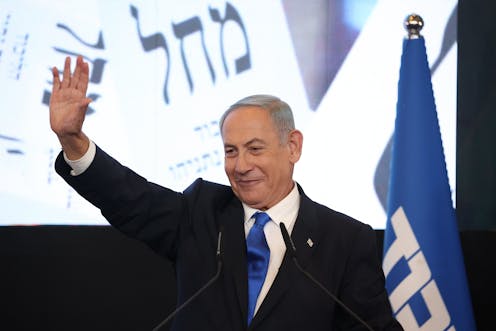
More than 71% of Israel’s 6.5 million eligible voters, a 20-year high, cast their votes in Israel’s November 1 elections[1]. This is the fifth Israeli election in less than four years; during that period, two shaky governments were formed, each of which lasted only a year.
Exit polls: a majority for the right wing camp
According to the exit polls[2], former Prime Minister Benjamin (Bibi) Netanyahu is in a good position to reclaim the prime ministership. Like all four previous elections campaigns since 2019, 2022 was again a referendum on his eligibility to be Israel’s head of government. Entangled in a legal battle[3] after being indicted on charges of bribery, corruption and breach of trust – which he vehemently denies – Netanyahu is still popular among most right-wing voters. His supporters largely believe an organised campaign against him is being run by the legal and political elites, promoted by the media.
Netanyahu’s Likud party is set to win around 30 Knesset (parliament) seats, out of the total 120, thereby retaining its status as the biggest party in Israel.
Read more: Netanyahu leaves behind a complex legacy in Israel. His successor will need to deliver change — and fast[4]
Senior Likud members have been promising to reform the judicial system, reducing what they consider the judges’ disproportionate power to challenge the authority of elected parliamentarians. Some of the judicial reform laws being proposed, if passed, could either aid Netanyahu in his legal battle or annul the case against him entirely.
The “star” of the elections was extreme right-wing politician Itamar Ben Gvir[5]. Ben Gvir achieved notoriety as a teenage activist for his role in the incitement in the mid-1990s against then-Prime Minister Yitzhak Rabin, shortly before Rabin was assassinated[6] by another right-wing extremist.
Ben Gvir has sought to re-brand himself as more “moderate” in recent months, rejecting some of his most extreme positions of the past. An alliance of Ben Gvir’s party with the Religious Zionism party, headed by Bezalel Smotrich, appears poised[7] to become Israel’s third largest party, gaining 14-15 seats.
The two will push for expansion of Israeli settlements in the West Bank, and rejection of any two-state resolution with the Palestinians. A coalition including Ben Gvir, Smotrich and Israel’s two conservative ultra-Orthodox religious parties (Shas and UTJ, 17-18 seats collectively) would be bad news for advocates of LGBTQI+ rights in Israel and abortion rights for women.
The picture for the centre-left anti-Netanyahu camp is a mixed bag. Yesh Atid[8], the party of outgoing caretaker Prime Minister Yair Lapid, is set to be second in several seats to Likud with 22-24. Meanwhile, the National Unity Party, led by Defence Minister Benny Gantz, gained 12-13 seats. Both these parties increased their strength but apparently failed in their bid to remain in government.
The left-wing Meretz and Labour parties polled poorly, winning a predicted 4-5 seats.
Right-wing secularist Avigdor Lieberman, a Netanyahu ally turned opponent, and his Yisrael Beitenu (“Israel our home”) party, barely made it to the Knesset, winning 4-5 seats.
Engulfed in bitter internal fighting, non-Zionist, mainly Arab-supported Israeli parties crashed after splitting their Joint List[9], which gained 15 seats in 2020, into three parties. Hadash-Ta’al, the central component of the former Joint List ended up with just four seats.
Another component of the former Joint List, the Arab Islamist party Ra’am[10], headed by Mansour Abbas at the party’s helm, has gained five seats, up one from last election.
This is significant, as Abbas took a bold and unprecedented step by joining a Zionist-led government in 2021 – the first time a majority Arab party has done this. Ra’am’s success among Arab Israeli voters suggest they want their representatives to enter governing coalitions to gain services and other policy priorities for Israeli Arab communities, rather than take an ideological stand against Zionism.
What happens now?
The big parties will immediately start the difficult rounds of consultations, trying to attract enough Knesset members to join their coalition and pull together the magic number of 61.
If exit polls are accurate, Netanyahu’s task is easier than anyone else’s, but nothing is assured. He has at least one major mine to defuse: many in Israel, the Jewish diaspora (including in Australia) and among Israel’s important allies, specifically the US, have warned against granting Ben Gvir a major role in a Likud-led government. Yet without Ben Gvir’s support, Netanyahu appears to have no government.
Lapid will aim at assembling a bloc that would prevent a Likud-led coalition and, if he succeeds, will likely send Israel to yet another election in a few months.
Israeli citizens are fed up with the chronic instability of the political system. They face the same rising costs of living challenges experienced worldwide at the moment. Since the collapse of the Oslo peace process in 2000, and the Palestinian rejection of a two-state peace offer in 2008, the belief the Palestinians can be a partner for peace is low among most Israeli Jews. According to surveys[11], Israelis still dream of peace based on a two-state solution, but think there is little chance of this happening soon.
Meanwhile, the Palestinian arena is far from stable, with ongoing Palestinian terror, a bloody succession battle on the horizon after the 86-year-old Palestinian Authority President Mahmoud Abbas finally goes, and Gaza governed by[12] the Islamist terror gang of Hamas.
In the background, Iranian[13] regional aggression, siding with Russia and relentless drive for nuclear weapons capability is casting a black shadow on Israeli security. Whoever becomes Israel’s next PM, these challenges will be at the centre of the government’s agenda, along with trying to heal the great divides within Israel’s society.
Read more: Benjamin Netanyahu was on the brink of political defeat. Then, another conflict broke out in Gaza[14]
Everything may change
It’s going to be days before the final vote counting is concluded. A few hundred votes each way could lead to dramatic changes that will determine if Israel is going to another election, or a Netanyahu-led government is on the cards.
For example, according to latest real vote counting, non-Zionist Arab nationalist party Balad is polling just under the minimum four-seat threshold, while Yisrael Beitenu and Mertez both risk failing to get into the Knesset.
Despite the recurring elections of recent years, Israel has remained a vibrant and strong democracy, an economic success story and a hi-tech powerhouse[15], with increasingly good relations[16] across the Arab Middle East. The vote count over the next few days will be crucial in determining if Israel will have a stable new government or not.
References
- ^ November 1 elections (lens.monash.edu)
- ^ exit polls (www.timesofisrael.com)
- ^ a legal battle (www.nytimes.com)
- ^ Netanyahu leaves behind a complex legacy in Israel. His successor will need to deliver change — and fast (theconversation.com)
- ^ Itamar Ben Gvir (aijac.org.au)
- ^ assassinated (www.theguardian.com)
- ^ appears poised (www.jpost.com)
- ^ Yesh Atid (www.timesofisrael.com)
- ^ Joint List (en.wikipedia.org)
- ^ Ra’am (www.timesofisrael.com)
- ^ surveys (mitvim.org.il)
- ^ Gaza governed by (www.bbc.com)
- ^ Iranian (aijac.org.au)
- ^ Benjamin Netanyahu was on the brink of political defeat. Then, another conflict broke out in Gaza (theconversation.com)
- ^ hi-tech powerhouse (www.timesofisrael.com)
- ^ good relations (www.mei.edu)










