More women are studying STEM, but there are still stubborn workplace barriers
- Written by: Lisa Harvey-Smith, Australian Government Women in STEM Ambassador, Professor, UNSW Sydney

Today, the Australian government released the STEM Equity Monitor 2022[1] – the nation’s annual scorecard on gendered participation in science, technology, engineering, and mathematics (STEM) education and careers.
These data are more relevant than ever. Australia is facing unprecedented skills shortages[2] in critical areas – we need highly qualified people to help address our economic, environmental, and technological challenges.
Future careers in all sectors will rely heavily on STEM skills. But a lack of diversity means we have a limited workforce, and it’s missing a broad range of perspectives.
Read more: Australia needs more engineers. And more of them need to be women[3]
What does the scorecard say?
We start with some positive news – the number of women enrolling in university STEM courses increased by a whopping 24% between 2015 and 2020, compared with a 9% increase among men. There was a more gradual rise in vocational STEM enrolments, where only 16% are women.
Women’s workforce participation is gradually increasing too. The proportion of STEM-qualified jobs held by women was 15% in 2021 – that’s an increase of 2% in just 12 months.
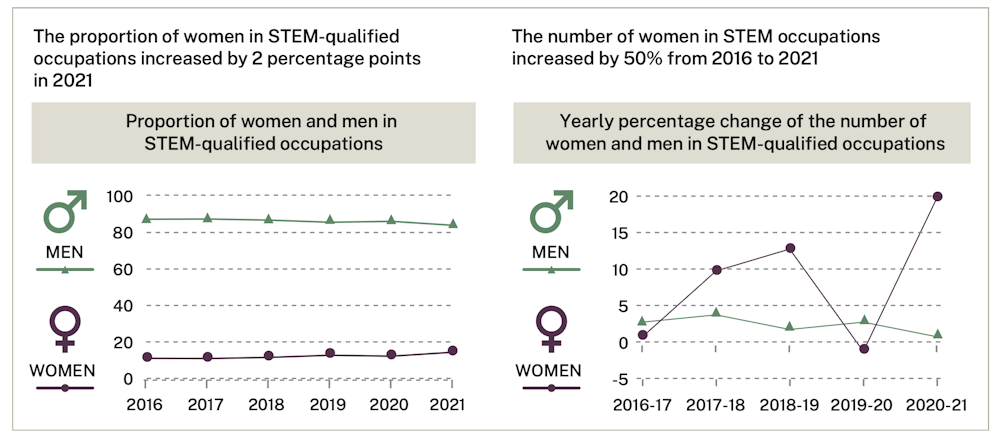
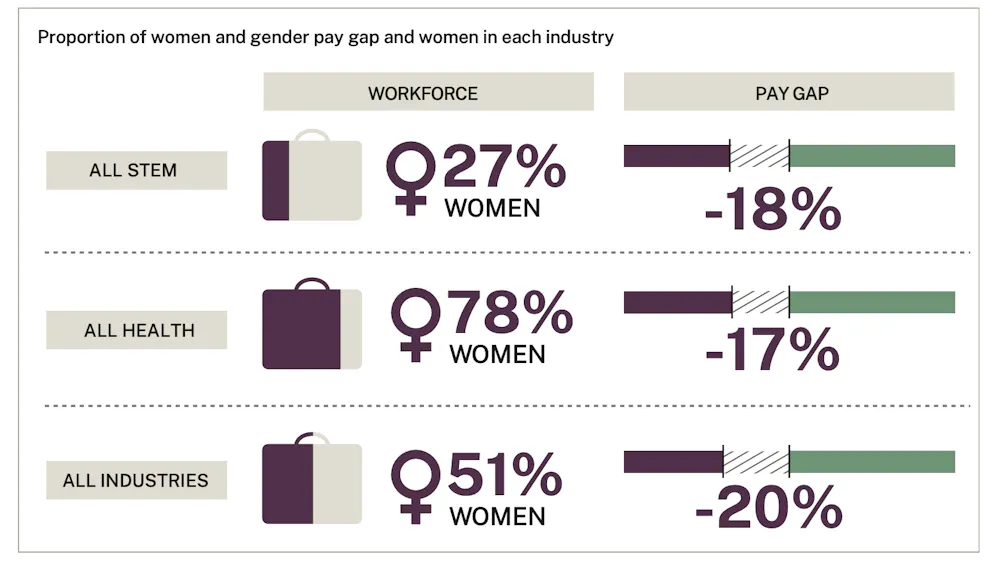 Stem Equity Monitor Data Report 2022, CC BY[5]
Although we are doing a better job at attracting women to some university STEM courses, very few women are still going for vocational STEM education. And there’s far too little attention paid to actually keeping STEM-qualified women in the workforce.
A five-year study of STEM graduates[6] from the year 2011 found that by 2016, only 1 in 10 STEM-qualified women worked in a STEM industry, compared with more than 1 in 5 STEM-qualified men. Data on other gender identities were not collected.
The huge difference in retention rates should come as no surprise when we consider the gendered roles our society enforces, and the vastly different experiences people face, both in workplaces and in society at large.
It is important to acknowledge the major gaps in these data, for example on other gender identities, sexual orientation, socioeconomic factors, disability, and race. Broadening the data captured will enable us to better understand the full impact of the many intersecting barriers to participation that people face.
Read more:
Educators can help make STEM fields diverse – over 25 years, I've identified nudges that can encourage students to stay[7]
We need structural workplace changes
Businesses suffering chronic skills shortages can’t keep focusing on programs designed to grow the pipeline, in the hope that the system will fix itself. We need structural workplace changes.
One avenue is to introduce more flexible work options and broaden access to paid parental leave. According to the Workplace Gender Equality Agency[8], gender-equal primary carer’s leave was offered by 3 in 5 employers in 2020-21.
Thanks to a concerted effort by many employers, 12% of this leave was taken by men last year, almost twice as much as the year before. This figure was even higher (20%) in management roles.
Bias, discrimination, and sexual harassment are major factors that drive people from workplaces. Solving these issues receives too little funding and attention.
Workplace sexual harassment costs Australia A$3.5 billion per year and inflicts a terrible personal toll on those affected. Women are more likely to be sexually harassed than men, and people from racial minorities, people with disabilities and LGBTQIA+ individuals suffer disproportionately.
Read more:
Antarctic stations are plagued by sexual harassment – it's time for things to change[9]
According to the Respect@Work: Sexual Harassment National Inquiry Report[10], sexual harassment is more prevalent in male-dominated industries. The Australian government recently committed to implementing all 55 recommendations of that report – a significant, positive step.
Businesses must urgently put robust systems in place to prevent discrimination, bias, and sexual harassment. There are many excellent tools available to guide this work, for example these provided by the Australian Human Rights Commission[11], Chief Executive Women[12], the Workplace Gender Equality Agency[13], Our Watch[14], and the Australian Academy of Technology and Engineering[15].
Crashing barriers
Ultimately, we need rigorous and well-resourced initiatives to reduce barriers to workforce participation. My office has created a national evaluation guide for STEM equity programs[16] for this purpose.
Stem Equity Monitor Data Report 2022, CC BY[5]
Although we are doing a better job at attracting women to some university STEM courses, very few women are still going for vocational STEM education. And there’s far too little attention paid to actually keeping STEM-qualified women in the workforce.
A five-year study of STEM graduates[6] from the year 2011 found that by 2016, only 1 in 10 STEM-qualified women worked in a STEM industry, compared with more than 1 in 5 STEM-qualified men. Data on other gender identities were not collected.
The huge difference in retention rates should come as no surprise when we consider the gendered roles our society enforces, and the vastly different experiences people face, both in workplaces and in society at large.
It is important to acknowledge the major gaps in these data, for example on other gender identities, sexual orientation, socioeconomic factors, disability, and race. Broadening the data captured will enable us to better understand the full impact of the many intersecting barriers to participation that people face.
Read more:
Educators can help make STEM fields diverse – over 25 years, I've identified nudges that can encourage students to stay[7]
We need structural workplace changes
Businesses suffering chronic skills shortages can’t keep focusing on programs designed to grow the pipeline, in the hope that the system will fix itself. We need structural workplace changes.
One avenue is to introduce more flexible work options and broaden access to paid parental leave. According to the Workplace Gender Equality Agency[8], gender-equal primary carer’s leave was offered by 3 in 5 employers in 2020-21.
Thanks to a concerted effort by many employers, 12% of this leave was taken by men last year, almost twice as much as the year before. This figure was even higher (20%) in management roles.
Bias, discrimination, and sexual harassment are major factors that drive people from workplaces. Solving these issues receives too little funding and attention.
Workplace sexual harassment costs Australia A$3.5 billion per year and inflicts a terrible personal toll on those affected. Women are more likely to be sexually harassed than men, and people from racial minorities, people with disabilities and LGBTQIA+ individuals suffer disproportionately.
Read more:
Antarctic stations are plagued by sexual harassment – it's time for things to change[9]
According to the Respect@Work: Sexual Harassment National Inquiry Report[10], sexual harassment is more prevalent in male-dominated industries. The Australian government recently committed to implementing all 55 recommendations of that report – a significant, positive step.
Businesses must urgently put robust systems in place to prevent discrimination, bias, and sexual harassment. There are many excellent tools available to guide this work, for example these provided by the Australian Human Rights Commission[11], Chief Executive Women[12], the Workplace Gender Equality Agency[13], Our Watch[14], and the Australian Academy of Technology and Engineering[15].
Crashing barriers
Ultimately, we need rigorous and well-resourced initiatives to reduce barriers to workforce participation. My office has created a national evaluation guide for STEM equity programs[16] for this purpose.
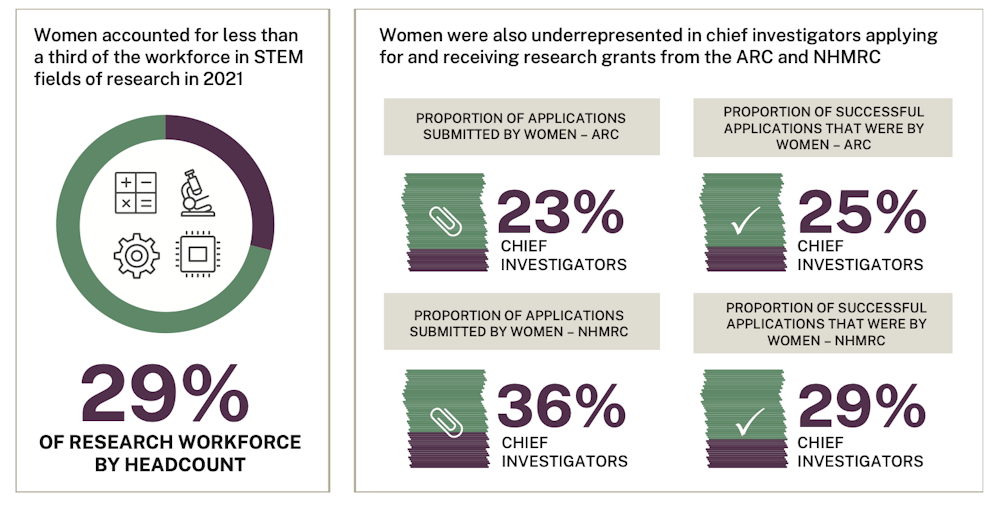 Women are underrepresented in teaching and research roles in STEM.
Stem Equity Monitor Data Report 2022, CC BY[17]
Rather than the usual PR campaigns and cupcake drives, we need investment in evidence-based solutions to address systemic issues affecting people who face discrimination in the workforce.
Nothing short of strong, decisive, and coordinated action from governments and the business sector will shift this pattern. The Australian government has already committed to this path, by announcing[18] a review of existing government women in STEM programs.
This review will determine the impact of these programs, to drive future investments into measures that are proven to strengthen Australia’s STEM workforce.
The key to diversifying STEM workplaces is respect – and reducing power differentials that appear along gendered, cultural and other lines.
Greater respect for every person will build a stronger, more cohesive society ready to tackle future challenges. And it will ensure that Australia’s fast-growing sectors – like space, advanced manufacturing, quantum technologies and cybersecurity – are well supported by a qualified workforce into the future.
Read more:
A law on workplace gender equality is under review. Here's what needs to change[19]
References^ STEM Equity Monitor 2022 (www.industry.gov.au)^ skills shortages (theconversation.com)^ Australia needs more engineers. And more of them need to be women (theconversation.com)^ CC BY (creativecommons.org)^ CC BY (creativecommons.org)^ five-year study of STEM graduates (www.industry.gov.au)^ Educators can help make STEM fields diverse – over 25 years, I've identified nudges that can encourage students to stay (theconversation.com)^ According to the Workplace Gender Equality Agency (www.wgea.gov.au)^ Antarctic stations are plagued by sexual harassment – it's time for things to change (theconversation.com)^ Respect@Work: Sexual Harassment National Inquiry Report (humanrights.gov.au)^ Australian Human Rights Commission (humanrights.gov.au)^ Chief Executive Women (cew.org.au)^ Workplace Gender Equality Agency (www.wgea.gov.au)^ Our Watch (workplace.ourwatch.org.au)^ Australian Academy of Technology and Engineering (www.atse.org.au)^ national evaluation guide for STEM equity programs (womeninstem.org.au)^ CC BY (creativecommons.org)^ announcing (www.minister.industry.gov.au)^ A law on workplace gender equality is under review. Here's what needs to change (theconversation.com)
Women are underrepresented in teaching and research roles in STEM.
Stem Equity Monitor Data Report 2022, CC BY[17]
Rather than the usual PR campaigns and cupcake drives, we need investment in evidence-based solutions to address systemic issues affecting people who face discrimination in the workforce.
Nothing short of strong, decisive, and coordinated action from governments and the business sector will shift this pattern. The Australian government has already committed to this path, by announcing[18] a review of existing government women in STEM programs.
This review will determine the impact of these programs, to drive future investments into measures that are proven to strengthen Australia’s STEM workforce.
The key to diversifying STEM workplaces is respect – and reducing power differentials that appear along gendered, cultural and other lines.
Greater respect for every person will build a stronger, more cohesive society ready to tackle future challenges. And it will ensure that Australia’s fast-growing sectors – like space, advanced manufacturing, quantum technologies and cybersecurity – are well supported by a qualified workforce into the future.
Read more:
A law on workplace gender equality is under review. Here's what needs to change[19]
References^ STEM Equity Monitor 2022 (www.industry.gov.au)^ skills shortages (theconversation.com)^ Australia needs more engineers. And more of them need to be women (theconversation.com)^ CC BY (creativecommons.org)^ CC BY (creativecommons.org)^ five-year study of STEM graduates (www.industry.gov.au)^ Educators can help make STEM fields diverse – over 25 years, I've identified nudges that can encourage students to stay (theconversation.com)^ According to the Workplace Gender Equality Agency (www.wgea.gov.au)^ Antarctic stations are plagued by sexual harassment – it's time for things to change (theconversation.com)^ Respect@Work: Sexual Harassment National Inquiry Report (humanrights.gov.au)^ Australian Human Rights Commission (humanrights.gov.au)^ Chief Executive Women (cew.org.au)^ Workplace Gender Equality Agency (www.wgea.gov.au)^ Our Watch (workplace.ourwatch.org.au)^ Australian Academy of Technology and Engineering (www.atse.org.au)^ national evaluation guide for STEM equity programs (womeninstem.org.au)^ CC BY (creativecommons.org)^ announcing (www.minister.industry.gov.au)^ A law on workplace gender equality is under review. Here's what needs to change (theconversation.com)