Sacred Aboriginal sites are yet again at risk in the Pilbara. But tourism can help protect Australia’s rich cultural heritage
- Written by: Nicole Curtin, PhD Candidate, Charles Darwin University
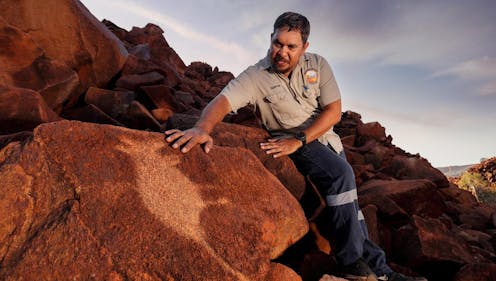
An application from Traditional Owners to block the construction of a fertiliser plant near ancient rock art in the Pilbara was denied[1] by the federal Environment Minister Tanya Plibersek this week. This decision is deeply concerning, and points to a much larger problem with Indigenous heritage management.
Plibersek says she went with the views of the Murujuga Aboriginal Corporation in making her decision, calling it[2] the “most representative organisation on cultural knowledge” in the region. Yet, she also acknowledged[3] that these views don’t represent all Traditional Owner perspectives in the area.
Save Our Songlines, a separate organisation of Murujuga Traditional Owners, oppose the fertiliser plant, which they say poses a threat to sacred rock art sites. They say[4] the minister’s decision is “based on faulty reasoning and false conclusions”.
In 2020, the world reacted in horror when Rio Tinto lawfully[5] destroyed Juukan Gorge – sacred Aboriginal rock shelters in the Pilbara some 46,000 years old. Broader community understanding of the value of Aboriginal and Torres Strait Islander knowledges for looking after Country can help us avoid repeating this tragedy. Tourism and community education is an important way to do that.
‘Enough is enough’
The A$4.5 billion Perdaman fertiliser plant will be constructed in the World Heritage nominated Murujuga National Park[6] in Western Australia. It is home to the world’s largest rock art gallery, with more than 1 million images scattered across the entire Burrup Peninsula and Dampier Archipelago.
As many as 20 sacred sites[7] may be impacted by the plant, according to Save Our Songlines.
Read more: Rio Tinto just blasted away an ancient Aboriginal site. Here’s why that was allowed[8]
In an interview[9] with ABC Radio National, Plibersek said the Murujuga Aboriginal Corporation have agreed that some of these rock carvings can be moved safely, and others can be protected on site even if the plant goes ahead.
However, the situation isn’t so clear cut. For example, the ABC revealed[10] on Thursday that the Murujuga Aboriginal Corporation refused permission to move the rock art sites multiple times, preferring they remain undisturbed. Elders finally agreed after receiving advice that this wasn’t possible.
This isn’t the first time we’ve seen issues regarding consultation processes with Traditional Owners, such as during the notorious battle for the Kimberley[11] against a major gas plant in 2012.
Traditional Owner and co-author Clinton Walker has been sharing his intimate knowledge of the Pilbara with visitors through his tourism venture Ngurrangga Tours[12] for the past 11 years. He has the cultural authority and capacity to speak for his Country.
Clinton was a signatory on the open letter from Traditional Owners and Custodians of Murujuga[13] concerning threats to cultural heritage in the area. He describes the potential impact of the fertiliser plant:
This hill is a very very sacred site to my people. If they build their plant here we’re not gonna have the same access we do now to go visit our rock art and teach our kids and family their culture.
This impact is going to damage our culture and it will damage us as the Traditional Owners because we’re connected to these sites in a spiritual way. I want people to know how important these sites are. We need to protect them. Enough is enough.
The need for consent
The federal inquiry into the Juukan Gorge[14] disaster highlighted[15] the need for free, prior and informed consent from any affected Aboriginal and Torres Strait Islander group.
The inquiry also called for[16] the removal of so-called “gag clauses” from land-use agreements, which prevent Aboriginal people from speaking out against developers.
Save Our Songlines Traditional Owners say principles from the inquiry aren’t being upheld, and are concerned gag clauses[17] are silencing members of the Murujuga Aboriginal Corporation[18].
We find it deeply problematic that Plibersek did not acknowledge these concerns around gag clauses in announcing her approval of the fertiliser plant. It is the role of the government to keep industry accountable for their obligations to abide by Indigenous heritage laws[19] and to ensure proper consultation processes are undertaken.
This decision is also not in line with the federal government’s vocal commitment to the environment and to Aboriginal and Torres Strait Islander affairs[20] prior to winning the election.
In a submission to the United Nations[21] about how to “decolonise our legal system”, Nyikina Warrwa Indigenous leader and respected researcher Professor Anne Poelina[22] said:
If the Lawful Laws which are awful, are enabled as lawful, what chance do Indigenous people and our lands, water, lifeways, and livelihoods stand against destruction?
Read more: Juukan Gorge inquiry puts Rio Tinto on notice, but without drastic reforms, it could happen again[23]
Understanding Indigenous connection to Country
Non-Indigenous people need to better understand the importance of Country[24] for Aboriginal and Torres Strait Islander people. Classrooms are a good place to start.
Deficits in the Australian education system[25] have led to poor knowledge and frequent and pervasive misunderstandings of Aboriginal people, places and cultures. A psychological hangover[26] from White Australia’s assimilation policies persists.
When school education doesn’t provide accurate and truthful accounts of Australian histories, harmful stereotypes are left unchallenged[27].
Clinton Walker describes a common response from visitors on his tours showcasing the culture, Country and history of the Pilbara:
People say ‘how the hell don’t we know that? Why have we never learnt this stuff?’
Improvements in education have been slow. For example, the Australian Institute for Teacher and School Leadership only released their report “Building a culturally responsive Australian teaching workforce[28]” in June this year.
Resources to support teachers are said to be scheduled for release in the coming months.
Read more: First Nations students need culturally safe spaces at their universities[29]
Learn about Country through tourism
Tourism is one context[30] where the visibility and recognition of Indigenous people as knowledge-holders can be promoted and celebrated.
Aboriginal and Torres Strait Islander tourism operators are delivering truthful accounts of Australian history and telling their stories of their connection to Country and culture. This work is an emotional labour[31] as they challenge entrenched colonial narratives.
Indigenous tourism operators are agents of reconciliation[32]. Operators speak about wanting to educate visitors to build awareness of social and environmental issues facing their communities. The potential destruction of cultural sites at Murujuga is one such issue.
Ongoing research from lead-author Nicole Curtin involves conversations with Aboriginal tourism operators and their visitors. It finds that deep listening is required for visitors to interrogate their own biases and privileges during their tourism experience. Visitors must be willing to “go and sit and learn” about Indigenous sovereignty and knowledges in their own lives.
Indeed, an enhanced sense of connection to our local communities may help to drive people to speak out about the destruction of sites of environmental and cultural significance.
Raising community awareness to fuel social momentum is one way of exerting pressure on decision makers to protect Australia’s rich cultural heritage and environment.
Read more: 'Although we didn’t produce these problems, we suffer them': 3 ways you can help in NAIDOC's call to Heal Country[33]
We acknowledge the Bininj, Larrakia, Noongar, Ngarluma, Yindjibarndi and Yawuru peoples as the Traditional Owners of Country where this article, and our research, was conducted and written. We pay our respects to Elders past and present.
References
- ^ was denied (www.abc.net.au)
- ^ calling it (www.abc.net.au)
- ^ also acknowledged (www.abc.net.au)
- ^ They say (www.saveoursonglines.org)
- ^ lawfully (theconversation.com)
- ^ Murujuga National Park (exploreparks.dbca.wa.gov.au)
- ^ 20 sacred sites (www.saveoursonglines.org)
- ^ Rio Tinto just blasted away an ancient Aboriginal site. Here’s why that was allowed (theconversation.com)
- ^ an interview (www.abc.net.au)
- ^ the ABC revealed (www.abc.net.au)
- ^ battle for the Kimberley (www.smh.com.au)
- ^ Ngurrangga Tours (www.ngurrangga.com.au)
- ^ open letter from Traditional Owners and Custodians of Murujuga (www.saveoursonglines.org)
- ^ federal inquiry into the Juukan Gorge (parlinfo.aph.gov.au)
- ^ highlighted (theconversation.com)
- ^ called for (www.abc.net.au)
- ^ gag clauses (www.nit.com.au)
- ^ silencing members of the Murujuga Aboriginal Corporation (www.theguardian.com)
- ^ Indigenous heritage laws (www.legislation.gov.au)
- ^ Aboriginal and Torres Strait Islander affairs (alp-assets.s3.ap-southeast-2.amazonaws.com)
- ^ submission to the United Nations (www.majala.com.au)
- ^ Professor Anne Poelina (www.notredame.edu.au)
- ^ Juukan Gorge inquiry puts Rio Tinto on notice, but without drastic reforms, it could happen again (theconversation.com)
- ^ importance of Country (theconversation.com)
- ^ Deficits in the Australian education system (journals.sagepub.com)
- ^ psychological hangover (insidestory.org.au)
- ^ harmful stereotypes are left unchallenged (www.reconciliation.org.au)
- ^ Building a culturally responsive Australian teaching workforce (www.aitsl.edu.au)
- ^ First Nations students need culturally safe spaces at their universities (theconversation.com)
- ^ Tourism is one context (www.welcometocountry.com)
- ^ This work is an emotional labour (journals.sagepub.com)
- ^ agents of reconciliation (theconversation.com)
- ^ 'Although we didn’t produce these problems, we suffer them': 3 ways you can help in NAIDOC's call to Heal Country (theconversation.com)