People stationed in Antarctica menstruate too – and it's a struggle. Here's how we can support them
- Written by: Meredith Nash, Professor and Associate Dean - Community, Australian National University
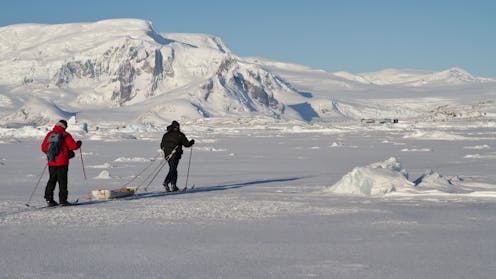
Women have been doing fieldwork in Antarctica for more than 40 years. Yet they comprise just 25% of expeditioners in the Australian Antarctic Program. Despite decades of progress, historical issues[1] with sexism and gender bias continue in extreme field environments set up for men.
Managing menstruation[2], in particular, is an overlooked challenge for women working in Antarctica and other extreme, male-dominated environments.
If we want to build a diverse and inclusive polar workforce, we need to openly and willingly address the challenges that women, trans and non-binary menstruators face in the field.
Who gets to work in Antarctica?
Over the decades, toileting has been a primary way for men to control who has access to extreme environments. For instance, until the late 1970s women were being told they couldn’t work in Antarctica because there were no facilities[3] for them on station.
Women have been similarly excluded from space travel because their hormonal bodies were deemed to be too unpredictable[4] by NASA’s male leaders.
Sally Ride’s 1983 mission on the Space Shuttle Challenger heralded a new era of progress for women’s access to Antarctic fieldwork. If women could go to space, they could certainly go to Antarctica! It was around this time the British, United States and Australian National Antarctic Programs began to allow women[5] to do fieldwork in Antarctica.
Ride’s mission also uncovered NASA’s inexperience with menstruation. In re-designing the space flight kit for her, NASA engineers famously asked Ride if 100 tampons[6] would be enough for a one-week mission.
In my latest research[7], I spoke to dozens of women expeditioners about how they negotiated the hurdles associated with menstruating in Antarctica. They revealed that managing menstruation remains taboo, and has been made even more difficult by a culture of silence.
As one expeditioner told me:
I haven’t had great conversations with other women because there haven’t been any that I’ve worked with. I’ve been very much by myself with these things.
Life as a woman expeditioner
So why is menstruating in Antarctica difficult?
Well, for one, you can only toilet in certain places due to environmental protection laws. You must collect all your bodily waste in sealed containers, which are carried back to a station for incineration.
Because expeditioners may have to keep used menstrual products with them for several weeks in the field, they need to consider not only what products they will use, but how they will dispose of them.
Re-usable menstrual cups are often preferred because they produce no waste and can be left in the body longer (4-8 hours) than disposable products. However, cups must be emptied and cleaned[8] at least three times within 24 hours to minimise the risk of toxic shock syndrome.
As one expeditioner explained:
Cups are amazing but [they are] also a huge learning curve. I started learning to use them for [an expedition] because I’m like I can’t carry used tampons around in my bag anymore […] The hard thing is cleaning them discreetly.
Menstruators must also be prepared to manage their menstruation in small, shared spaces. The women I interviewed described the complexity of doing this in male-dominated teams:
The first time I went to Antarctica I was out on a boat […] It was me and [a group of] men. It’s my period and I’m like, oh, my god, what do I do here?
All Antarctic expeditioners wear many thick layers to protect themselves from the extreme conditions. However, women need to be able to change menstrual products without exposing their skin to the cold for prolonged periods. The participants in my study came up with creative ways to cope:
I sewed myself underpants that I could Velcro on the side so that I didn’t have to take all the layers off my legs and my feet to change my undies…
To avoid these challenges during long-duration expeditions, menstruators often rely on menstrual suppression technologies[9]. These include the combined oral contraceptive pill, or long-acting reversible contraception (LARC) such as an intrauterine device or injection.
These methods prevent a period and pregnancy. And this is critical in extreme environments, where pregnancy is extremely high-risk.
LARC is convenient because it requires no extra supplies and little maintenance following insertion. That said, breakthrough bleeding[10] or spotting can be a side effect:
Having my period [in Antarctica] was a nightmare. Somebody told me that they had an [Depo Provera] injection before they went […] and I thought, “Well, that wouldn’t be a bad idea, to not have a period for that particular time” […] but I had my period the whole time I was in the field.
How to support menstruators
Apart from their other already-demanding work, my research shows women must also undertake additional psychological and physical labour to manage menstruation in extreme environments. Whether in Antarctica or on military deployment, women will often:
change their menstrual products without privacy or adequate sanitation
carry bloody menstrual products around with them in the field for a long time
improvise menstrual products when none are available
keep menstrual products in their bodies for longer than recommended because they aren’t provided with adequate toilet stops
alter their hormonal balance with medication to make menstruation less inconvenient.
The bottom line is this: menstruation in these settings has largely been treated as an individual problem, and not a site for organisational attention. This needs to change.
Some simple changes can be applied in any field environment where menstruation is difficult for women. Organisations should make it a priority to:
destigmatise menstruation and acknowledge the unique needs of diverse menstruators, including trans people and non-binary folk
update field manuals to include relevant information about toileting and menstruation
provide menstrual health education to all expeditioners – especially cisgender men leading field teams
make toilet stops standard operating practice
provide menstruators with free menstrual products, and make period underwear available as part of field gear.
I recently supported the Australian Antarctic Program to revise its field manual and help reconsider how field environments can be sensitised to the needs of menstruators. This is an important first step. But success will only come when inclusive operational measures happen by default.
Read more: Supporting menstrual health in Australia means more than just throwing pads at the problem[11]
References
- ^ historical issues (journals.plos.org)
- ^ Managing menstruation (www.tandfonline.com)
- ^ facilities (www.tandfonline.com)
- ^ unpredictable (heinonline.org)
- ^ allow women (www.tandfonline.com)
- ^ 100 tampons (www.nationalgeographic.co.uk)
- ^ research (www.tandfonline.com)
- ^ cleaned (www.mooncup.co.uk)
- ^ technologies (theconversation.com)
- ^ breakthrough bleeding (www.mayoclinic.org)
- ^ Supporting menstrual health in Australia means more than just throwing pads at the problem (theconversation.com)