


The Times Australia
Fisher and Paykel Appliances
The Times World News

.

How much are the parties spending on ads? And how come One Nation's Townsville candidate lives in Melbourne? – podcast

  • Written by Benjamin Clark, Deputy Engagement Editor, The Conversation
How much are the parties spending on ads? And how come One Nation's Townsville candidate lives in Melbourne? – podcast

On Monday May 9, early voting centres will open and Australians can start casting their votes for the federal election.

Increasing numbers of Australians are choosing not to line up for their democracy sausage on election day, opting instead to get it out of the way beforehand. In 2019, about 40% of Australians either voted early by visiting a pre-poll station (32.7%) or they filled out a postal ballot (8.5%).

So the next week is crucial for parties’ and candidates’ campaigns – can they convince enough persuadable voters before they cast their ballots?

In this episode of Below the Line, award-winning broadcaster Jon Faine and our regular panel of political scientists discuss how early voting is “truncating” political campaigns, by bringing forward the crucial vote-turning period.

This means that the campaign will intensify in the next week, says Anika Gauja. The parties will need to get their key messages out repeatedly. Early voting is one of the reasons the leaders may have agreed to two debates in the next seven days – on Mothers’ Day with Channel 9 in prime time and another again on Wednesday 11 May with Channel 7.

They also discuss whether the Reserve Bank’s recent interest rate hike will hurt Prime Minister Scott Morrison, or perhaps help him among mortage-free retirees. On the whole, polling expert Simon Jackman believes it represents a net-negative for the government, because there are more mortgage-holders in marginal seats.

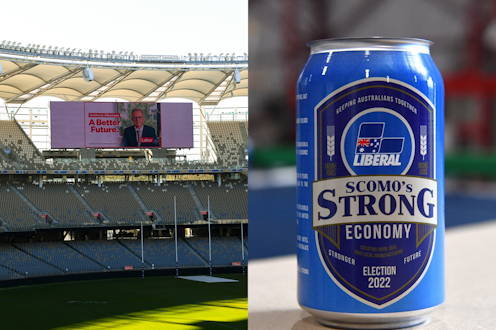
The political parties’ advertising is also dissected. Spending on ads shot up in the last week, with Labor coming out on top as the biggest spender on social media.

Finally, they discuss preferences, campaign finance disclosures and the curious case of a candidate for Pauline Hanson’s One Nation party who lives 2,500 kilometres away from the electorate she’s seeking to represent.

Below the Line is a limited-edition election podcast brought to you by The Conversation and La Trobe University. The show is produced by Courtney Carthy and Benjamin Clark.

Correction: Jon states that the One Nation candidate for “Bob Katter’s seat in northern Queensland” lives in the Melbourne suburb of Pakenham, whereas the far-flung candidate Diane Pepe is actually contesting the seat of Herbert[1], which is adjacent to Katter’s seat of Kennedy.

Disclosure: Andrea Carson has received funding for research projects from Facebook.

Image credit: Lukas Coch/Mick Tsikas/AAP

References

  1. ^ contesting the seat of Herbert (www.theguardian.com)

Read more https://theconversation.com/below-the-line-how-much-are-the-parties-spending-on-ads-and-how-come-one-nations-townsville-candidate-lives-in-melbourne-podcast-182596

Times Magazine

Australia’s electric vehicle surge — EVs and hybrids hit record levels

Australians are increasingly embracing electric and hybrid cars, with 2025 shaping up as the str...

Tim Ayres on the AI rollout’s looming ‘bumps and glitches’

The federal government released its National AI Strategy[1] this week, confirming it has dropped...

Seven in Ten Australian Workers Say Employers Are Failing to Prepare Them for AI Future

As artificial intelligence (AI) accelerates across industries, a growing number of Australian work...

Mapping for Trucks: More Than Directions, It’s Optimisation

Daniel Antonello, General Manager Oceania, HERE Technologies At the end of June this year, Hampden ...

Can bigger-is-better ‘scaling laws’ keep AI improving forever? History says we can’t be too sure

OpenAI chief executive Sam Altman – perhaps the most prominent face of the artificial intellig...

A backlash against AI imagery in ads may have begun as brands promote ‘human-made’

In a wave of new ads, brands like Heineken, Polaroid and Cadbury have started hating on artifici...

The Times Features

Last-Minute Christmas Holiday Ideas for Sydney Families

Perfect escapes you can still book — without blowing the budget or travelling too far Christmas...

98 Lygon St Melbourne’s New Mediterranean Hideaway

Brunswick East has just picked up a serious summer upgrade. Neighbourhood favourite 98 Lygon St B...

How Australians can stay healthier for longer

Australians face a decade of poor health unless they close the gap between living longer and sta...

The Origin of Human Life — Is Intelligent Design Worth Taking Seriously?

For more than a century, the debate about how human life began has been framed as a binary: evol...

The way Australia produces food is unique. Our updated dietary guidelines have to recognise this

You might know Australia’s dietary guidelines[1] from the famous infographics[2] showing the typ...

Why a Holiday or Short Break in the Noosa Region Is an Ideal Getaway

Few Australian destinations capture the imagination quite like Noosa. With its calm turquoise ba...

How Dynamic Pricing in Accommodation — From Caravan Parks to Hotels — Affects Holiday Affordability

Dynamic pricing has quietly become one of the most influential forces shaping the cost of an Aus...

The rise of chatbot therapists: Why AI cannot replace human care

Some are dubbing AI as the fourth industrial revolution, with the sweeping changes it is propellin...

Australians Can Now Experience The World of Wicked Across Universal Studios Singapore and Resorts World Sentosa

This holiday season, Resorts World Sentosa (RWS), in partnership with Universal Pictures, Sentosa ...









