


The multiverse is huge in pop culture right now – but what is it, and does it really exist?
- Written by: Luke Barnes, Lecturer in Physics, Western Sydney University
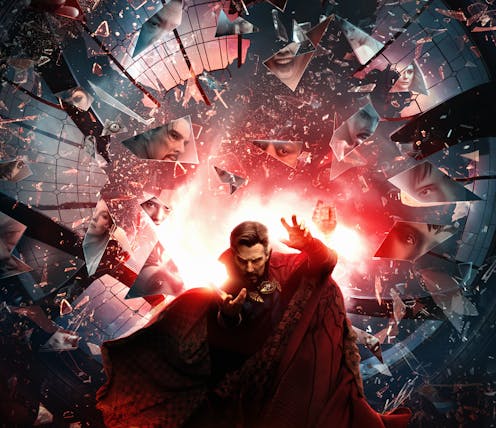
Whether you need a new villain or an old Spider-Man, your sci-fi movie will sound more scientifically respectable if you use the word multiverse. The Marvel multiverse puts different versions of our universe “out there”, somewhere. In these films, with the right blend of technology, magic, and imagination, travel between these universes is possible.
For example (spoilers!), in Spider-Man: No Way Home[1], we discover there are other universes and other Earths, some of which have their own local Spider-Man. In the universe of the movie, magic is possible.
This magic, thanks to a misfiring spell from superhero Dr Strange, causes some of the other Spider-Men to be transported into our universe, along with a few supervillains.
In Doctor Strange in the Multiverse of Madness[2] (in cinemas this week), the universe-on-universe buffoonery threatens a “desecration of reality”.
So, which of these ideas has Marvel borrowed from science, and which ones are pure fiction?
Multiverse lite: a really big universe
Could there be other Earths? Could there be other people out there, who look a lot like us, on a planet that looks like ours? Scientifically, it’s possible, because we don’t know how big our universe actually is.
We can see billions of light years into space, but we don’t know how much more space is out there, beyond what we can see.
If there is more space out there, full of galaxies, stars and planets, then there are more and more chances for Another-Earth to exist. Somewhere. With enough space and enough planets, any possibility becomes likely.
The fiction of the Marvel multiverse stems from the ability to travel between these other earths. There’s a good reason why Dr Strange needs to use magic for this.
According to Albert Einstein, we can’t travel through space faster than light. And while more exotic ways to travel around the universe are scientifically possible – wormholes, for example – we don’t know how to make them, the universe doesn’t seem to make them naturally, and there is no reason to think they’d connect us to Another-Earth rather than some random part of empty space.
So, almost certainly, if Another-Earth is out there somewhere, it’s unimaginably far away, even for an astronomer.
Changing the laws of nature
The Marvel multiverse might seem wild, but from a scientific perspective it’s actually too tame. Too normal. Too familiar. Here’s why.
The basic building blocks of our universe - protons and neutrons (and their quarks), electrons, light, etc. - are able to make amazing things, such as human life. Your body is astounding: energy-gathering, information-processing, mini-machine building, self-repairing.
Physicists have discovered[3] that the ability of our universe’s building blocks to make life forms is extremely rare. Just any old blocks won’t do.
If electrons had been too heavy, or the force that holds atomic nuclei together had been too weak, the stuff of the universe wouldn’t even stick together, let alone make something as marvellous as a living cell. Or, indeed, anything that could be called alive.
How did our universe get the right mix of ingredients? Perhaps we won the cosmic lottery. Perhaps, on scales much bigger than what our telescopes can see, other parts of the universe have different building blocks.
Our universe is just one of the options – a particularly fortunate one – among a multiverse of universes with losing tickets.
This is the scientific multiverse: not simply more of our universe, but universes with different fundamental ingredients. Most are dead, but very very rarely, the right combination for life-forms comes up.
The Marvel multiverse, by contrast, merely rearranges the familiar atoms and forces of our universe (plus a bit of magic). That’s not enough.
 In Spider-Man No Way Home, three different Spider-Man’s from alternate universe (and alternate Spider-Man movie franchises) team up to battle villains from across the multiverse.
IMDB
In Spider-Man No Way Home, three different Spider-Man’s from alternate universe (and alternate Spider-Man movie franchises) team up to battle villains from across the multiverse.
IMDB
Cosmic inflation and the Big Bang
What was our universe like in the past? The evidence suggests that the universe was hotter, denser and smoother. This is called the Big Bang Theory[4].
But was there a Big Bang? Was there a moment when the universe was infinitely hot, infinitely dense, and contained in a single point? Well, maybe. But we’re not sure, so scientists have explored a bunch of other options.
One idea, called cosmic inflation[5], says that in the first fraction of a second of the universe, it expanded extremely quickly. If true, it would explain a few things about why our universe expands in just the way it does.
But, how do you make a universe expand so rapidly? The answer is a new type of energy field. It has control of the first moments of the universe, causes a rapid expansion, and then hands the reins to the more familiar forms of matter and energy: protons, neutrons, electrons, light, etc.
Read more: Butt plug duels and fanny pack stunts: how Everything Everywhere All At Once fits into the canon of comedy-martial arts films[6]
Cosmic inflation might make a multiverse. Here’s how. According this idea, most of space is expanding, inflating, doubling in size, moment to moment. Spontaneously and randomly, in small islands, the new energy field converts its energy into ordinary matter with enormously high energies, releasing what we now see as a Big Bang.
If these high energies scramble and reset the basic properties of matter, then each island can be thought of as a new universe with different properties. We’ve made a multiverse.
 Everything Everywhere All At Once (2022) is about a regular woman trying to get her taxes done, who must also battle an evil that spans across the multiverse.
IMDB
Everything Everywhere All At Once (2022) is about a regular woman trying to get her taxes done, who must also battle an evil that spans across the multiverse.
IMDB
So is there a Multiverse?
In the cycle of the scientific method, the multiverse is in an exploratory phase. We’ve got an idea that might explain a few things, if it was true. That makes it worthy of our attention, but it’s not quite science yet. We need to find evidence that is more direct, more decisive.
Something left over from the aftermath of the multiverse generator might help. A multiverse idea could also predict the winning numbers on our lottery ticket.
However, as Dr Strange explains, “The multiverse is a concept about which we know frighteningly little.”
References
- ^ Spider-Man: No Way Home (www.imdb.com)
- ^ Doctor Strange in the Multiverse of Madness (www.imdb.com)
- ^ have discovered (www.scientificamerican.com)
- ^ Big Bang Theory (www.space.com)
- ^ cosmic inflation (www.newscientist.com)
- ^ Butt plug duels and fanny pack stunts: how Everything Everywhere All At Once fits into the canon of comedy-martial arts films (theconversation.com)










