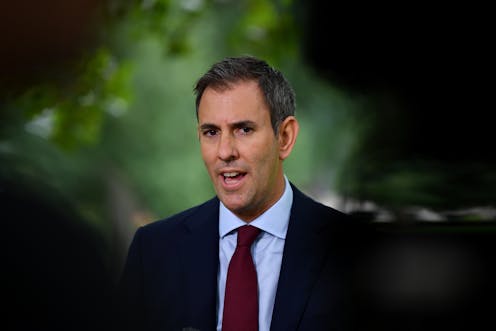
If Labor wins the election, he is set to become the next federal treasurer. So who is Jim Chalmers?
- Written by: Carol Johnson, Emerita Professor, Department of Politics and International Relations, University of Adelaide
This is the second in a two-part series on the major parties’ Treasury spokespeople. You can read Michelle Grattan’s profile of Josh Frydenberg here[1].
Shadow Treasurer Jim Chalmers decided it would be premature to stand for the Labor leadership after Bill Shorten’s 2019 election defeat. However, he is likely to be a serious candidate if Anthony Albanese loses the 2022 election. At the least, Chalmers has positioned himself to be a very capable senior minister in an Albanese government.
So who is Jim Chalmers?
He grew up in southern Brisbane and Logan City, in his current electorate of Rankin. He feels[2]
part of all I have met there: the local parents and pensioners, cleaners and kitchen hands, businesses and battlers, tradies and truckies.
His mother Carol was a nurse and his father Graham a courier. A favourite school teacher remembers[3] Chalmers as “always going to go into politics.”
Chalmers’ subsequent education suggests he was indeed aiming for a political career. He gained a Bachelor of Arts and Bachelor of Communication from Griffith University, and a PhD in political science from the Australian National University.
Chalmers’ PhD[4] on Paul Keating studied the sources and constraints of prime ministerial power. He argued Keating’s flaws included failing to build a good relationship with the media, and not engaging sufficiently with the concerns and aspirations of voters.
Chalmers had already begun working for the ALP before he completed his PhD. He went on to hold a variety of state and federal government advisory roles, including being former Labor Treasurer Wayne Swan’s chief of staff.
Chalmers’ experiences in the Rudd and Gillard governments led to a book[5], Glory Daze, which defended Labor’s economic management of the Global Financial Crisis (GFC) against critics, particularly the Murdoch press. After the Rudd government’s defeat, Chalmers co-authored a book[6] with Mike Quigley on the economic and social policy implications of technological disruption, Changing Jobs: The Fair Go in the New Machine Age.
He is married to Laura Anderson, and they have three children.
Read more: Politics with Michelle Grattan: Jim Chalmers on the budget Labor can't oppose[7]
What does Chalmers believe in?
Chalmers is therefore a somewhat unusual politician, more reflective and intellectual than most. However, he has also established himself as a very capable media performer with excellent communication skills. He is more personable, engaging and better at cutting through than his former boss, Wayne Swan.
But what does he stand for? Chalmers is a member of Labor’s right faction. In Glory Daze, he defined Labor as standing for intergenerational mobility, aspiration and the Fair Go, while emphasising the importance of sound economic management.
In many respects, those are still Chalmers’ values. However, there is one key difference. Acceptance of large deficits as a legitimate tool of economic management has grown since COVID-related stimulus spending. Labor increased government debt to fund stimulus packages during the GFC by significantly less[9] than the Coalition has during COVID.
Nonetheless, Rudd[10] and Swan[11] still emphasised the importance of getting back in the black, blaming massively falling government revenues for their failure to do so.
Chalmers now argues it is the quality not quantity of the government spend that is most important. Labor’s alternative budget should be assessed[12] “not on whether it’s a little bit bigger or a little bit smaller than our opponents” but on “value for money”. He criticises the Morrison government for a history of incompetent expenditure, claiming[13] it wasted billions on French submarines, consultants, unnecessary job keeper payments and electoral pork-barrelling.
He argues[14] the budget deficit is best addressed by ending the Coalition’s wasteful spending and rorts, while using government expenditure to increase productivity and grow the economy. Investing in education and training, innovation and developing local business supply chains are central to this agenda. Meanwhile increased funding for childcare and health would have both social and economic benefits.
Chalmers emphasises[15] the need for a future Labor government to work with business. He shares Anthony Albanese’s view that Bill Shorten’s targeting of the “big end of town” in the last election was a mistake[16].
Similarly, in line with his previous arguments, Chalmers prioritises encouraging “aspiration[17]”. Shorten’s focus on combating increasing class inequality has been replaced by a focus on addressing the cost of living pressures suffered by “working families”[18] who have experienced increasing prices and declining real wages.
Here, as elsewhere[19], Chalmers often draws on pre-Shorten Labor strategies. The term “working families” was widely used[20] by Kevin Rudd in the 2007 election campaign. It can evoke class but is less alienating to business and conservative voters than emphasising economic inequality.
Clearly Chalmers sees the focus on cost of living pressures and aspiration as connecting with voters’ concerns in a way that he has long argued Labor needs to do.
Meanwhile, the emphasis on working with business is intended to shore up Labor’s reputation as good economic managers. It reflects a traditional Labor view[21], strongly reaffirmed[22] by Anthony Albanese, that business and labour have common interests in a healthy, productive economy that generates employment.
Chalmers has repeatedly stressed [23] that Labor is committed to securing “an economy and a society stronger after COVID than before.” He is attempting to sell a positive message[24] of hope for the 2022 election campaign, while avoiding controversial policies that could unleash Coalition scare campaigns.
However, there are after-effects of the pandemic that may pose major challenges for Labor’s agenda, especially when combined with the economic fallout of international security issues.
Challenges ahead
There are good reasons[25] for Labor to tackle wage stagnation and low-paid, precarious work. Nonetheless, Chalmers skates over a potential contradiction in Labor’s plans to both work closely with business and increase real wages.
Labor argues that it will pursue a Bob Hawke-style consensus with business. However, it conveniently overlooks that Hawke’s consensus was reinforced by an Accord process[26] that substituted better government services and benefits for wage rises, eventually leading to real wage cuts.
Read more: Australian politics explainer: the Prices and Incomes Accord[27]
Hawke later admitted [28]that a rationale for the Accord was that “employers didn’t have to pay as much”. Furthermore, even former Labor prime ministers Chifley[29] and Whitlam[30] attempted to restrain real wage increases in times of inflation.
An Albanese Labor government would fund wage rises in aged care. However, many rises would cost the private sector, including in other sectors of predominantly female employment[31] where Chalmers supports substantial real wage increases.
Some far-sighted business people, in highly profitable industries, might accept that wage stagnation has damaged the economy by reducing consumption levels. Nonetheless, pandemic losses, combined with rising supply costs exacerbated by the war in Ukraine, have contributed to many sections of business being even more hesitant to raise their own workers’ wages now than would usually be the case.
Multiple business leaders and organisations have recently opposed wage rises, or argued for a substantial delay. These range from Restaurant and Catering Australia[32] to the Master Grocers Australia[33] and Timber Merchants Australia[34].
Meanwhile, the Masters Building Association[35] is mounting a campaign against Labor’s proposed abolition of the Australian Building and Construction Commission, arguing that it would unleash rogue building unions and “risk the economic recovery”.
Read more: The story of 'us': there's a great tale Labor could tell about how it would govern - it just needs to start telling it[36]
Widespread business opposition[37] can indeed give rise to perceptions Labor can’t manage the economy, with particular implications for voters employed in the private sector. Furthermore, Chalmers praises[38] the opportunities technology provides, including for working from home.
However, increased working from home during the pandemic has also demonstrated that many tasks can be done remotely, thereby exacerbating existing trends towards electronic offshoring[39] to lower wage countries.
Similarly, Labor’s and Chalmers’ much vaunted emphasis on education and training, including free TAFE, may no longer be the simple panacea it once was for improving standards of living. As machines become smarter[40], they replace not just unskilled jobs but many skilled ones as well.
In short, there can be downsides to the benefits technology can bring that Chalmers has arguably underestimated both in recent statements[41] and in his co-authored book on jobs in the Machine Age.
There are also other potential problems with Labor’s heavy reliance on education and training. Albanese’s recent statement[42] that “Labor’s historic task is to move more people into the middle-class” gels with Chalmers’ long-term focus on intergenerational mobility and aspiration.
While it is excellent to provide greater access to skills, training and equal opportunities, what about the traditional working class?
COVID provides lessons here too. There is some truth in the aphorism that during the pandemic the educated middle class often stayed safely working from home while members of the working class brought them things and kept essential services running.
Yet Labor rhetoric about aspiration all too often suggests a major solution to inequality lies in people leaving the working class. Consequently, what attracts “aspirationals”, risks leaving some traditional supporters feeling alienated and unappreciated.
Labor will also face a host of other economic and social challenges. Ruling out[43] increasing taxes other than on multinationals will still leave major government revenue losses resulting from Howard[44] and Morrison government[45] tax cuts. Increasing revenues from commodities trade with China [46] has temporarily helped the budget bottom line.
However, security concerns and declining trust have resulted in a decoupling[47] of the Australian and Chinese economies. This is likely to worsen as China searches for other markets, with negative implications for the Australian economy.
Admittedly, Chalmers would find it difficult to acknowledge such complex challenges during a small-target election campaign that focuses on promising a positive future. And he may be willing to address at least some future challenges in interesting ways if Labor wins office.
His book Changing Jobs includes a long list of new policy proposals for dealing with the Machine Age. For example, Chalmers and Quigley argue a robot tax is worthy of careful consideration. An opinion piece co-authored with Andrew Charlton (an architect of Kevin Rudd’s stimulus policies since parachuted in as Labor candidate for Paramatta) argues[48] for the possibility of “linking the tax and transfer system to ensure a minimum basic income for those who need it.”
A robot tax would encounter major business opposition and is ruled out in the near term by Chalmers’ rejection of new taxes. But Chalmers recently reaffirmed[49] that a minimum basic income for those who need it would be among “the sorts of issues that a Labor government would look at” given medium and longer term agendas.
In short, Chalmers may turn out to be a far more innovative politician than his current cautious election rhetoric suggests. Meanwhile, he continues to affirm[50] that Labor governments have historically been better economic managers than the Coalition.
Nonetheless, whoever wins government will face major economic and social challenges.
References
- ^ here (theconversation.com)
- ^ feels (parlinfo.aph.gov.au)
- ^ remembers (www.theaustralian.com.au)
- ^ PhD (openresearch-repository.anu.edu.au)
- ^ book (www.mup.com.au)
- ^ book (www.blackincbooks.com.au)
- ^ Politics with Michelle Grattan: Jim Chalmers on the budget Labor can't oppose (theconversation.com)
- ^ jimchalmers.org (jimchalmers.org)
- ^ less (theconversation.com)
- ^ Rudd (pandora.nla.gov.au)
- ^ Swan (alp.org.au)
- ^ be assessed (jimchalmers.org)
- ^ claiming (jimchalmers.org)
- ^ argues (jimchalmers.org)
- ^ emphasises (jimchalmers.org)
- ^ mistake (www.theaustralian.com.au)
- ^ aspiration (jimchalmers.org)
- ^ “working families” (jimchalmers.org)
- ^ elsewhere (insidestory.org.au)
- ^ widely used (electionspeeches.moadoph.gov.au)
- ^ traditional Labor view (catalogue.nla.gov.au)
- ^ reaffirmed (www.heraldsun.com.au)
- ^ stressed (jimchalmers.org)
- ^ positive message (www.jimchalmers.org)
- ^ good reasons (link.springer.com)
- ^ Accord process (insidestory.org.au)
- ^ Australian politics explainer: the Prices and Incomes Accord (theconversation.com)
- ^ admitted (www.abc.net.au)
- ^ Chifley (www.abc.net.au)
- ^ Whitlam (pmtranscripts.pmc.gov.au)
- ^ predominantly female employment (jimchalmers.org)
- ^ Restaurant and Catering Australia (www.theaustralian.com.au)
- ^ Master Grocers Australia (www.theaustralian.com.au)
- ^ Timber Merchants Australia (www.theaustralian.com.au)
- ^ Masters Building Association (www.theaustralian.com.au)
- ^ The story of 'us': there's a great tale Labor could tell about how it would govern - it just needs to start telling it (theconversation.com)
- ^ business opposition (insidestory.org.au)
- ^ praises (jimchalmers.org)
- ^ electronic offshoring (link.springer.com)
- ^ machines become smarter (link.springer.com)
- ^ recent statements (jimchalmers.org)
- ^ recent statement (www.heraldsun.com.au)
- ^ Ruling out (jimchalmers.org)
- ^ Howard (www.theguardian.com)
- ^ Morrison government (www.acoss.org.au)
- ^ commodities trade with China (thenewdaily.com.au)
- ^ decoupling (melbourneasiareview.edu.au)
- ^ argues (www.jimchalmers.org)
- ^ reaffirmed (jimchalmers.org)
- ^ affirm (jimchalmers.org)