A year after Myanmar’s coup, the military still lacks control and the country is sliding into an intractable civil war
- Written by: Nicholas Farrelly, Professor and Head of Social Sciences, University of Tasmania
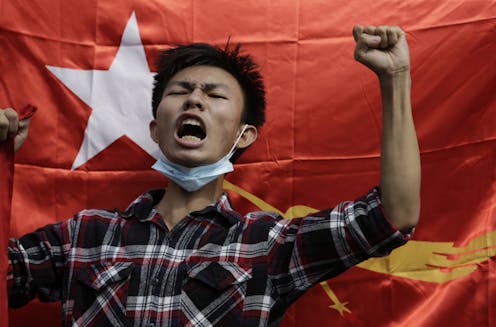
In the year since Myanmar’s coup[1] on February 1 2021, the country’s prospects have deteriorated sharply, with untold misery[2] for millions: deaths, arrests, detention, sickness, displacement, poverty and trauma.
The military’s misjudgement of the popular mood means the coup leader, Senior General Min Aung Hlaing, and his lieutenants still have only a loose grip on power.
The regime’s heavy-handed and often callous response to the initially peaceful defiance also means protest groups have been forced underground, where they have linked up with the exiled National Unity Government[3].
The ongoing detention[4] of the eternally popular[5] State Counsellor Aung San Suu Kyi, President Win Myint, and scores of other senior figures in the National League for Democracy government, including Australian economics advisor Professor Sean Turnell[6], has required a new generation of activists and leaders[7] to step up the resistance both on the ground and online.
Read more: Aung San Suu Kyi: Myanmar's democracy figurehead could face life imprisonment in 'politically motivated' prosecution[8]
While many of these activists have successfully evaded arrest, and some have found sanctuary with sympathetic ethnic armed groups in the borderlands, others have been detained[9] and paraded as “terrorists”.
They then disappear deep into the regime’s prisons and torture centres[10]. To confront the military regime takes untold courage. This includes the countless supporters who are not on the front line, but quietly use their networks, resources and skills to undermine the confidence of the dictatorship.
A new and torrid civil war
With the regime’s brutality[11] on daily display, peaceful protests have been largely abandoned as a tactic.
There are now relentless counterattacks by ethnic armies and the new People’s Defence Force[12], which mean it is a dangerous time to be wearing a Myanmar army or police uniform, or even to be serving in the government in a civilian role. Assassinations[13] and other reprisals are now a part of the unpredictable security landscape.
The military needs to keep up its fighting strength, although it has reportedly[14] struggled to recruit fresh cadets for its top training school.
However, it has been securing new weapons from Russia[15] and China[16]. Attack planes and helicopters are regularly used against civilian populations. The military has even been accused of destroying[17] unarmed humanitarian convoys.
Military commanders at every level must now fear the prospect of being held to account for this violence, whether by their own people or a future international tribunal.
Read more: Sanctions against Myanmar's junta have been tried before. Can they work this time?[18]
Historically, Myanmar military units have acted with impunity in remote ethnic minority regions far from the gaze of journalists and civil society. Much of the fighting in the past year, however, has been well-documented, with special attention to actions that could be deemed war crimes.
In Chin State[19] and Sagaing Region[20], both sites of alleged atrocities against civilians, tens of thousands of people have been newly displaced and now hunker down under the protection of the People’s Defence Forces.
They join the Rohingya[21] and others who have suffered similar fates too often over the years.
Deteriorating conditions and weak responses
While the Association of Southeast Asian Nations (ASEAN) has discussed a diplomatic response to the deteriorating situation, there are no indications the military leadership is listening to advice or considering surrendering its power. Instead, the generals talk vaguely of scheduling an election in 2023.
With an ailing economy, a public health care system[22] in disarray and a shattered international reputation, Myanmar faces a difficult path back from this crisis. Even if the generals eventually succeed in consolidating their rule – a big “if” – they will remain pariahs for their unflinching attacks on their own people.
There is now also momentum[23] behind the resistance forces and, for the first time in many decades, it is plausible the army could be defeated.
However, it is more likely Myanmar’s humanitarian, political and security situation continues to deteriorate in the months ahead, with large-scale battles, tit-for-tat ambushes, and continued military campaigns against civilians.
Under these trying and tragic circumstances, the regional and global diplomatic response[24] is vital.
So far, ASEAN has frustratingly vacillated between important[25] expressions of disapproval[26] and its more traditional stance of non-interference[27] in members’ internal affairs.
Russia, meanwhile, has provided the coup leaders with direct support[28], such as arms and firm diplomatic endorsement.
China appears to have taken a more watchful posture, but also recently transferred[29] a second-hand submarine to the junta.
Beijing is no doubt concerned about how an ongoing civil war could imperil its interests, including the gas and oil pipelines running from Myanmar’s coast to China’s Yunnan province. It has the extra challenge[30] of dealing with the often unruly borderland populated by some of Myanmar’s most powerful armed groups.
Where does it end?
For the western democracies, and for the more progressive ASEAN countries, the best medium-term outcome is the military regime being forced from power in a negotiated settlement. This could limit the bloodshed, but many people in Myanmar are now fully committed to defeating the junta on the battlefield.
This would require western countries to recognise the National Unity government and offer the People’s Defence Force more humanitarian, and perhaps military, support. Without that type of backing, the NUG is likely to remain isolated and under-resourced against the relative might of the Myanmar military machine.
Read more: Myanmar's coup might discourage international aid, but donors should adapt, not leave[31]
Getting the right balance will be difficult for western governments sympathetic to the anti-coup forces, but mindful that ill-timed moves against the military will only generate more retribution against civilians. And this could spiral into a great power proxy war.
On the other hand, this risk could give China and other players reason to proceed more cautiously. China can hardly afford a global flashpoint on its backdoor.
It is an immense pity the people of Myanmar now carry such a heavy burden in fighting for the future of their country. International observers can provide material support for the opposition movement or push their governments to act more strongly in response to the crimes against humanity being committed in Myanmar.
But the hard reality, at this moment in geopolitics, is Myanmar’s people will be the ultimate authors of their own destiny.
References
- ^ coup (theconversation.com)
- ^ misery (drive.google.com)
- ^ National Unity Government (www.nugmyanmar.org)
- ^ ongoing detention (www.abc.net.au)
- ^ eternally popular (theconversation.com)
- ^ Professor Sean Turnell (theconversation.com)
- ^ a new generation of activists and leaders (theconversation.com)
- ^ Aung San Suu Kyi: Myanmar's democracy figurehead could face life imprisonment in 'politically motivated' prosecution (theconversation.com)
- ^ others have been detained (theconversation.com)
- ^ torture centres (www.hrw.org)
- ^ brutality (www.theguardian.com)
- ^ People’s Defence Force (www.crisisgroup.org)
- ^ Assassinations (www.rfa.org)
- ^ reportedly (www.irrawaddy.com)
- ^ Russia (www.reuters.com)
- ^ China (www.rfa.org)
- ^ destroying (thediplomat.com)
- ^ Sanctions against Myanmar's junta have been tried before. Can they work this time? (theconversation.com)
- ^ Chin State (www.myanmar-now.org)
- ^ Sagaing Region (www.myanmar-now.org)
- ^ Rohingya (theconversation.com)
- ^ public health care system (www.msf.org)
- ^ momentum (www.sbs.com.au)
- ^ regional and global diplomatic response (theconversation.com)
- ^ important (www.aspistrategist.org.au)
- ^ disapproval (theconversation.com)
- ^ non-interference (www.theguardian.com)
- ^ direct support (www.irrawaddy.com)
- ^ transferred (www.defensenews.com)
- ^ extra challenge (www.irrawaddy.com)
- ^ Myanmar's coup might discourage international aid, but donors should adapt, not leave (theconversation.com)