Insect repellents work – but there are other ways to beat mosquitoes without getting sticky
- Written by: Cameron Webb, Clinical Associate Professor and Principal Hospital Scientist, University of Sydney
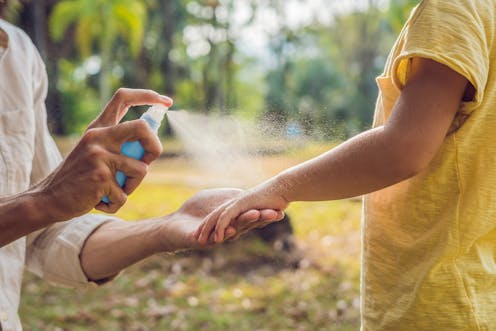
Summer can be hot and sticky. And insect repellent creams, lotions, and sprays can make it stickier.
Stopping mosquito bites is key to avoiding itchy bumps and mosquito-borne disease. Thankfully, there are several methods can you try – and some things to avoid – for a mozzie bite-free summer.
Topical insect repellents are safe and effective
Insect repellents are a safe, effective, and affordable way to prevent mosquito bites[1].
They are promoted by health authorities in Australia[2] as the best way to avoid mosquito bites.
Products sold in Australia must be approved for sale by the Australian Pesticides and Veterinary Medicines Authority[3] (APVMA) which checks products for safety and effectiveness. If applied as recommended – a thin and even coat over all exposed areas of skin – insect repellents can prevent mosquito bites. How long bite protection lasts varies with the strength of the formulation but research has shown it can last for many hours[4].
But insect repellents aren’t always the perfect solution. Despite being recommended by health authorities and experts[5] around the world and many studies demonstrating registered repellents cause minimal adverse reactions[6], there remains a perception they can pose a health risk[7], contaminate[8] the natural environment or they’re unpleasant to use.
In Australia, not much has changed with regard to the active ingredients used in repellent formulations but the cosmetic constituents have greatly improved, making them more pleasant to use.
For those who find insect repellents a challenge, there are alternatives to creams, lotions and sprays.
Insecticide sprays ✅
Insecticides can help knock down or repel[9] buzzing and biting mosquitoes. But, be warned, these products aren’t specific to mosquitoes so using them too frequently will reduce the beneficial insects[10] around your home.
Mosquito coils and other devices ✅
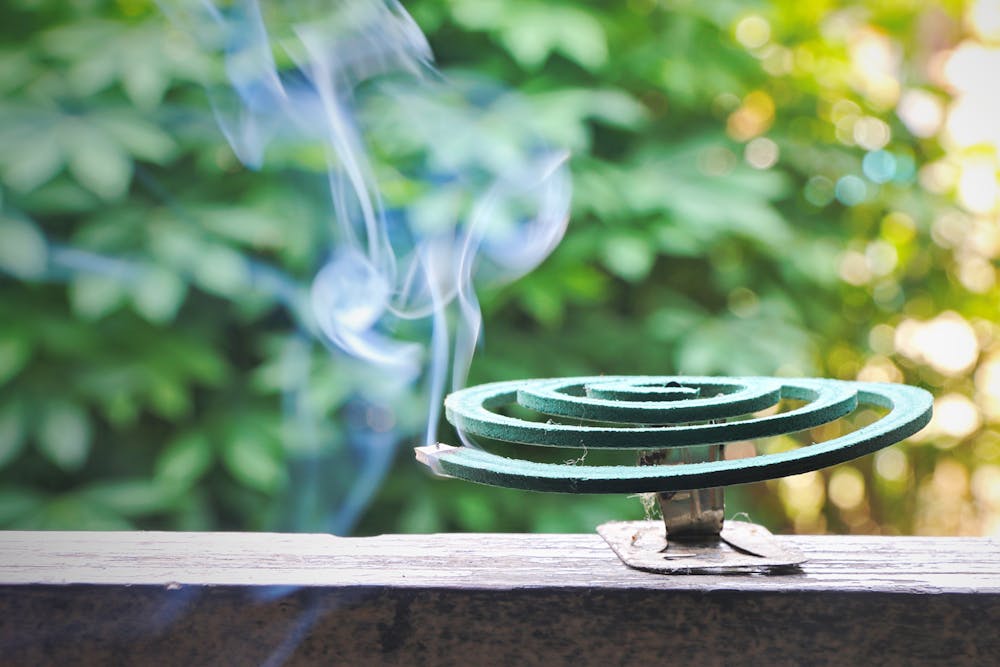
Mosquito coils have been a mainstay of the Australian summer. They will certainly assist in reducing bites[11] in sheltered areas and those with insecticides will work best.
But never burn them inside, especially not beside the bed at night. The smoke you inhale can be bad for your health[12].
A range of alternative devices[13] work like “smoke free” mosquito coils. These devices are either battery or plug in powered and rely on heating an insecticide treated pad or reservoir of oil to release product that knocks out or repels mosquitoes. These can be a useful option indoors and can even be paired with a timer to work for only a few hours during the evening.
Portable devices are that can be clipped to your belt when out and about. It’s important to remember that as soon as you’re outside, especially in windy conditions or close to wetland or bushland areas, these products become less effective.
Read more: Curious Kids: When we get bitten by a mosquito, why does it itch so much?[15]
Dress for success ✅
Probably the best alternative to putting repellents on your skin is to cover up. This is always tricky when it is hot and humid but the physical barrier clothing provides may be the best option in areas where mosquito activity is high.
Long sleeved shirts, long pants, and covered shoes are key[16] to this approach.
Protection against mosquito bites can be improved by applying an insecticide to clothing[17]. For extra protection[18], clothing can be treated with the insecticide permethrin – the same insecticide used to treat bed nets in countries prone to malaria. Always use as directed and do not apply directly to the skin.
Wrist bands and sound emitting devices ❌
For those wanting to avoid topical repellents, the coloured wrist bands sold in many pharmacies and supermarkets may seem an desirable option. Unfortunately, there is no scientific evidence[19] these devices, irrespective of the active ingredients they contain, can provide whole body protection against mosquitoes.
Mosquitoes don’t seem put off by sound either. For decades small sound-emitting devices have been sold, and repeatedly shown to be ineffective[20]. “Mosquito repellent” smart phone apps don’t work either[21].
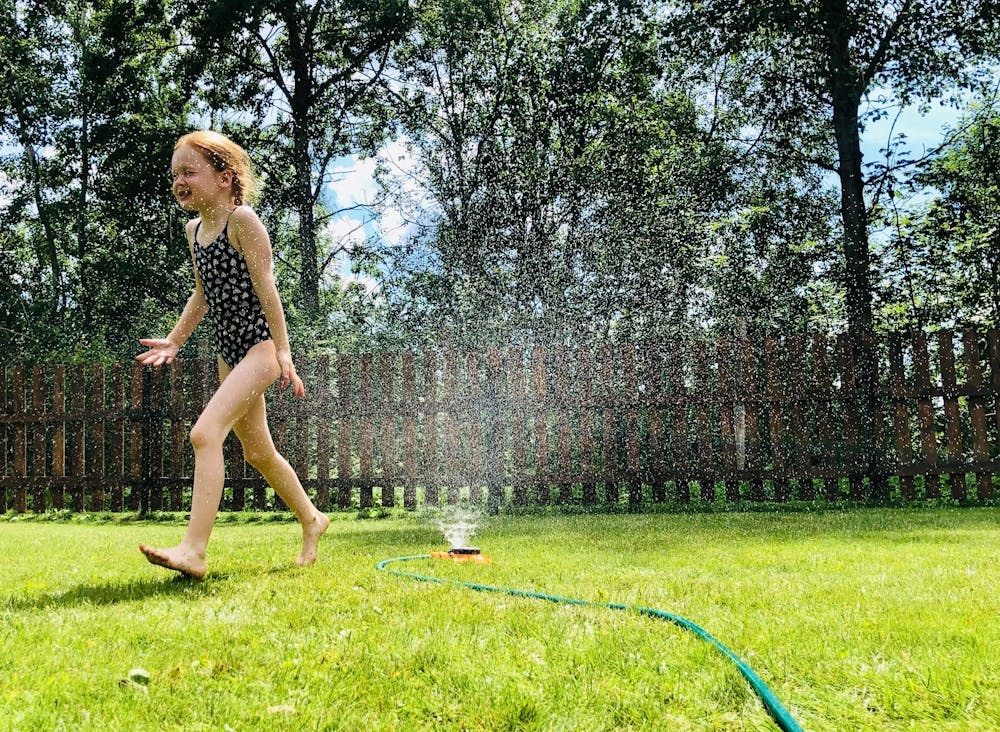 Summer fun is quickly ruined by mosquito bites.
Elena Rabkina/Unsplash, CC BY[22][23]
Summer fun is quickly ruined by mosquito bites.
Elena Rabkina/Unsplash, CC BY[22][23]
Changing your diet ❌
It would be wonderful if there was a pill we could take to prevent us being bitten by mosquitoes. It would overcome the challenges of getting you to apply sticky and unusual smelling solutions throughout summer. Problem is, such a thing doesn’t exist. There is no scientific evidence[24] anything you can eat or drink will prevent mosquitoes biting you.
You can still enjoy your gin and tonic, bananas, or vegemite on toast – just don’t expect the mosquitoes to stop biting!
Read more: Bzzz, slap! How to treat insect bites (home remedies included)[25]
The final word (give repellents a chance)
It is important to remember mosquitoes are more than just a nuisance[26]. Viruses spread by mosquitoes in Australia can cause debilitating disease. There are few treatments available for these illnesses, so prevention is vital.
You may not like applying insect repellent, but it is probably the best strategy we’ve got. Just as we’ve developed the habit of using sunscreen on a regular basis, we need to get into the swing of smearing or spraying on some insect repellent during the warmer months too.
References
- ^ prevent mosquito bites (www.phrp.com.au)
- ^ promoted by health authorities in Australia (www.frontiersin.org)
- ^ Australian Pesticides and Veterinary Medicines Authority (apvma.gov.au)
- ^ last for many hours (onlinelibrary.wiley.com)
- ^ recommended by health authorities and experts (academic.oup.com)
- ^ minimal adverse reactions (www.sciencedirect.com)
- ^ health risk (www.health.harvard.edu)
- ^ contaminate (pubmed.ncbi.nlm.nih.gov)
- ^ knock down or repel (academic.oup.com)
- ^ reduce the beneficial insects (theconversation.com)
- ^ assist in reducing bites (bioone.org)
- ^ can be bad for your health (theconversation.com)
- ^ alternative devices (parasitesandvectors.biomedcentral.com)
- ^ Shutterstock (image.shutterstock.com)
- ^ Curious Kids: When we get bitten by a mosquito, why does it itch so much? (theconversation.com)
- ^ key (www.health.nsw.gov.au)
- ^ applying an insecticide to clothing (theconversation.com)
- ^ extra protection (journals.plos.org)
- ^ no scientific evidence (search.informit.org)
- ^ repeatedly shown to be ineffective (www.cochranelibrary.com)
- ^ don’t work either (theconversation.com)
- ^ Elena Rabkina/Unsplash (unsplash.com)
- ^ CC BY (creativecommons.org)
- ^ no scientific evidence (theconversation.com)
- ^ Bzzz, slap! How to treat insect bites (home remedies included) (theconversation.com)
- ^ more than just a nuisance (theconversation.com)