A short history of the Aboriginal Tent Embassy – an indelible reminder of unceded sovereignty
- Written by: Bronwyn Carlson, Professor, Indigenous Studies and Director of The Centre for Global Indigenous Futures, Macquarie University
Aboriginal and Torres Strait Islander readers are advised this article contains names and images of deceased people.
Often people think about the Aboriginal Tent Embassy as something historic, dating back to the 1970s. But it should also be thought of as a site of the longest protest for Indigenous land rights, sovereignty and self-determination in the world[1].
In fact, this year, the Tent Embassy is set to celebrate its 50th continuous year of occupation[2]. Demonstrating its significance to Australian history, it was included on the Commonwealth Heritage List[3] in 2015 as part of the Old Parliament House precinct.
In this momentous year, it’s worth remembering how the Tent Embassy came to be and what it has continued to stand for since its erection in 1972 – and the significance it still has today.
Aliens in our own land
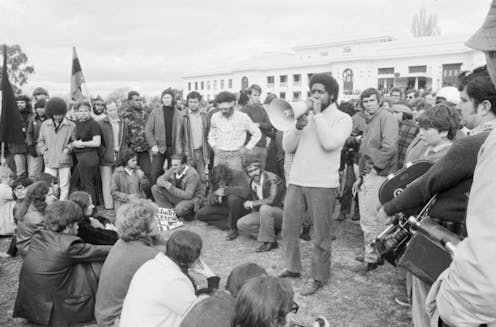
The Tent Embassy began its public life on January 26 1972. On that day, Michael Anderson, Billy Craigie, Bertie Williams and Tony Coorey left Redfern and drove to Ngunnawal Country (Canberra), where they planted a beach umbrella opposite Parliament House (now known as Old Parliament House).
They erected a sign that said “Aboriginal Embassy”. With them on that day was their driver, Tribune photographer Noel Hazard, who captured the event in a series of photos.
The term “embassy” was used to bring attention to the fact Aboriginal people had never ceded sovereignty nor engaged in any treaty process with the Crown. As a collective, Aboriginal people were the only cultural group not represented with an embassy.
According to Aboriginal activist and scholar Gary Foley, the absence of an Aboriginal embassy in Canberra was a blatant indication Aboriginal people were treated like aliens in their own land[4].
Initially, the protesters were making a stand about land rights following the then prime minister William McMahon’s speech that dismissed any hope for Aboriginal land rights[5] and reasserted the government’s position on the policy of assimilation[6]. The Tent Embassy was therefore a public display of our disapproval of and objection to the policies and practices of the government.
In later years, it has become an acclaimed site of our continued resistance to the continuity of colonial rule.
Read more: Why the Australian government must listen to Torres Strait leaders on climate change[7]
Demands of protesters
Police who were patrolling the area at the time of the Tent Embassy’s erection asked the protesters what they were doing outside Parliament House. They said they were protesting and would do so until the government granted land rights to Aboriginal people. The police were said to have responded, “That could be forever[8]”.
As it turned out, it was not illegal to camp on the lawns of Parliament House, so the police could not remove them.
Later, on February 6 1972, the members of the Tent Embassy issued their list of demands to the government. The demands were clearly about our rights as Aboriginal people to our homelands, regardless of the fact cities were now built on the land or mining companies were interested in the bounties within.
Compensation was called for in the instances where the lands was not able to be returned. There were also demands for the protection of our sacred sites.
While the McMahon government cared little about negotiating with the protesters, the leader of the Opposition, Gough Whitlam, visited the Tent Embassy and publicly proclaimed a promise of Aboriginal land rights[9] under a future Labor government.
There was widespread support for the Tent Embassy from Aboriginal and Torres Strait Islander people and allies across the continent, and indeed the world.
Media attention also grew as it became obvious the Tent Embassy and protesters were not going to move on. Other Aboriginal activists joined the embassy, including Foley, Isabel Coe, John Newfong, Chicka Dixon, Gordon Briscoe and many others.
Read more: From dispossession to massacres, the Yoo-rrook Justice Commission sets a new standard for truth-telling[10]
Forced removal and revival
The government was not too keen on being reminded Aboriginal people were demanding rights, so it amended[11] the Trespass on Commonwealth Lands Ordinance to make it illegal to camp on the lawn of Parliament House. This gave the police the authority to remove the protesters.
The ordinance was but a few hours old when police attempted to forcibly remove the embassy[12]. They did so to the roar of the crowd chanting “land rights now”. A violent confrontation with police[13] ensued.
On September 12 1972, the ACT Supreme Court ruled against the use of the trespass laws, and the Tent Embassy was temporarily re-erected before being removed again the following morning.
Then, at the end of 1972, the Coalition government led by McMahon lost the federal election to Labor. Whitlam was able to keep his promise in part – he did give the land title deeds to the Gurindji people. This was captured in the historical photo[14] by Merv Bishop of Whitlam pouring a fistful of dirt into Vincent Lingiari’s hand.
While this iconic image has become a demonstration of what might be possible, the work of the embassy is not yet done. Land rights across the continent have yet to be fully achieved.
The Tent Embassy was re-established the following year and remained until activist Charles Perkins negotiated its removal[15] pending the enactment of the Aboriginal Land Rights Act in 1976.
In the ensuing years, it occupied several other sites around Canberra, including the site of the current Parliament House. In 1992, it returned to its original site on the lawn of Old Parliament House to mark the 20th anniversary of the original protest.
Eleven years later, much of the Tent Embassy was destroyed by fire in a suspected case of arson[16]. The police once again attempted to remove protesters from the site under orders from federal government’s National Capital Authority[17].
An enduring symbol of protest
Today, the Tent Embassy remains on the lawns of Old Parliament House as a reminder of the successive failures of subsequent governments to address the demands for justice represented by the embassy and its people.
As Foley reflects[18] in his history of the embassy:
That it has endured for [five] decades as a potent symbol rejecting the hypocrisy, deceit and duplicity by successive Australian governments is a testament to the refusal of large numbers of Aboriginal people to concede defeat in a 200-year struggle for justice.
Nowhere else in the world have we seen such longevity around a site of protest. The Aboriginal Tent Embassy is an impressive achievement that demonstrates the tenacity of Aboriginal and Torres Strait Islander people and our continued fight for the reclamation of our lands and sovereign rights as First Nations peoples.
References
- ^ in the world (www.echo.net.au)
- ^ 50th continuous year of occupation (www.smh.com.au)
- ^ Commonwealth Heritage List (www.canberratimes.com.au)
- ^ Aboriginal people were treated like aliens in their own land (www.naa.gov.au)
- ^ dismissed any hope for Aboriginal land rights (law.unimelb.edu.au)
- ^ assimilation (australianstogether.org.au)
- ^ Why the Australian government must listen to Torres Strait leaders on climate change (theconversation.com)
- ^ That could be forever (press-files.anu.edu.au)
- ^ publicly proclaimed a promise of Aboriginal land rights (www.theguardian.com)
- ^ From dispossession to massacres, the Yoo-rrook Justice Commission sets a new standard for truth-telling (theconversation.com)
- ^ amended (law.unimelb.edu.au)
- ^ police attempted to forcibly remove the embassy (www.youtube.com)
- ^ violent confrontation with police (www.youtube.com)
- ^ historical photo (www.abc.net.au)
- ^ Charles Perkins negotiated its removal (commonslibrary.org)
- ^ suspected case of arson (www.culturalsurvival.org)
- ^ orders from federal government’s National Capital Authority (www.greenleft.org.au)
- ^ Foley reflects (www.routledge.com)