Are parents criminally responsible for the actions of their child? In the Oxford shooting case, prosecutors say yes
- Written by: Thaddeus Hoffmeister, Law Professor, University of Dayton
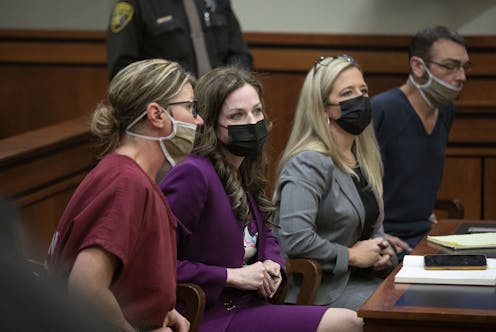
Many were surprised when James and Jennifer Crumbley[1], the parents of Ethan Crumbley[2], the 15-year-old boy accused of killing four classmates at Oxford High School in Oakland County, Michigan, were charged for their alleged role in the tragedy.
Criminal law, unlike civil law, is less likely to hold defendants liable for the actions of a third party, even if that third party is the defendant’s child. This is because in criminal law defendants face incarceration and the associated stigma that comes with a conviction.
Both Crumbley parents have pleaded not guilty to four counts each of involuntary manslaughter. If convicted on all counts, they each face a maximum prison sentence of 60 years[3] and maximum fines of US$30,000. Unable to make the combined $1 million bond, they appeared before a judge on Dec. 3, 2021, in prison uniforms and chains.
In the rare instances that parents of school shooters are prosecuted[4], they are normally charged with crimes such as child abuse, child neglect and failure to properly secure a firearm. The charge lodged against the Crumbleys, involuntary manslaughter[5], also known as gross negligent homicide, is even more uncommon.
But it’s not without precedent.
A first grader’s death
In 2000, Jamelle James[6], a Michigan resident, pleaded no contest to involuntary manslaughter for leaving his handgun in a shoebox in his bedroom. At the time, James lived in an apartment prosecutors described as a “flophouse” that was shared with a number of people, including two young children.
A 6-year-old boy – James’ nephew – was temporarily living in the apartment and discovered the gun, brought it to school and fatally shot his first grade classmate Kayla Rolland. James spent more than two years in prison before he was released on probation.
Prosecutors claimed that James’ conduct was “grossly negligent” and “so reckless as to demonstrate a substantial lack of concern for whether an injury resulted.” Arguably, leaving an unsecured gun around very young children demonstrated James’ gross negligence.
The Oxford shootings were the deadliest at a U.S. K-12 campus since 2018 and claimed the lives of Madisyn Baldwin, 17; Tate Myre, 16; Hana St. Juliana, 14; and Justin Shilling, 17. Seven others were injured.
Oakland County prosecutor Karen McDonald took direct aim at Crumbley’s parents. Their behavior, McDonald explained, was “egregious.”[8]
“I want to be really clear that these charges are meant to hold the individuals who contributed to this tragedy accountable and also send a message that gun owners have a responsibility,” McDonald said during a news conference[9]. “When they fail to uphold that responsibility, there are serious and criminal consequences.”
One of the key questions for jurors, assuming no plea deal is reached, is whether the parents knew that a school shooting would occur or had reckless disregard of this fact. To prove the parents’ gross negligence[10], the prosecution will most likely rely on a series of alleged facts.
‘Egregious’ behavior
Among the most central facts is that the Crumbleys bought their son the handgun[11] as a Christmas present and later took him to target practice.
Neither parent informed the school that they had bought the gun and that their son had access to it.
After being told that her son was searching for ammo on his phone at school, Jennifer Crumbley told her son via text message not to get caught[12]: “LOL I’m not mad. You have to learn not to get caught.”
Neither of the parents opted to remove their son from school after being told that a teacher found a disturbing drawing of a bloody figure[13] in his desk.
Finally, the gun was unsecured.
Though the prosecution’s case appears compelling, the Crumbleys’ defense team has some very strong counterarguments.
For starters, the weapon was legal to own, and Michigan has no law requiring the gun to be properly stored away from juveniles. As for informing the school about their son’s access to weapons, the defense will likely argue that the Crumbleys had no duty to do so, nor were they required to pull their son from school.
Finally, with regards to the text, Jennifer Crumbley will most likely claim that her text about the ammo was sent jokingly and she thought her son planned to shoot at targets, not other children.
Changing the laws
In the James case, the 6-year-old who shot his classmate was never charged with a crime because most jurisdictions hold that children under the age of 7 are unable to formulate criminal intent.
The same cannot be said for Ethan Crumbley. He has been charged with four counts[14] of first-degree murder, one count of terrorism causing death, seven counts of assault with intent to murder and 12 counts of possession of a firearm in the commission of a felony.
Despite the challenges facing the prosecution, many people on both sides of the gun safety debate applaud the efforts of Oakland County prosecutor Karen McDonald[16].
This may be attributable to the fact that most school shooters have little difficulty acquiring their weapons. According to a 2019 assessment by the U.S. Department of Homeland Security[17], 76% of the guns used in school shootings came from a parent or close relative, and approximately half the weapons were easily accessible.
Prosecuting the Crumbleys may reverse this trend, as may recently proposed state and federal legislation. Two weeks after the Oxford shootings, U.S. Rep. Elissa Slotkin, D-Mich., proposed a new law[18] holding parents or other responsible adults liable for failing to secure their firearms. Michigan, along with a majority of other states, lacks a secure gun storage law, and a new federal law could make up for the absence of legislation at the state level and create penalties for failure to safely store guns.
The tragic events at Oxford High School – and the case against the Crumbleys – may be the catalyst for getting this legislation enacted and making parents criminally responsible for their children’s behavior. This case also may demonstrate that the debate on gun safety has moved from the statehouse to the courthouse.
[The Conversation’s Politics + Society editors pick need-to-know stories. Sign up for Politics Weekly[19].]
References
- ^ James and Jennifer Crumbley (www.detroitnews.com)
- ^ Ethan Crumbley (www.independent.co.uk)
- ^ prison sentence of 60 years (www.clickondetroit.com)
- ^ parents of school shooters are prosecuted (www.newsweek.com)
- ^ involuntary manslaughter (www.justia.com)
- ^ Jamelle James (www.mlive.com)
- ^ Photo by Oakland County Sheriff's Office via Getty Images (www.gettyimages.com)
- ^ “egregious.” (www.npr.org)
- ^ McDonald said during a news conference (www.cnn.com)
- ^ gross negligence (dictionary.law.com)
- ^ Crumbleys bought their son the handgun (www.nytimes.com)
- ^ Crumbley told her son via text message not to get caught (www.bbc.com)
- ^ disturbing drawing of a bloody figure (www.washingtonpost.com)
- ^ charged with four counts (www.usatoday.com)
- ^ Scott Olson/Getty Images (www.gettyimages.com)
- ^ applaud the efforts of Oakland County prosecutor Karen McDonald (quchronicle.com)
- ^ According to a 2019 assessment by the U.S. Department of Homeland Security (www.pbs.org)
- ^ proposed a new law (detroit.cbslocal.com)
- ^ Sign up for Politics Weekly (memberservices.theconversation.com)