New Zealanders are super-connected. When restrictions lift in Auckland, it won't take much to amplify Delta's spread
- Written by: Dion O'Neale, Lecturer - Department of Physics, University of Auckland; Principal Investigator - Te Pūnaha Matatini, University of Auckland
As Aotearoa New Zealand moves from elimination to suppression, we need to understand how this could change the nature of transmission from Auckland’s Delta outbreak to the rest of New Zealand.
Aucklanders can expect a three-step easing of restrictions[1], followed by the new traffic light COVID-19 protection framework[2], once 90% of those eligible are vaccinated.
The lifting of restrictions will come as a relief for many who are missing friends and family and are struggling with social isolation. But as additional transmission pathways open, simple changes in a network can result in complex outcomes.
A common phenomenon within complex networks is called the “percolation effect” — the addition of new connections results in a “phase transition” where a once poorly connected network can quickly turn into a highly connected one.
For Auckland, this means the gradual addition of just one or two new connections between families could result in a vastly more connected city. The whole country could become far more connected than initially assumed.
As part of our work to simulate viral transmission under the new conditions, we have created a synthetic version of Aotearoa[3] using the Populated Aotearoa Interaction Network (PAIN).
This is a synthetic network representing Aotearoa New Zealand, where every person has an age, sex, ethnicity, and place of employment or education. These individuals are treated as nodes in a network and interact through community contexts, much like those we will experience when we begin interacting with family members and friends as restrictions ease.
With the PAIN, we can model transmission to more accurately reflect the experiences of individuals, compared to less complex models that average interaction patterns.
This has allowed us to model the potential trajectory of COVID-19 outbreaks[4] and predict how changes in alert level policy, vaccination rates and increased social connection might affect the spread of the virus.
Simple changes, complex outcomes
One important feature of an interaction network is the “largest connected component” (LCC), which tells us the approximate number of people COVID-19 could theoretically spread to, based on the connections people share.
In a scenario like the strictest alert level 4, where most community connections are removed, we see the interaction network for Aotearoa broken up into many small disconnected sections. In this case, the largest connected component through households and community interactions would contain around 90,000 linked individuals.
But for a level of intervention like alert level 3, potential community interactions increase through families extending their bubbles. We see the largest connected component increase by a factor of almost 15, to around 1.4 million connected individuals.
Read more: ‘If you want summer, get vaccinated’ – Jacinda Ardern sets the target for re-opening New Zealand[5]
These numbers are based on the optimistic assumption we can neglect interactions in workplaces on the basis that masking and good ventilation reduce transmission significantly.
This clearly demonstrates New Zealand is a highly connected society and most New Zealanders will be connected to each other through interactions we share. We argue this makes mitigation strategies — vaccination, masking, distancing — even more important.
Given ongoing community transmission and a rising number of unlinked cases, the three-step roadmap, even with people only meeting up in pairs, moves us to a situation where Auckland is essentially reconnected, from a contagion point of view.
Equity in a ‘pandemic of the unvaccinated’
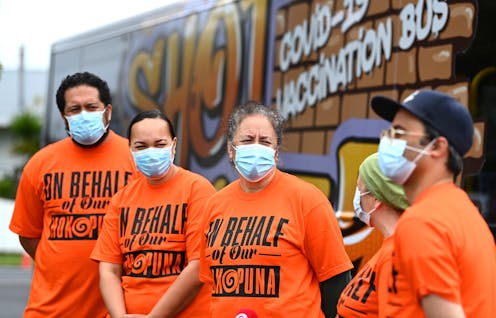
The move away from elimination comes at a point when some communities still have low vaccination rates, in particular Māori and younger people. The average age of Māori in Auckland is 26; most of this younger cohort (Group 4) has only been eligible for vaccination since September 1.
The return of children to early childhood centres, with bubbles of up to ten, is concerning since infants and toddlers cannot currently be vaccinated. High rates of respiratory illness among New Zealand children further compounds the risk of serious illness from COVID-19.
Our models clearly show only a small number of additional connections are necessary to sufficiently connect existing bubbles such that a large percentage of the population would be reachable if there is uncontrolled spread. The evidence from the current Delta outbreak shows the virus is finding unvaccinated people.
Read more: New Zealand cannot abandon its COVID elimination strategy while Māori and Pasifika vaccination rates are too low[6]
Most of us don’t have any influence on decisions the government makes. What we can control is the decisions we make ourselves. The best we can do right now is manage our own risk, making sure the virus can’t spread when connections are made.
There are several steps[7] we can take to ensure connections do not turn into uncontrolled clusters of COVID-19. With the exception of those now required to go back to work, we should think of new freedoms as options, not targets.
Reducing transmission
Even if we’re vaccinated, we should continue to act like we have the virus, thinking about our new contacts as potentially connected to cases of COVID-19 that haven’t been detected yet.
If you reconnect with family or friends, keep the total number of new connections to a minimum. If meeting people from other households, take every precaution to keep each other safe, stay outside and always wear a well fitted mask.
Make a note of all your connections, in the app or a diary. Remember to record the name and phone numbers to make contact tracing as fast and easy as possible, should you come into contact with the virus.
Creating large chains by connecting with lots of different bubbles will very quickly result in one large connected network, increasing the risk of spread and making contact tracing more difficult. It falls upon all of us to take every step we can to make sure we protect our loved ones, and our community.
We would like to acknowledge the contribution of Kylie Stewart, a member of the team at Te Pūnaha Matatini and the HRC-funded project Te Matatini o te Horapa — a population based contagion network for Aotearoa NZ.
References
- ^ three-step easing of restrictions (covid19.govt.nz)
- ^ COVID-19 protection framework (covid19.govt.nz)
- ^ synthetic version of Aotearoa (www.tepunahamatatini.ac.nz)
- ^ potential trajectory of COVID-19 outbreaks (www.tepunahamatatini.ac.nz)
- ^ ‘If you want summer, get vaccinated’ – Jacinda Ardern sets the target for re-opening New Zealand (theconversation.com)
- ^ New Zealand cannot abandon its COVID elimination strategy while Māori and Pasifika vaccination rates are too low (theconversation.com)
- ^ several steps (time.com)