2025 CIFTIS: Green technology empowers global trade in services
BEIJING, CHINA - Media OutReach Newswire - 15 September 2025 - Global trade in services is accelerating its shift toward greener and smarter development, with green technologies and environmental solutions emerging as new growth drivers and creating broader opportunities for international cooperation.
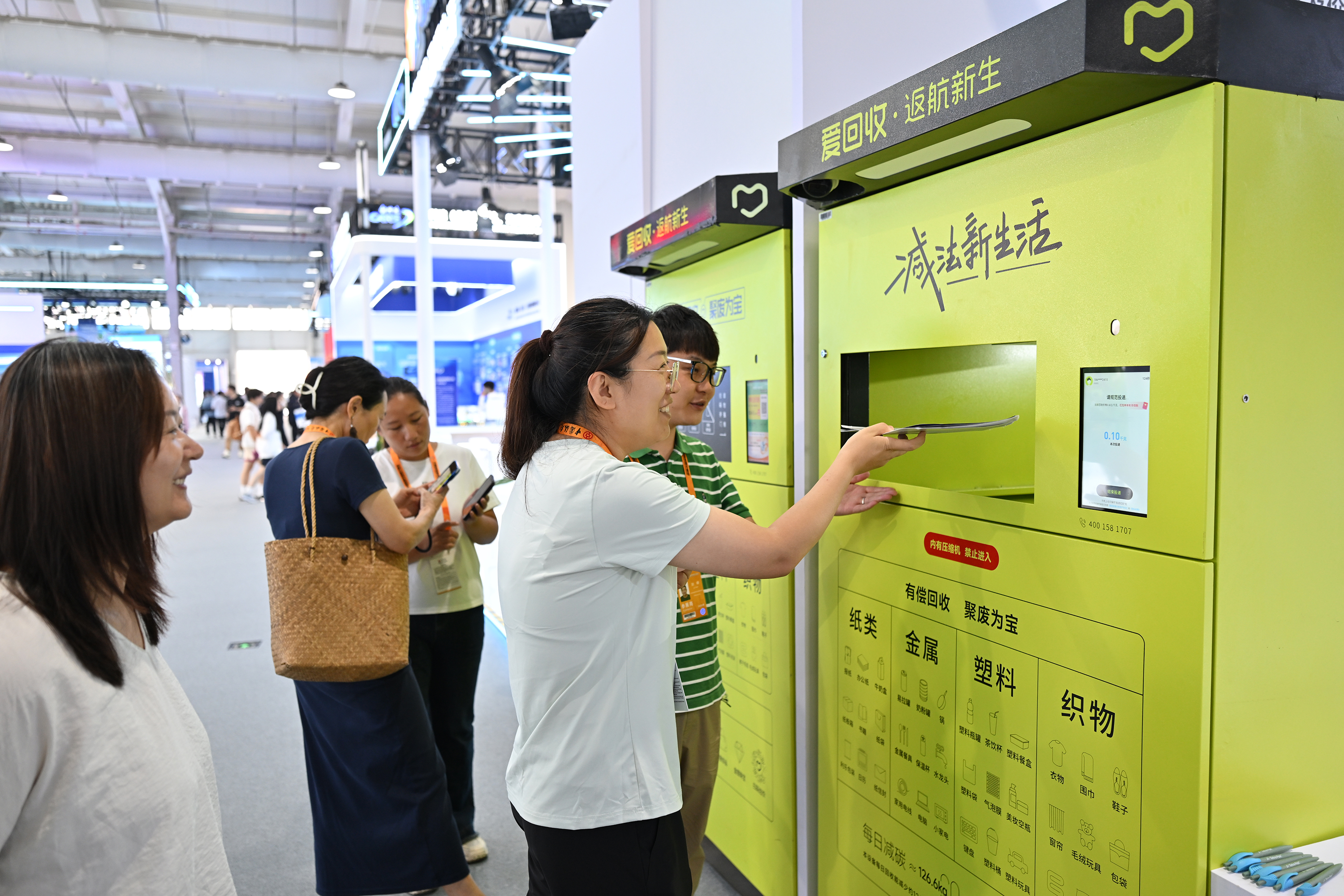
Visitors learn about an intelligent recycling machine at the 2025 China International Fair for Trade in Services (CIFTIS) in Beijing, capital of China, Sept. 12, 2025. The 2025 CIFTIS opened in Beijing on Wednesday, themed "Embrace Intelligent Technologies, Empower Trade in Services." The participating enterprises present their latest technological achievements, showcasing experiences in green and low-carbon development. (Xinhua/Li Xin)
At the ongoing China International Fair for Trade in Services (CIFTIS) in Beijing, new-type energy storage technology, interactive waste-sorting bins, unmanned weed-cutting boats, and a range of other green products and services have attracted wide attention.
Beistar CZ, a Czech company making its debut at CIFTIS, showcased an energy storage technology that converts surplus grid electricity into thermal energy, storing it inside a unit filled with hot air and high heat-resistant material, at a cost about one-fiftieth that of battery storage.
George Jermakov, technology director at Beistar CZ, said he hopes the technology would be "used and useful" in China. "There are no greater opportunities anywhere in the world than in China," he added, noting that he was impressed by the country's open business environment, with CIFTIS serving as a good example.
Jermakov also highlighted China's strong push for sustainability. "There is a great wave in China to go green," he said. "Many steps have been taken by the government and the people, and they are moving faster and faster toward their goals."
The 2025 CIFTIS, held in Beijing from Sept. 10 to 14 with the theme "Embrace Intelligent Technologies, Empower Trade in Services," has drawn nearly 2,000 on-site exhibitors. Participants include representatives from more than 20 of the world's top 30 countries and regions in services trade.
TestraBin, developed by Australian company Sencity, is an interactive garbage-sorting bin. Equipped with three sensor-fitted slots for different types of waste, the bin is ringed with electronic screens that reward correct sorting with playful animations or digital content such as a basketball dropping through a hoop.
"In the past, a lot of money was spent on public campaigns to encourage people to sort their waste. This product makes the process interactive and fun," said Wanchen Zhao, vice president of Sencity. "Every time we showcase it in China, people show great interest. Many see it as a glimpse of the next era, where everyday items are infused with more technology and interactivity."
Chinese companies are also unveiling a wide range of homegrown green innovations at this year's fair, underscoring the country's dual role as a major market and an important source of technological solutions for the global green transition.
An unmanned street-sweeping vehicle developed by Beijing Environment Sanitation Group has attracted wide attention at the fair. Equipped with lidar, 360-degree cameras and ultrasonic radar, the vehicle can clean up to 6,000 square meters per hour, equivalent to the workload of six to eight workers.
The group, which provides integrated services ranging from public-space cleaning to waste collection, transportation and treatment, has offered consulting and technical support to countries including Mongolia, Pakistan, Laos, Bangladesh and Chad.
An unmanned weed-cutting vessel, equipped with sharp blades to clear aquatic plants, was also on display at the fair. A smart system embedded in the vessel simulates plant growth to identify the best time for removal, providing a modern solution for aquatic vegetation management.
"For a city of more than 20 million people like Beijing, many of these urban management solutions can be applied to cities elsewhere in the world," said Chen Nan, a technician with the Beijing Water Science and Technology Institute, which developed the vessel.
Huatong Technology, a one-stop provider of zero-carbon industrial park solutions, also attracted attention at the fair. The Chinese company develops such parks by integrating renewable energy sources like wind, solar and biomass to boost green power use and clean transport, while retrofitting buildings, upgrading equipment and operating a central platform to monitor energy use and cut emissions.
With about 20 years of experience in energy saving and carbon reduction, Huatong Technology has completed over 10,000 projects in China across high-tech zones, industrial and logistics parks, as well as cultural and agricultural parks.
China's services trade topped 1 trillion U.S. dollars for the first time in 2024. In the first seven months of 2025, it expanded 8.2 percent year on year to nearly 4.58 trillion yuan (about 644.9 billion U.S. dollars), official data showed.
Meanwhile, the trade structure has continued to improve, shifting away from reliance on traditional sectors such as logistics toward more value-added, knowledge-intensive and innovation-driven fields.
"China is at the forefront of major green technologies. It is the low-cost producer of wind, solar, long-distance power transmission and zero carbon power supplies," said Jeffrey Sachs, chairman of the United Nations Sustainable Development Solutions Network, in a speech at the fair.
Sachs added that the world is facing the urgent challenge of environmental transformation and China can use its global capacity to accelerate the transformation.
Hashtag: #CIFTIS
The issuer is solely responsible for the content of this announcement.