VinFuture Prize empowered the woman scientist Dr. Firdausi Qadri to give back to Bangladesh
HANOI, VIETNAM - Media OutReach Neswire - 24 March 2025 - A leading force in cholera vaccine research, Dr. Firdausi Qadri at the International Centre for Diarrheal Disease Research, Bangladesh (icddr,b) has dedicated her career to combating this dramatic mortal disease through the innovative improvement of oral cholera vaccination, aiming to large-scale vaccination effort in developing countries.
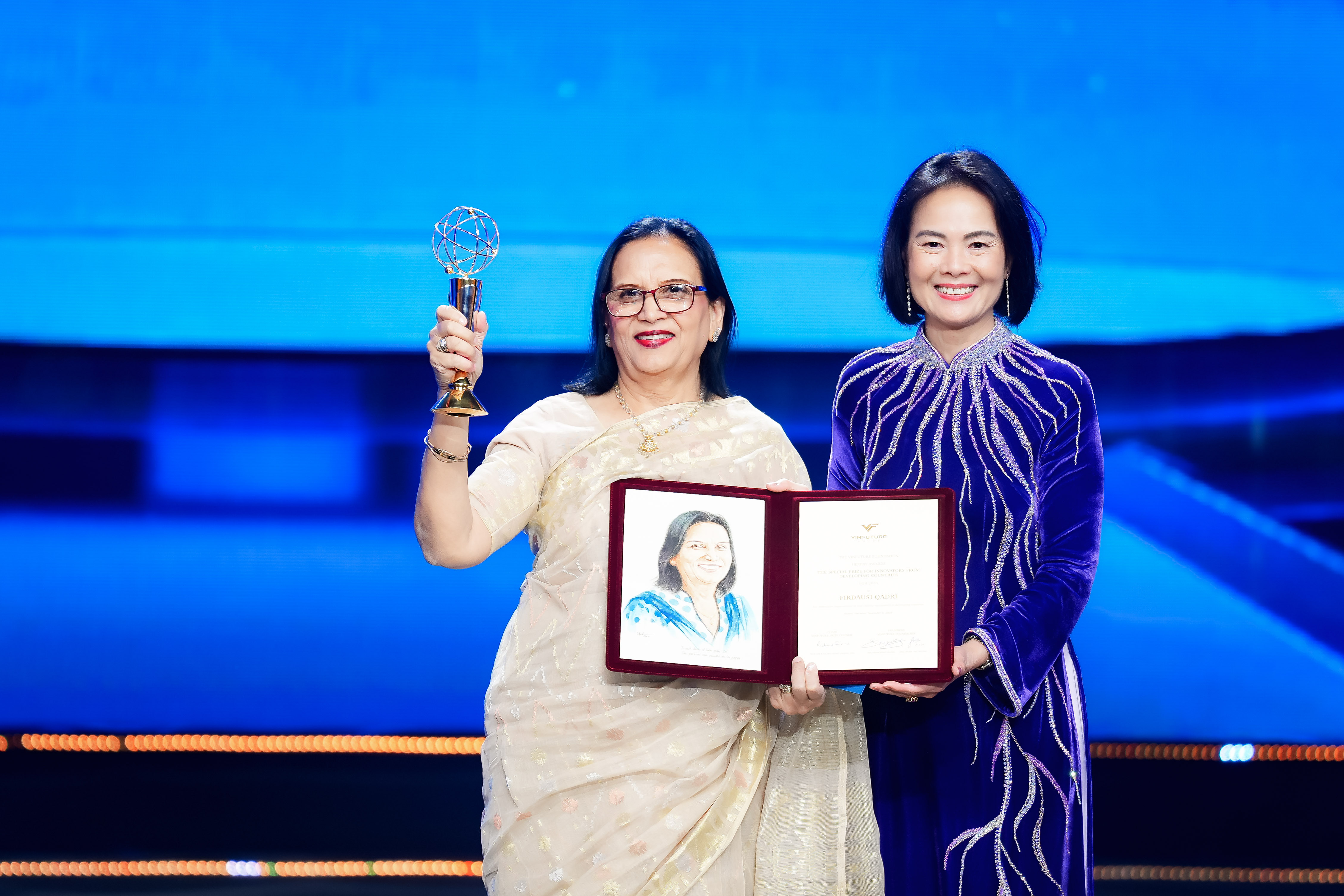
Sharing with the VinFuture Foundation, Dr. Qadri reflects on her groundbreaking work and her passion for expanding STEM education for women. In the face of societal barriers, particularly in Bangladesh, she remains committed to empowering women in science and using her VinFuture Prize value to strengthen the country's scientific community.
The ongoing battle against cholera
Having established herself as one of the scientific titans in the vaccine area, Dr. Qadri has developed a single oral dose of an affordable cholera vaccine to address the public health needs in Bangladesh. Her research opens the possibility of large-scale vaccination campaigns in poor countries to prevent outbreaks and reduce the healthcare cost burden, allowing them to invest in education and economic activities. This revolutionizing discovery has earned her global recognition, including the 2024 VinFuture Special Prize for Innovators from Developing Countries.
"The VinFuture Prize was completely unexpected, but it has given me immense energy and a profound sense of purpose to turn scientific solutions into real-world applications that benefit those in adverse settings, including humanitarian crises globally," Dr. Qadri said.
Beyond its personal significance, the VinFuture Prize also empowered Dr. Qadri to give back to her home country. In 2014, Dr. Qadri formed a non-profit research institution called the ideSHi (Institute for Developing Science and Health Initiatives) located on the 11th floor of Blue Moon Gram Tower in ECB Chattar, Dhaka. She shared an astounding initiative to expand this institute using the 500,000 USD prize value from VinFuture, "Together with the VinFuture Prize money and a quarter of my personal funds, I took a bold step forward, acquiring an additional 5,000 square feet of space within the same building as ideSHi's original facility," she elaborated.
This facility is a bold initiative dedicated to improving public health and nurturing the next generation of scientists. Since then, this institute provides state-of-the-art facilities, offers training programs, collaborates with international partners, conducts research on genetic diseases including thalassemia - the most common blood disorder in Bangladesh - as well as infectious diseases.
"Over the past decade, ideSHi has expanded tremendously, and this new extension will allow us to tackle even more critical health challenges while further strengthening scientific capacity in Bangladesh," she shared. "With prize money received from VinFuture, I am confident that this support will help ideSHi develop pragmatic solutions to public health challenges and ultimately help advance Bangladesh's position in biomedical research."
The achievement results in her determination after witnessing firsthand the dire impact of cholera and diarrheal diseases. Her journey began as a scientist with a deep passion for immunology, later on extended her work beyond the laboratory to the field, fully devoted to the cause of uplifting the lives of Bangladesh and beyond.
However, through her extensive work in diarrheal diseases at their main hospital in Bangladesh, Dr. Qadri estimates an annual intake of approximately 200,000 patients, with 90-95% comes from impoverished backgrounds. Living in overcrowded conditions with shared toilets, kitchens, and bathrooms, they face rapid disease transmission. "If one person contracts cholera, the infection can spread to three other people in the family and beyond due to contaminated hands and food," Dr. Qadri explained. "It's very difficult to control."
Recognizing the persistent devastation of global health crises, Dr. Qadri extended her research beyond the laboratory. She conducted field studies on vaccine effectiveness, distribution strategies, and public health interventions. Her efforts extended beyond academia as she worked more with the government, advocating for necessary actions to improve healthcare access.
"Over 15 to 20 years, my work has evolved to encompass not just vaccine development, but also implementation strategies - exploring the effectiveness of different modes in delivering vaccines and understanding how to integrate water, sanitation, and hygiene (WASH) with vaccination programs to achieve cholera control," she noted.
Dr. Qadri emphasized that cholera remains a disease of poverty, often overlooked due to its association with inadequate sanitation and clean water access. She also pointed out that some governments were reluctant to acknowledge the disease's prevalence, fearing for their global image. Therefore, she expressed deep gratitude and immense joy at being recognized by such a prestigious global award as the VinFuture Prize. "This recognition is a tremendous honor and serves as a motivation for me to move ahead," she shared.
Breaking glass ceilings
Dr. Qadri's dedication to rigorous scientific research and her success in the cholera vaccine area serves as an inspiration for young women all over the world. However, for women in science, particularly in developing countries across Asia, the road is often fraught with challenges. Deep-seated prejudices and invisible glass ceilings make it difficult for women to gain recognition in male-dominated fields.
"I always want to be known as a scientist, not a "woman scientist," who works alongside men as equals", Dr. Qadri shared. "But I cannot deny that acceptance has not always come easily."
The unwavering support of her family played a crucial role, encouraging her to push boundaries and proving that a woman is just as capable as a man. "I traveled to remote areas, worked long hours in the field, and committed myself fully to scientific research. I have managed to overcome many prejudices, though challenges remain," she noted.
It is also a driving force that motivates her to passionately advocate for empowering women in STEM education. According to her, science, technology, engineering, and mathematics are the foundation of progress, driving innovation and shaping the future. Yet, women remain underrepresented in STEM fields, not only in developing countries but even in advanced economies.
"If we truly want to make a meaningful contribution to the world, women must be part of this transformation," Dr. Qadri emphasized.
Many hesitate to pursue careers in STEM, not due to a lack of ability but because of societal expectations and deeply ingrained biases. Fields including engineering and mathematics, in particular, remain male-dominated, with cultural norms dictating which professions are deemed "suitable" for women.
Another critical factor is the cost and commitment required. STEM education is more demanding, expensive, and time-intensive compared to fields including finance or commerce. Success in STEM requires years of dedication and persistence, making it an uphill battle, especially for women who must balance professional ambitions with societal expectations of family life.
"I try to use my journey to show young women that it is possible to have a family, raise children, and do science." She remarked, "You just need to know the mechanism to do it. There is no secret formula: just focus, perseverance, and unwavering commitment to the work you choose to do."
Addressing health disparities
Driven by the goal to seek effective preventive public health solutions for Bangladesh and other developing countries, Dr. Qadri focuses on large-scale clinical studies using Vietnamese live vaccine train, which allowed her to conclude the benefit, power and feasibility of an oral dose of an affordable vaccine.
"Vietnam, which has been able to control cholera better through concerted public health efforts, has always been an example I reflected on." She stated, "If Vietnam can better control cholera through a comprehensive public health approach, why can't we?"
Besides vaccination, the scientific titan emphasized the need for a holistic approach, including improvements in WASH education, and surveillance. However, behavioral change and access to clean water remain significant hurdles. Thus, according to Dr. Qadri, to provide crucial protection in the short term, there are two key strategies: reactive vaccination during an outbreak and preventive vaccination to build immunity.
However, a major obstacle the world faces is the global shortage of cholera vaccines. "Despite cholera affecting millions across Asia, Africa, and Latin America, only 80 million vaccine doses are currently available annually. This is far below what is needed - Bangladesh alone requires 100 million doses in the coming years," she noted.
The economic constraints surrounding cholera vaccines also present a challenge. Since cholera is often considered a "disease of poverty," many pharmaceutical companies hesitate to invest in its production due to low profit margins. "This is already happening," she stressed.
To address this, Dr. Qadri actively advocates for increased vaccine production in Bangladesh. She shared that one of her team's key achievements has been demonstrating that in a major outbreak, giving the vaccine in a reactive way can quickly reduce the number of cases. "We have implemented this strategy in multiple regions of Bangladesh," Dr. Qadri added.
"More importantly, as a result of our dedication, we now have a national cholera control plan, centered on preventive vaccination, ensuring that people receive doses regularly - whether annually or every three years - to stay protected before outbreaks occur. This is a significant milestone in our fight against the disease." she said.
Hashtag: #VinFuture
https://vinfutureprize.org/vinfuture-prize-nomination/
The issuer is solely responsible for the content of this announcement.
VinFuture
The VinFuture Foundation, established on International Human Solidarity Day on December 20th, 2020, is a non-profit organization co-founded by billionaire Mr. Pham Nhat Vuong and his wife, Mrs. Pham Thu Huong. The Foundation's core activity is awarding the annual VinFuture Prize, which recognizes transformative scientific and technological innovations capable of making significant positive changes in the lives of millions of people worldwide.
The nomination period for the 2025 VinFuture Prize will close at 2:00 PM on April 17, 2025 (Vietnam time, GMT+7).
The VinFuture Prize consists of four prestigious awards presented each year. The most esteemed is the VinFuture Grand Prize, valued at US$3 million, making it one of the largest annual prizes globally. Additionally, there are three Special Prizes, each valued at US$500,000, specifically dedicated to honoring women innovators, innovators from developing countries, and innovators with outstanding achievements in emerging fields.