Seasonic PRIME TX-1600 and PRIME PX-1600 ATX 3.1 review
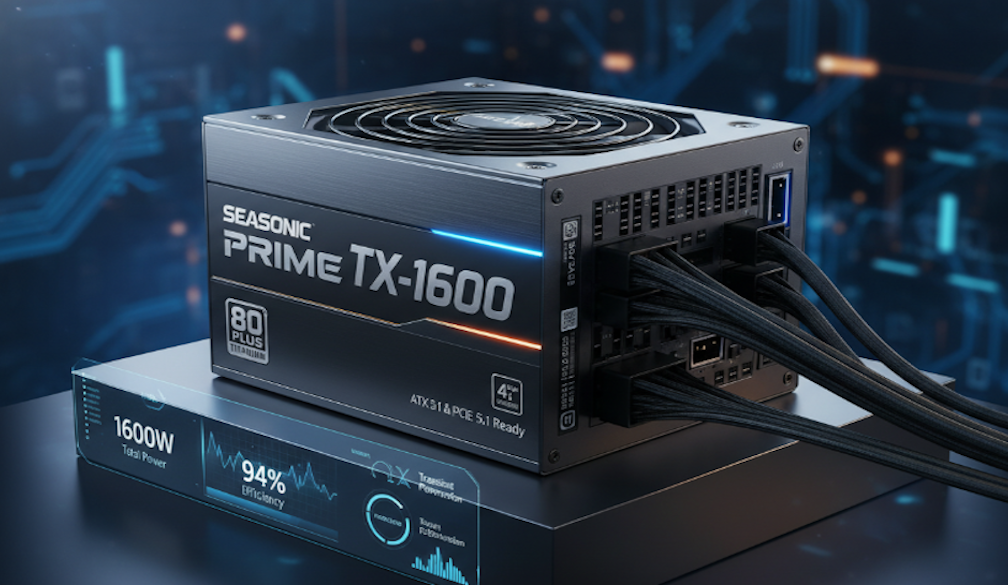
Seasonic PRIME TX-1600 and PX-1600 PSU models are the flagship electrical tools from the manufacturer, designed specifically for the most power-demanding systems. They both support the ATX 3.1 standard with updated 12V-2x6 cables for safer and more stable GPU power delivery.
They are among the most reliable and powerful PSUs on the market. The TX PSU model is built for the most demanding enthusiasts, while PX is a great fit for premium high-end builds without the extra cost of the Titanium tier.
-
Seasonic PRIME TX-1600 (80 PLUS® Titanium) – max efficiency, super stable power delivery, and really low ripple.
-
Seasonic PRIME PX-1600 (80 PLUS® Platinum) – a bit less efficient, but still a premium PSU with very quiet operation.
Both PSU models go with:
-
Fully modular cables.
-
Support for ATX 3.1 and PCIe 5.1 standards.
-
Native 12V-2×6 cable without adapters.
-
Extremely stable +12V line.
-
Premium components and long service life.
-
12-year warranty.
Performance comparison: Titanium vs. Platinum efficiency level.
Titanium is basically the top of the 80 PLUS® ladder. It hits peak efficiency especially at light loads (idle, office work, light gaming), where power loss is minimal. Under extreme loads, it also behaves as a power provider without heat loss during high-end games or AI training. That means less heat, quieter fan behavior, and slightly better long-term power savings.
80 PLUS® Platinum certification level is just one step down from Titanium. But in real-world use, the difference is usually tiny. You still get very high efficiency, low losses, and solid performance under load. The difference is just in a bit more waste heat, especially when the system is sitting idle.
Build quality, components, and long-term reliability
Both models feature a very tight, premium-grade build with minimal tolerances. The casing, soldering, and internal layout are all top quality, with no obvious weak spots in the design. That’s also why Seasonic PRIME models are often chosen for high-end and workstation builds.
And, accordingly, their components are also at the top quality level to support their excellent performance. There are high-quality Japanese capacitors and premium components that work on this for stability under load and low power loss. In the Seasonic Platinum PSUs series, components and tuning are a bit tighter and more precise, which gives you better control and more consistent performance.
Alongside this, both PSU series are built for long-term heavy-load operation, with a very stable +12V rail and low ripple. Another big plus is the 12-year warranty, which really highlights that it’s designed for long service life. It’s the longest offer among all PSU manufacturers.
ATX 3.1/ PCIe 5.1 support: which model is more future-proof?
Both Seasonic PRIME TX and PX equally support ATX 3.1 vs. PCIe 5.1 standards. They are compatible with future GPUs, but Titanium models are a bit more future-proof thanks to a higher 80 PLUS® efficiency level. Both also support modern 12V-2×6 cable, which is what really matters for next-gen graphics cards.
Cooling performance and noise levels under heavy load
Under heavy load, Seasonic PRIME TX/PX ATX 3.1 PSUs stay very quiet and cool thanks to a well-tuned hybrid fan mode. In short:
-
At low and medium loads, they often run semi-passively (fan stays off).
-
Under load, the fan ramps up smoothly and stays very quiet even at high power (~1000W–1600W).
-
High efficiency (Titanium/Platinum) means less heat, so less cooling is needed.
-
Even at max load, noise stays low and far from “turbine” levels.
-
Some units may have faint coil whine, but that’s normal variation and not a cooling issue.
PRIME TX-1600 ATX 3.1 – pros and cons
Pros:
-
Maximum efficiency with 80 PLUS® Titanium certification.
-
Extremely stable performance under peak GPU loads.
-
Native 12V-2×6 (PCIe 5.1) support without adapters.
-
Very quiet operation even under heavy load.
-
Premium components and top-tier build quality.
-
Excellent long-term reliability (flagship-level durability).
Cons:
-
Large form factor (not compatible with all cases).
-
May overkill power headroom for some PC systems.
PRIME PX-1600 ATX 3.1 – pros and cons
Pros:
-
High 80 PLUS® Platinum efficiency.
-
Nearly the same stability level as TX.
-
Native 12V-2×6 (PCIe 5.1) support.
-
Quiet and cool operation under load.
-
Great balance between price and premium quality.
-
Ideal for high-end gaming and workstation builds.
Cons:
-
Slightly lower efficiency compared to TX.
-
A bit more power loss in low-load scenarios.
Which PSU should you choose for gaming, workstations, or AI builds?
The Seasonic PRIME PX-1600 ATX 3.1 is a great fit for gaming. It’s because it delivers the same stability and quiet operation, without paying extra for max efficiency, that you barely notice in real gameplay.
For workstation builds, the Seasonic PRIME TX-1600 ATX 3.1 makes more sense. Titanium efficiency means less energy loss and lower heat during long, heavy workloads like rendering and 3D work.
For AI or always-on high-load systems, the Seasonic TX-1600 ATX 3.1 is also the better pick, as it handles sustained maximum load with better efficiency and thermal balance over time.
Conclusion
Seasonic PRIME TX-1600 and PRIME PX-1600 ATX 3.1 PSUs both demonstrate the highest level of efficiency and productivity. Their difference is slightly seen, and lies in their 80 PLUS® efficiency levels and, accordingly, in use cases.