


Blue line poly pipe for compressed air: Why it's the preferred choice in the Australian industry
When it comes to compressed air distribution in industrial and commercial settings, material selection is one of the most consequential decisions a facility manager or maintenance engineer will make. The wrong pipe material can mean pressure drops, ongoing leaks, contamination, or, at worst, catastrophic failure under pressure.
Blue line poly pipe has become the dominant choice for compressed air systems across a wide range of Australian industries. Lightweight, corrosion-resistant, and quick to install, it addresses most of the shortcomings of traditional materials and does so at a competitive cost. This article explores what blue poly pipe is, how it works, and what to look for when specifying a system.
What is blue line poly pipe?
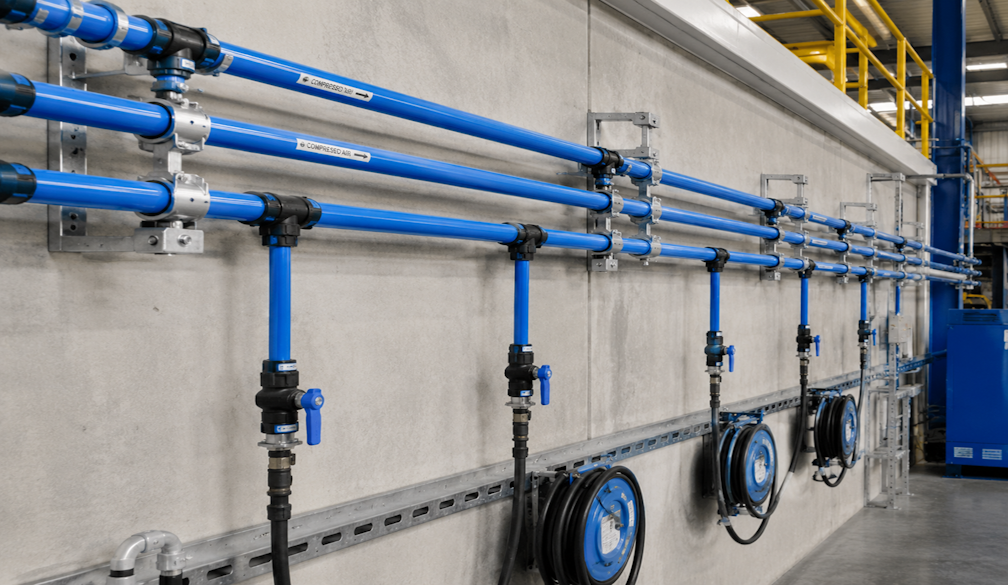
Blue line poly pipe is a polyethylene-based tube specifically engineered for compressed air distribution. The blue colouring is both a visual identifier and a convention widely adopted across the Australian industry. When you see blue, you know it's compressed air.
Systems like Blutube compressed air poly pipe are manufactured to handle the pressures typical in industrial compressed air networks, offering consistent bore dimensions, smooth internal surfaces, and resistance to the oils and moisture that compressed air inevitably carries.
Unlike steel or copper systems, poly pipe does not corrode internally, which means less contamination downstream and a longer effective service life with minimal maintenance.
Advantages over traditional compressed air piping materials
For decades, galvanised steel was the default for compressed air distribution. It's been largely superseded in new installations for good reason. Steel corrodes, particularly when moisture in the compressed air isn't fully controlled. Internal rust contamination affects air quality, clogs filters, and damages pneumatic equipment. Steel is also heavy, slow to install, and requires skilled labour for any modification.
Copper is a cleaner option and resists corrosion well, but its cost has made it increasingly difficult to justify, especially in larger installations or where the network needs to be extended or reconfigured.
Blue poly compressed air pipe offers a third path: compressed air piping that is lightweight, clean, corrosion-free, and significantly faster to install. Push-fit and compression fittings mean that most connections can be made without specialised tools or trade-specific skills.
Pressure ratings and safety considerations
Any pipe material used for compressed air must be rated appropriately for the operating pressure of the system. This is non-negotiable: using an under-rated pipe in a compressed air application is a serious safety risk.
Quality blue poly pipe systems are manufactured and tested to handle the pressures typical in workshop and industrial environments, generally up to 16 bar depending on the product specification and installation temperature. Always confirm the pressure rating of any product against your system's maximum operating pressure, including any potential surge conditions.
Temperature is also a factor. Polyethylene's pressure rating decreases at elevated temperatures, so systems in hot environments near compressor rooms, external installations in direct sun, should be specified with appropriate safety margins.
Installation best practices
One of the most significant advantages of blue poly pipe is installation speed. A loop system, the preferred configuration for most compressed air networks, can typically be completed far more quickly with poly than with steel, reducing downtime during commissioning or upgrade projects.
A few installation principles worth following:
-
Always use a loop configuration rather than a dead-end layout. This maintains consistent pressure throughout the network and provides redundancy
-
Slope distribution lines slightly back toward the compressor or to low-point drains to remove condensate
-
Install drop-leg connections from the bottom of the main pipe, not the top, to prevent condensate from entering branch lines
-
Allow for thermal expansion, particularly in outdoor or variable-temperature installations
-
Use proper pipe clips and support spacing as specified by the manufacturer. Unsupported spans can cause sagging over time
-
Label all pipework clearly with direction-of-flow arrows and pressure ratings
Compatibility with fittings and existing systems
Blue poly pipe systems designed for compressed air poly pipe applications are typically supplied with a complementary range of fittings, tees, elbows, reducers, end caps, and drop manifolds designed to work specifically with the pipe's outside diameter.
Integration with existing compressed air systems is generally straightforward. Compression fittings allow connection to copper, steel, or other pipe types at interface points, making poly a practical choice for extension or upgrade projects rather than requiring full system replacement.
Always verify fitting compatibility before ordering at scale, particularly if combining products from different manufacturers.
Conclusion
Blue line poly pipe for compressed air distribution represents a significant improvement over older materials for most industrial applications. Its combination of corrosion resistance, installation efficiency, cleanliness, and competitive cost makes it the logical default for new compressed air networks and upgrade projects alike.
Specifying the right product with the appropriate pressure rating, quality fittings, and proper installation ensures a compressed air system that performs reliably, costs less to maintain, and lasts for decades.










