
Pfizer doses to be spaced out in NSW crisis, but state fails to get change in vaccination program
- Written by: Michelle Grattan, Professorial Fellow, University of Canberra
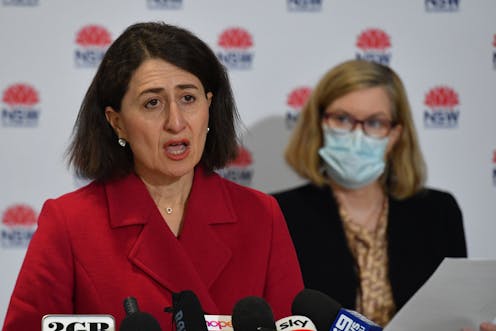
Pfizer doses in NSW will be spaced out to enable more first jabs to be administered quickly, as the Berejiklian government on Friday declared the Sydney COVID crisis a “national emergency”.
But the plea by the state for Pfizer doses to be diverted to Sydney as part of a refocusing of the national vaccine program has fallen on deaf ears.
Scott Morrison indicated if any extra Pfizer supplies became available they would be directed to NSW – but he made clear there would be no change in the national vaccination program.
“Where there is a potential to put more vaccines into NSW, even beyond what we’re already doing, well, of course, we will seek to do that. But we are not going to disrupt the vaccination program around the rest of the country,” he said after a meeting of the national cabinet.
Vaccines are distributed on a population basis, although NSW was recently given a special allocation of 300,000 doses, half AstraZeneca and half Pfizer.
Morrison also said suppression was the key immediate means of stopping community transmission and getting on top of the outbreak that is concentrated in south western Sydney. “Suppression is the primary tool to achieve that, and vaccines can help that.”
Earlier, General JJ Frewen, who is in charge of the vaccine rollout, was dismissive of the suggestion supplies be diverted.
“Vaccines are only one part of a response to the outbreak like this,” Frewen told a Senate committee.
Other states made it clear they would not give up any of their Pfizer supplies.
Morrison said extending the time between Pfizer doses – normally three weeks – to six weeks was within the advice of The Australian Technical Advisory Group on Immunisation (ATAGI). This would be done in NSW vaccination clinics.
He also said there was “agreement amongst the national cabinet that we need to continue to lean in to AstraZeneca, particularly in NSW”.
Australian Medical Association President Dr Omar Khorshid on Friday called on ATAGI to review its advice on AstraZeneca in response to the growing risks posed by the outbreak of the Delta variant in NSW.
“As we don’t have enough Pfizer to use in a targeted rollout, the only option is AstraZeneca. It will save lives and help see life return to some normality in Greater Sydney,” Khorshid said.
ATAGI has preferred Pfizer for those under 60, although it recently qualified its advice in light of the Sydney outbreak.
As NSW on Friday reported 136 new cases in the 24 hours to 8pm Thursday, Victorian Premier Daniel Andrews said “Sydney is on fire with this virus and we need a ring of steel put around Sydney”.
But Morrison said that at national cabinet Berejiklian had spelled out “in very specific detail the extensive lockdown” the state had in place.
“There’s nothing light about the lockdown in NSW – in Sydney, I can assure you. My family are in it,” he said.
At her news conference on Friday morning, Berejiklian said Chief Health Officer Kerry Chant and her team “advised us that the situation that exists now in NSW, namely around south-western and now western Sydney suburbs, is regarded as a national emergency.”
She appealed for the vaccination strategy to be redirected to south western Sydney, particularly to younger people who had to perform essential work such as the production of food.
She said there was a very young population in the affected communities, “and we need at least more first doses of Pfizer.”
Meanwhile, figures given to the Senate COVID committee showed only 47.2% of residential aged care workers had had a first vaccine dose and 27.8% had received their second dose. Vaccination has been made mandatory by September for these workers.