
WA election could be historical Labor landslide, but party with less than 1% vote may win upper house seat
- Written by: Adrian Beaumont, Honorary Associate, School of Mathematics and Statistics, The University of Melbourne
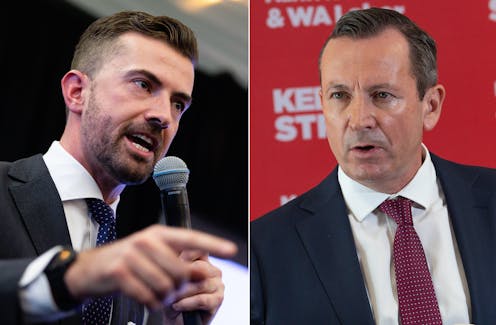
The Western Australian election will be held on Saturday, March 13. Polls close at 9pm AEDT. I am not aware of any WA polling conducted since the blowout 68-32 lead for Labor in a Newspoll that I covered two weeks ago.
Read more: Whopping lead for Labor ahead of WA election, but federal Newspoll deadlocked at 50-50[1]
If replicated at the election, a 68-32 two party result would be over ten points better for Labor than at the November 2018[2] Victorian election, which was regarded as a Labor landslide.
In recent Australian electoral history, Labor was crushed at the March 2011 NSW election, and at the March 2012 Queensland election. In NSW 2011[3], the Coalition under Barry O'Farrell won the two party vote by 64.2-35.8, and Labor won just 20 of the 93 lower house seats.
A more extreme seat wipeout occurred in Queensland 2012[4], despite a slightly narrower two party margin. Labor was reduced to just seven of the 89 seats on a two party result of 62.8-37.2 to the LNP under Campbell Newman.
The fortunes of Queensland and NSW Labor have diverged since these elections. Queensland Labor won the 2015 election, and has held office since with wins in 2017 and 2020. In NSW, the Coalition decisively won both the 2015 and 2019 elections.
In February 2001[5], Queensland Labor under Peter Beattie reduced the Coalition parties to 15 of the 89 seats on primary votes of 48.9% Labor to 28.5% for the Coalition. At the December 1974[6] Queensland election, Labor won just 11 of the 82 seats; that election was in the Joh Bjelke-Petersen era.
The most recent Newspoll gave WA Labor a primary vote of 59%. Once the two major parties would win over 90% of the primary vote between them, but the rise of the Greens, One Nation and other small parties has seen the major party share decline.
It appears the last time a party came close to 59% of the primary vote was at the 1978 NSW election[7], when Neville Wran led Labor to 57.8%. At the 1974 Queensland election, the combined vote for the Nationals and Liberals was 59.0%.
A 68-32 two party result with a Labor primary vote of 59% would be a historical result in Australia.
Group voting tickets could see micro-party elected to upper house
Analyst Kevin Bonham[8] has conducted simulations using the ABC’s upper house group voting ticket calculators. He says the biggest danger of a micro-party winning is in the conservative Agricultural region, which spans four lower house electorates[9] - Central Wheatbelt, Geraldton, Moore and Roe.
As I covered previously, the WA upper house has six regions that each return six members. Three of those regions are in Perth, so that Perth has just half the upper house seats on almost 80% of the state’s population. The Agricultural region only has 6% of enrolled voters, but will elect one-sixth of the upper house.
In Bonham’s scenario, Bass Tadros, the lead candidate of Health Australia Party in Agricultural region who has put forward debunked theories [10]about a linke between 5G and vaccines, could win through a preference snowball on as little as 0.2% of the vote. Tadros Greens’ preferences are going to Tadros ahead of Labor in that region, so they will be partly responsible if he wins and costs Labor a seat.
This is a very conservative region, and the Greens have no chance of winning a seat themselves. It would be better for Greens voters in that region to vote Labor than risk electing Tadros and costing the left a seat that could see Labor and the Greens fail to win an upper house majority.
SA poll: 51-49 to Liberals
About a year before the next South Australian election, a YouGov poll has given the Liberals a 51-49 lead, a two-point gain for Labor since September. Primary votes were 43% Liberals (down three), 36% Labor (up one), 10% Greens (steady) and 6% SA Best (up one).
Incumbent premier Steven Marshall led Labor’s Peter Malinauskas by 50-30 as better premier (54-26 in September). This poll was conducted February 24 to March 1 from a sample of 843. Figures from The Poll Bludger[11].
Tasmanian poll: Liberals over 50%
A Tasmanian EMRS[12] poll, conducted February 15-23 from a sample of 1,000, gave the Liberals 52% (steady since November), Labor 27% (up two) and the Greens 14% (up one). Incumbent Peter Gutwein led Labor’s Rebecca White as preferred premier by 61-26, unchanged since November.
The next Tasmanian election is likely to be held in early 2022. Tasmania uses a proportional system with five electorates each returning five members that are elected using the Hare-Clark method. With a majority of the vote, the Liberals would easily win a majority of seats.
The EMRS polling suggests a big COVID boost for the Liberals, from 43% in March 2020 to a peak of 54% in August.
References
- ^ Whopping lead for Labor ahead of WA election, but federal Newspoll deadlocked at 50-50 (theconversation.com)
- ^ November 2018 (en.wikipedia.org)
- ^ NSW 2011 (en.wikipedia.org)
- ^ Queensland 2012 (en.wikipedia.org)
- ^ February 2001 (en.wikipedia.org)
- ^ December 1974 (en.wikipedia.org)
- ^ 1978 NSW election (en.wikipedia.org)
- ^ Kevin Bonham (kevinbonham.blogspot.com)
- ^ four lower house electorates (www.abc.net.au)
- ^ put forward debunked theories (www.abc.net.au)
- ^ The Poll Bludger (www.pollbludger.net)
- ^ Tasmanian EMRS (www.emrs.com.au)