The highs and lows for women in 2020
- Written by: Chris Wallace, Associate Professor, 50/50 By 2030 Foundation, Faculty of Business Government & Law, University of Canberra
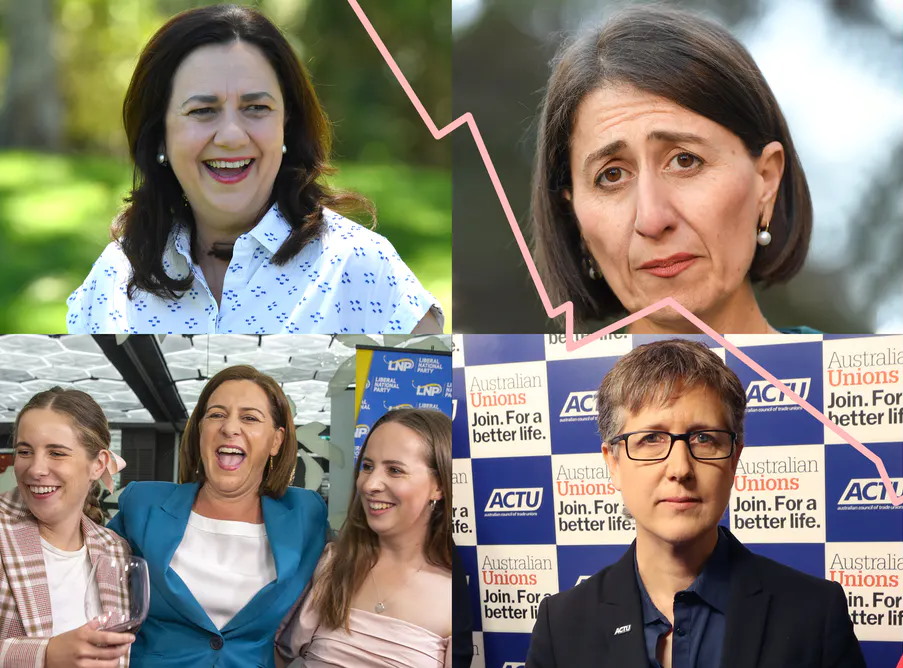
It has been both a remarkably good and remarkably bad year for Australian women.
Their leadership in Australian politics and public life has been more prominent and successful than ever before. Yet the pandemic has set back the broad swathe of women at home, in education and in the workplace.
A new golden age
First the good news. In 2020 we have entered something of a golden age for women in political leadership.
In October, Queensland Premier Annastacia Palaszczuk emerged as the most successful female politician in Australian history, when she became the first woman to win three elections in a row[1].
Read more: Queensland is making election history with two women leaders, so why is the campaign focused on men?[2]
Palaszczuk’s victory capped her 2015 success as the first woman in Australia to win an election from opposition. It also follows her 2017 win, when she created gender equity[3] in an Australian ministry for the first time.
But a woman would have been premier whatever happened on October 31. With Deb Frecklington leading the LNP, the Queensland election was the first state or federal election to see two women going head-to-head in a contest for premier.
Queensland has had a female leader for 10 of the past 13 years — between them, Anna Bligh and Palaszczuk have won four elections.
Palaszczuk’s achievement, and Bligh’s before her, is worth pondering. They show the often privately voiced assumption in federal political circles that male leaders are more likely succeed in what is seen as the masculinist state of Queensland as one of the great lies of Australian politics.
Palaszczuk and Berejiklian
Palaszczuk also survived sustained attacks[4] on her COVID border management in the lead up to and during the state election. She stared down NSW Premier Gladys Berejiklian[5] and brushed off similar pressure from Prime Minister Scott Morrison.
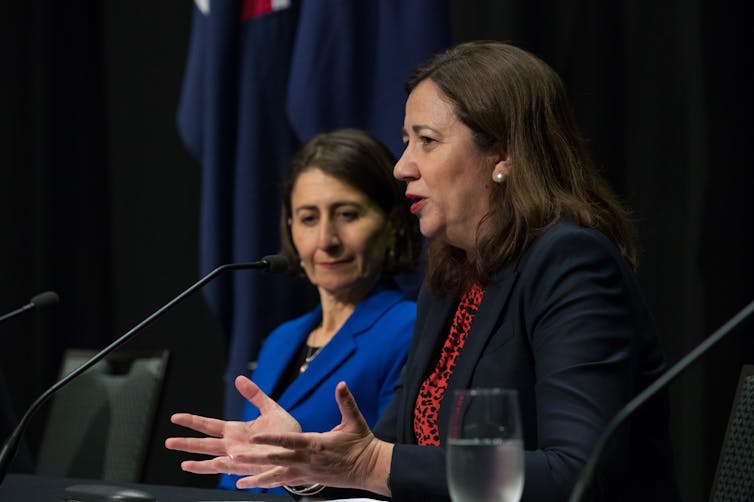 NSW Premier Gladys Berejiklian repeatedly called on Queensland’s Annastacia Palaszczuk to open the borders. Marc McCormack/AAP
The Queensland premier’s battles with her NSW counterpart Berejiklian also draw attention to another important feature of Australian politics in 2020. From opposite sides of politics, these two women govern about half of Australia’s population (about 13 million out of almost 26 million people) – literally, no small thing.
If there was a NSW election tomorrow, it too would be governed by a woman whatever the result, since the NSW opposition leader is Labor’s Jodi McKay[6].
Women win big in the ACT
Meanwhile, Australia got its first majority female ministry in a majority female parliament at the ACT Assembly election[7] in October. Each party in the ACT Assembly is at least 50% women, and the ACT Liberals chose an all-woman leadership team in the election aftermath.
New ACT opposition leader Elizabeth Lee[8] — as an Australian of Korean heritage — is the latest example of women thriving in politics despite not fitting the male Anglo-Celtic stereotype.
She joins Palaszczuk, with Polish and German heritage, Berejiklian with Armenian heritage and senior politicians like Penny Wong[9], with Chinese-Malaysian heritage and Tanya Plibersek[10], with Slovenian heritage — all making conspicuous contributions to Australian public life.
Lastly, it remains too little known that men and women are almost equally[11] represented in the federal Labor caucus – a mighty achievement and, given its commitment to the quota mechanism that helped bring this about, one set to last.
Women prominent in pandemic response
Women leading in a broader sense has been more conspicuous in 2020 than ever before, too.
Female chief health officers have been prominent in the management of the COVID-19 pandemic. The Australian Council of Trade Unions leadership team of president Michele O’Neil[12] and secretary Sally McManus[13] have been unrelenting in their efforts especially for those in the most vulnerable parts of Australia’s highly casualised workforce – typically women.
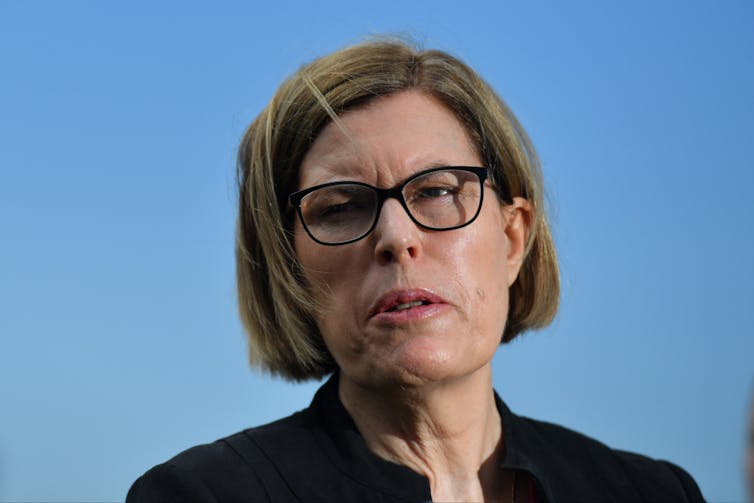 NSW chief health officer Dr Kerry Chant has been front and centre of Australia’s pandemic response. Mick Tsikas/AAP
Australia’s main employer organisation, the Business Council of Australia, is female-led too. Jennifer Westacott is due to reach her ten year milestone as chief executive in 2021. The chief justice of the High Court is also a woman, Susan Kiefel.
That’s the good news. The bad?
But (still) too few women in the federal Coalition
Less than one-quarter of Morrison government MPs are women[14]. This is because the federal Coalition parties remain stubbornly against the proven method[15] – quotas – which can change this. They do so on narrow ideological grounds.
ABC journalist Louise Milligan’s Four Corners report[16] on the bullying of female staffers inside the government provides the latest in a string of reminders of the cultural problems in Coalition ranks[17]. These are both a product and cause of gender inequity in the Coalition.
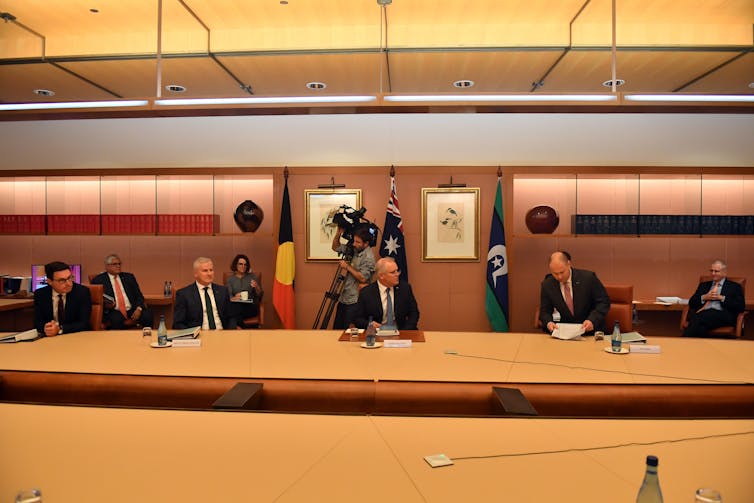 Women still are still in the minority in the Coalition’s ranks. Mick Tsikas/AAP
This lack of female representation has fed into a disastrously gendered policy response[18] to the COVID-19 pandemic, which was already especially bad for Australian women. They won’t quickly forget the government providing free childcare during lockdown, only to withdraw it[19] as one of its first policy decisions post-lockdown.
Already in a weaker position[20] in the workforce, concentrated in low-paid, casualised work, women disproportionately withdrew from the labour market compared to men during the pandemic — the hasty withdrawal of free childcare was a critical factor[21] in this.
The 14% difference between female and male average full-time weekly earnings – the national gender pay gap[22] – also influenced family decisions about who should pick up the extra burden at home. This and gender stereotyping saw men’s domestic labour rise a little during the pandemic and women’s rise a lot[23], especially for childcare and home-schooling.
Read more: She won't be right, mate: how the government shaped a blokey lockdown followed by a blokey recovery[24]
Women withdrew from higher education[25] at greater rates than men during the pandemic. Domestic violence, overwhelmingly committed by men against women,rose too[26].
Despite a chorus of community voices and academic analyses[27] showing how and where the Morrison government was either blind to, or actively worsening,the gendered impacts of its pandemic response[28], it failed to change course. Bereft of enough women to lean against these policies, the Morrison government discounted and disadvantaged women across the board.
The agenda for 2021
So a “pink” recession[29] has taken hold. 2020 likely marks a structural lurch backward in the position of women at home, in education, and in the labour force so significant it takes years to recover.
We need to take a leaf from the grace, guts and drive displayed by women working to make things better, come what may. They get up, get going, show solidarity with other women, and get things done.
Sharing the load, sharing the benefits and sharing the power ought to be on every woman’s agenda, and every other thinking person’s agenda, in 2021.
Read more: COVID-19 is a disaster for mothers' employment. And no, working from home is not the solution[30]
References
- ^ to win three elections in a row (theconversation.com)
- ^ Queensland is making election history with two women leaders, so why is the campaign focused on men? (theconversation.com)
- ^ gender equity (www.theguardian.com)
- ^ sustained attacks (www.theguardian.com)
- ^ stared down NSW Premier Gladys Berejiklian (theconversation.com)
- ^ Labor’s Jodi McKay (www.smh.com.au)
- ^ ACT Assembly election (www.broadagenda.com.au)
- ^ ACT opposition leader Elizabeth Lee (www.abc.net.au)
- ^ Penny Wong (insidestory.org.au)
- ^ Tanya Plibersek (www.theguardian.com)
- ^ almost equally (theconversation.com)
- ^ president Michele O’Neil (www.theage.com.au)
- ^ secretary Sally McManus (www.smh.com.au)
- ^ MPs are women (www.abc.net.au)
- ^ against the proven method (theconversation.com)
- ^ Four Corners report (www.abc.net.au)
- ^ cultural problems in Coalition ranks (www.broadagenda.com.au)
- ^ policy response (theconversation.com)
- ^ withdraw it (www.abc.net.au)
- ^ in a weaker position (www.wgea.gov.au)
- ^ critical factor (theconversation.com)
- ^ the national gender pay gap (www.wgea.gov.au)
- ^ rise a lot (womensagenda.com.au)
- ^ She won't be right, mate: how the government shaped a blokey lockdown followed by a blokey recovery (theconversation.com)
- ^ withdrew from higher education (theconversation.com)
- ^ rose too (theconversation.com)
- ^ academic analyses (theconversation.com)
- ^ the gendered impacts of its pandemic response (theconversation.com)
- ^ “pink” recession (www.smh.com.au)
- ^ COVID-19 is a disaster for mothers' employment. And no, working from home is not the solution (theconversation.com)