Two Years Later — a love story that quietly asks what really matters in life
- Written by: The Times
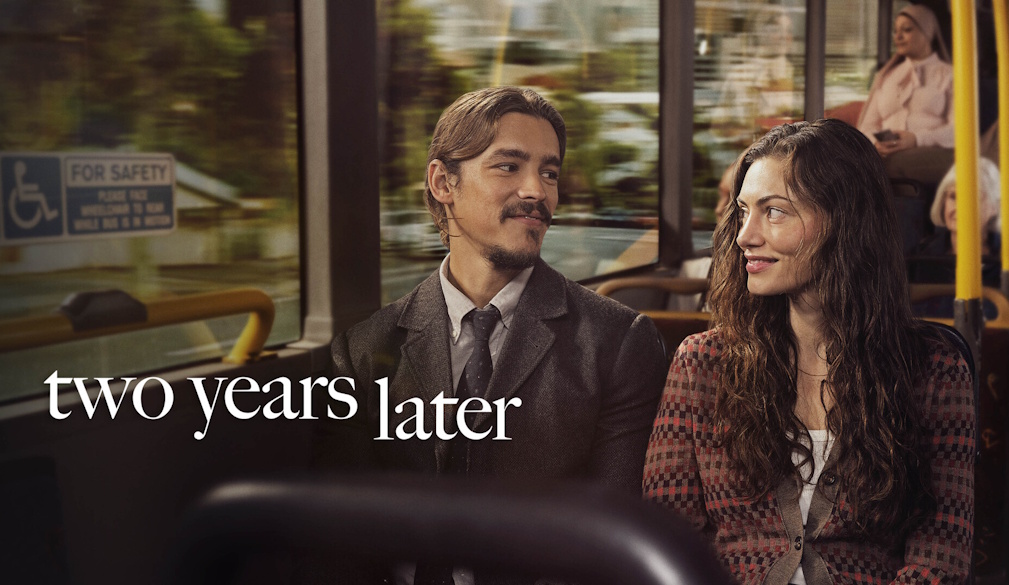
Two Years Later looks, initially, like a romantic television series.
It is considerably more interesting than that.
The Australian drama follows Emily and Ryan, played by Phoebe Tonkin and Brenton Thwaites, two thirty-somethings whose tentative connection during their daily commute is abruptly interrupted by COVID-19.
Then life intervenes.
Two years later they unexpectedly meet again.
Ryan proposes an unusual experiment: eight dates to determine whether they should get married.
One date becomes one episode. Across those eight encounters, they discover each other's families, careers, histories, insecurities and beliefs.
It is a clever dramatic device.
But beneath it sits a much more interesting question.
How well can we ever really know another person — and how much of a life can change while we are busy making other plans?
Two years is both nothing and everything
The title itself contains one of the series' most powerful observations.
Two years does not sound very long.
Yet think about your own life two years ago.
Who did you speak to regularly?
Where did you live?
What were you worried about?
What were you planning?
Who was important to you?
Some answers will be exactly the same.
Others may be almost unrecognisable.
That is what happens to Ryan and Emily. Their original connection is interrupted by something beyond their control, and when they meet again they are simultaneously the same people and different people.
The pandemic provides the mechanism, but the observation is universal.
Life does not wait for us.
We imagine relationships; then reality arrives
Eight dates sounds almost absurdly inadequate as a basis for deciding whether to marry someone.
That is partly the point.
Because the dates rapidly cease to be simply romantic encounters.
Emily attends the anniversary celebration of Ryan's grandparents.
Ryan meets Emily's parents.
They encounter uncertainty around work.
They discover contrasting world views.
Eventually, family tragedy forces them to reconsider what matters.
The progression resembles real relationships more closely than the conventional television romance.
Falling in love with someone is relatively simple when that person exists independently of everything else.
Real relationships do not work that way.
You also encounter their family.
Their history.
Their ambitions.
Their disappointments.
Their politics.
Their fears.
Their habits.
Their obligations.
Eventually, you discover the difference between the person you imagined and the complicated human being who actually exists.
That is when a relationship becomes interesting.
Compatibility is not sameness
One of the better observations in Two Years Later emerges when Emily and Ryan discover that they do not necessarily see the world in the same way.
That matters.
Modern life increasingly encourages us to associate with people who resemble us — people who consume similar information, hold similar views and inhabit similar social circles.
A relationship can destroy that comfortable arrangement.
Another person arrives carrying an entire worldview of their own.
The question is no longer simply whether two people disagree.
Most people eventually will.
The harder question is whether affection can accommodate disagreement.
That distinction applies well beyond romantic relationships.
Families do it.
Friendships do it.
Successful societies have to do it.
Human beings do not have to become identical before they can care about one another.
Work matters enormously — until suddenly it doesn't
The series also places professional uncertainty alongside the developing relationship.
That feels particularly contemporary.
For people in their thirties, career and identity can become almost inseparable.
The question "What do you do?" frequently substitutes for the much larger question "Who are you?"
Employment determines income, status, location, routine and sometimes self-worth.
Then something happens outside work.
A relationship begins.
A parent becomes ill.
A child arrives.
Someone dies.
And the hierarchy of importance changes almost instantaneously.
The job that occupied almost every waking thought on Tuesday can seem strangely insignificant by Wednesday.
Work matters.
But life periodically reminds us that it is only one part of living.
Family tells us who someone was before we met them
Meeting someone's family is one of life's great acts of discovery.
Until then, we know only the person standing before us.
Family supplies the backstory.
Suddenly there are explanations.
Why they react to certain things.
Why particular traditions matter.
Where their humour came from.
Why they fear something.
Why they value something else.
Two Years Later uses both Ryan's grandparents and Emily's parents to expand the characters beyond the relationship itself.
That reflects something true about life.
Every adult we meet existed for decades before we arrived.
We encounter the finished chapters without having read the beginning.
Intimacy is partly the process of discovering those missing pages.
Older relationships look different
Ryan's grandparents introduce another useful perspective.
Young relationships are usually portrayed through beginnings.
Attraction.
First dates.
First kisses.
Declarations.
Older relationships tell another story entirely.
Staying.
Compromise.
Forgiveness.
Routine.
Shared memories.
Illness.
Loss.
The accumulation of thousands of ordinary days.
A long relationship is not merely a romance that lasted.
It is a shared history.
And that offers a useful counterpoint to Ryan's proposition that eight dates might determine whether two people should marry.
Eight dates can reveal compatibility.
Only time reveals endurance.
Tragedy rearranges priorities
By the seventh date, family tragedy gives Emily and Ryan a different perspective on what matters.
That observation may be the most recognisable of all.
Human beings spend extraordinary amounts of emotional energy on matters that later prove to have been relatively unimportant.
Arguments.
Deadlines.
Possessions.
Status.
Minor grievances.
Being right.
Then something genuinely consequential happens.
The hierarchy rearranges itself immediately.
The tragedy is that we often require such an event before recognising the hierarchy was wrong.
COVID changed more than where we worked
The pandemic is important to Two Years Later, but the series does not remain a story about COVID. Contemporary reviews have noted that the pandemic recedes quickly and the focus shifts to the two characters and the small interactions through which their relationship develops.
That may be the more interesting way to think about the pandemic now.
For millions of people, COVID divided life into before and after.
Relationships disappeared.
Careers changed.
People moved.
Habits changed.
Some became more cautious.
Others became determined not to postpone things anymore.
Ryan and Emily's interrupted connection represents a much larger phenomenon.
History happened to individual lives.
And when normal life resumed, people did not necessarily return as the same people who had left it.
The ordinary is the story
Perhaps the most distinctive quality of Two Years Later is how little it needs to manufacture drama.
There are conversations.
A work event.
A family gathering.
A trip to IKEA.
Dinner.
Meeting parents.
Disagreement.
Loss.
These are not extraordinary events.
They are life.
Paramount itself describes the production as grounded in naturalism and says its strength lies in the ordinary. That assessment identifies why the series can linger after the credits.
Most lives are not composed primarily of spectacular events.
They are made from ordinary Tuesdays.
Meals.
Car journeys.
Conversations.
Work.
Shopping.
Family visits.
Sitting beside someone.
We tend to treat these moments as the spaces between important events.
Looking backwards, we often discover that they were the important events.
Eight dates cannot answer the question
Ryan's experiment assumes that eight dates might establish whether two people should spend their lives together.
Of course they cannot.
But neither can eighty.
There is no point at which another human being becomes completely known.
People change.
Circumstances change.
We change.
Perhaps that is the more mature understanding of commitment.
It is not certainty about what another person will be like in twenty years.
Nobody possesses that information.
It is deciding that the uncertainty is worth sharing.
Two years from now
That brings us back to the title.
Imagine yourself two years from today.
Some of the people presently around you will still be there.
Some may not.
Problems currently consuming your attention will have disappeared.
New ones will have replaced them.
Something you currently take completely for granted may have become precious.
Something you desperately want today may turn out not to have mattered very much.
And some ordinary moment from this week may eventually become a memory you would give almost anything to experience once more.
We cannot know.
That is not a defect in life.
It is one of its defining characteristics.
Two Years Later begins by asking whether two people should get married after eight dates.
Its more interesting question is one it never needs to state explicitly:
If life can change so much in two years, what should we be paying attention to while we still have it?
Perhaps the answer is simpler than we make it.
The people.
The conversations.
The ordinary days.
And the person sitting beside us while we are busy waiting for something important to happen.
Where to watch
All eight episodes of Two Years Later are streaming in Australia on Paramount+. The Australian original series stars Phoebe Tonkin and Brenton Thwaites and was filmed in Brisbane and south-east Queensland.
Watch Two Years Later on Paramount+ Australia